







How to Choose Bangs for Your Face Shape: 3 Styles for Each Shape
The right bangs can instantly rebalance your facial proportions and sharpen your best features without changing your overall hair length. Mechanically, a fringe acts as an optical tool: it shortens visible forehead height, redefines cheekbone width, and frames jawline angles. As celebrity hairstylist Larry King notes, “The majority of bangs can work on everyone, as long as the hairdresser tailors them to your features”.
This guide breaks down the 3 best bangs for each of the 10 common face shapes, plus what to skip for each one. You will also learn how key facial overrides (hair texture, forehead height, cheek fullness, and glasses) shift your best options, avoid the six most common styling mistakes, and maintain your cut effortlessly at home.
How To Identify Your Face Shape At A Glance?
To identify your face shape at a glance, you only need to determine two simple ratios: whether your face is longer than it is wide, and which horizontal line across your features is the widest.
Tie your hair completely back, look straight into a mirror at eye level, and follow these steps:
- Step 1: Check your vertical ratio. Compare your face length (hairline to chin) with its overall width to see if it is noticeably longer than wide or roughly balanced.
- Step 2: Identify your widest point. Compare three horizontal widths to find the widest feature:
- Forehead (at its broadest point)
- Cheekbones (outer corner to outer corner)
- Jawline (below the ears down to the chin)
- Step 3: Observe your hairline and angles. Note whether your hairline is straight, rounded, or peaked, and whether your jawline is sharp or soft.
If your features fall between two categories, pick the shape that targets the specific feature you want your fringe to balance, rather than strictly following the numbers on paper.
The table below sorts all ten shapes by those readings, and the last two columns say what a fringe has to do about each one.
| Face shape | Length vs width | Widest at | Jawline | Hairline | What a fringe needs to fix | Perfect bangs |
|---|---|---|---|---|---|---|
| Round | about equal | cheekbones | rounded, no corners | rounded, low | the face reads as wide as it is long, so it needs vertical length | curtain, side-swept, long bottleneck |
| Oval | slightly longer | cheekbones | slightly narrower than the cheeks, softly rounded | rounded | nothing is off balance, so the only real risk is over-correcting | almost anything: curtain, wispy, blunt |
| Square | about equal | forehead, cheeks, and jaw nearly equal | angular, corners set back | straight, often square | four corners and two horizontal lines, so it needs a diagonal or a curve that carries past the jaw | side-swept, off-center curtain, wispy |
| Heart | longer | forehead | narrow, pointed chin | widow’s peak | the width sits high and the chin has nothing beside it, so cover the top without adding to it | side-swept, curtain with long center lengths, arched wispy |
| Long (oblong) | much longer | cheekbones | rounded, soft | high, rounded | too much vertical, so it needs a horizontal to shorten what shows | blunt, full wispy, low-break curtain |
| Diamond | longer | cheekbones (forehead and chin both narrow) | narrow, pointed | narrow, often peaked | narrow at both ends and wide in the middle, so it needs width top and bottom | blunt, curtain swept to the temples, micro |
| Rectangle | much longer | the three lines are near equal | angular | straight | long and square at once, so shorten the vertical and soften the corner in one cut | side-swept, wispy, arched blunt |
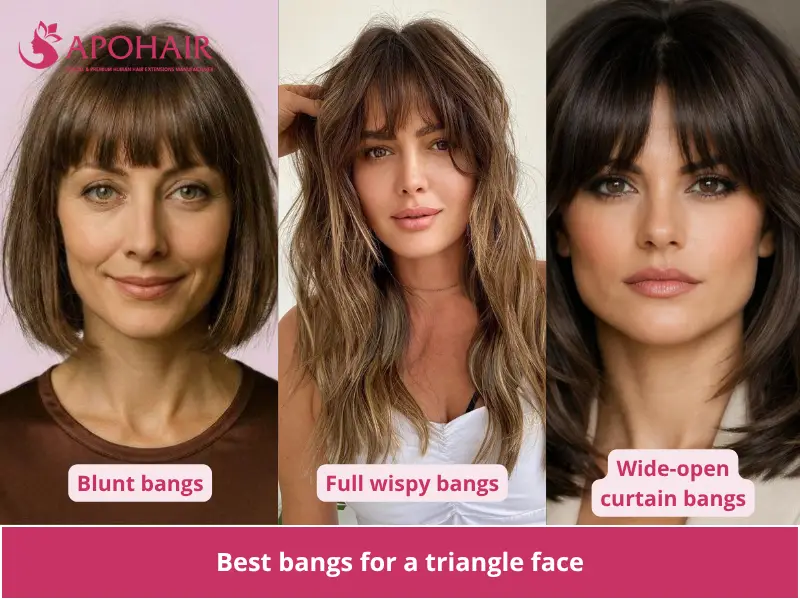
| Triangle | longer | jaw | angular, wide | narrow, straight | narrow up top over a wide angular jaw, so it needs width at the forehead | blunt, full wispy, wide-opened curtain |
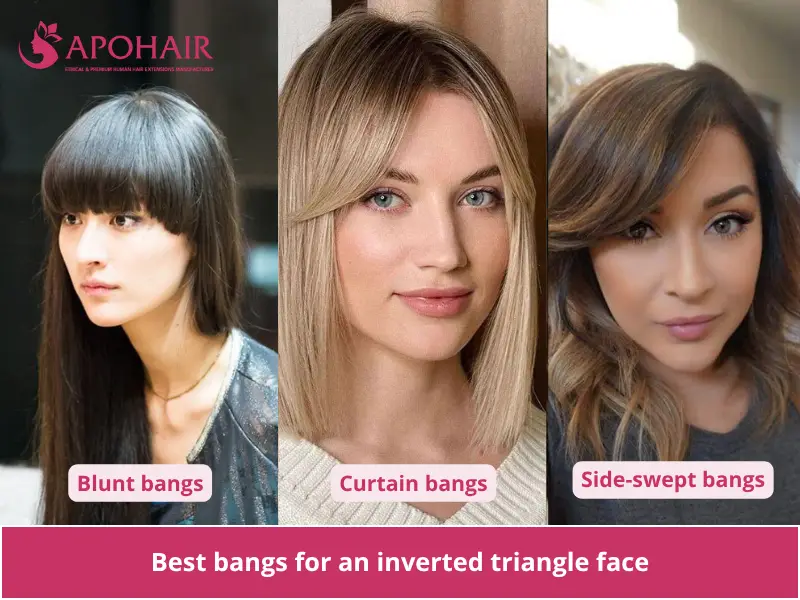
| Inverted triangle | longer | forehead | narrow chin | straight, no peak | wide up top over a narrow chin, and a straight hairline takes a dense horizontal that a peaked one cannot | blunt, curtain, side-swept |
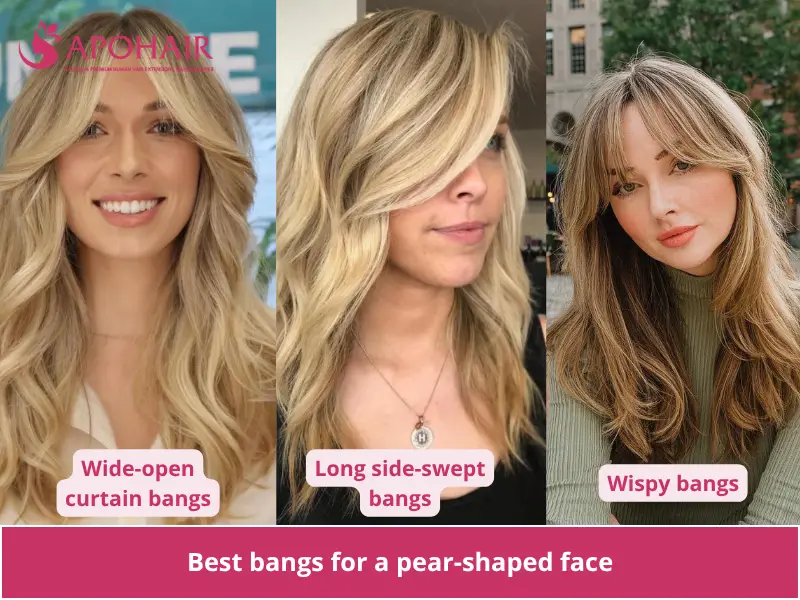
| Pear | longer | jaw | full, rounded, heavy | narrow | a narrow forehead over a full round jaw, so it needs width up top and a vertical beside the cheek | wide-opened curtain, long side-swept, wispy |
How to Choose Bangs For Your Face Shape?
The best bangs for your face shape draw the line your proportions are missing: vertical to add length, horizontal to shorten, diagonal or curved to soften a corner. The chart above shows which line you need. What the ten sections below add is the part a chart cannot hold, meaning where the fringe breaks, how wide it is cut, and where it is allowed to stop.
Round Face
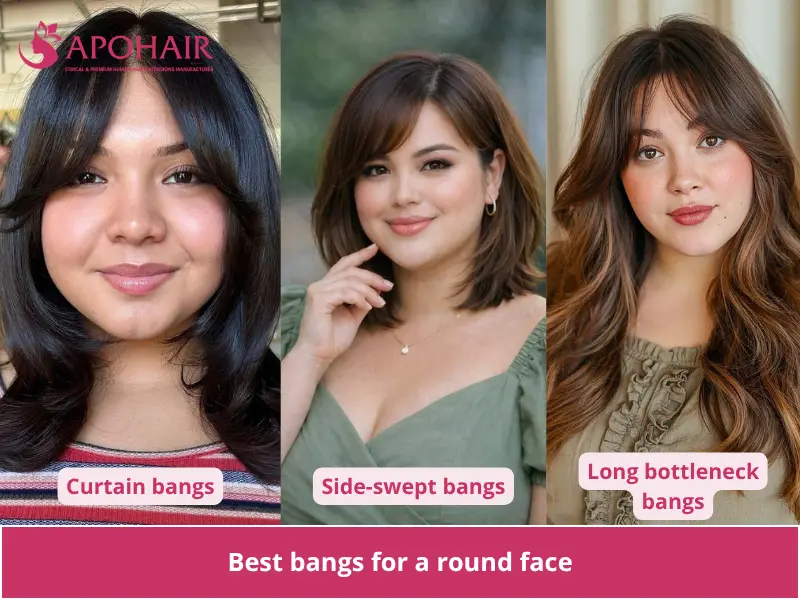
For a round face, keep every long fringe line below the cheekbone and avoid stopping at the face’s widest point. The extra length draws the eye downward, while a narrow opening prevents the fringe from adding width across equal face proportions.
Best bangs for a round face:
- Curtain bangs. Ask for a narrow opening with the break at the cheekbone. Two close-set panels replace one horizontal line with downward movement, which makes the outline read longer. Keep the outer pieces from kicking sideways at the cheeks.
- Side-swept bangs. Choose a deep side part and an endpoint below the cheekbone. The diagonal crosses the face’s width instead of tracing it. A brow-length inner piece can blend into the longer edge without creating a cheek-level stop.
- Long bottleneck bangs. Keep the top narrow, then start the flare after the cheekbone. The widest part of the face stays clear rather than being framed by the ends. A higher flare would bracket both cheeks.
Bangs to avoid on a round face:
- Blunt bangs add a hard horizontal to a face that already has equal width and length.
- Micro bangs shorten the visible face, which makes the equal ratio look rounder.
- Bardot bangs repeat the wide curve of the face instead of adding a contrasting line.
Oval Face
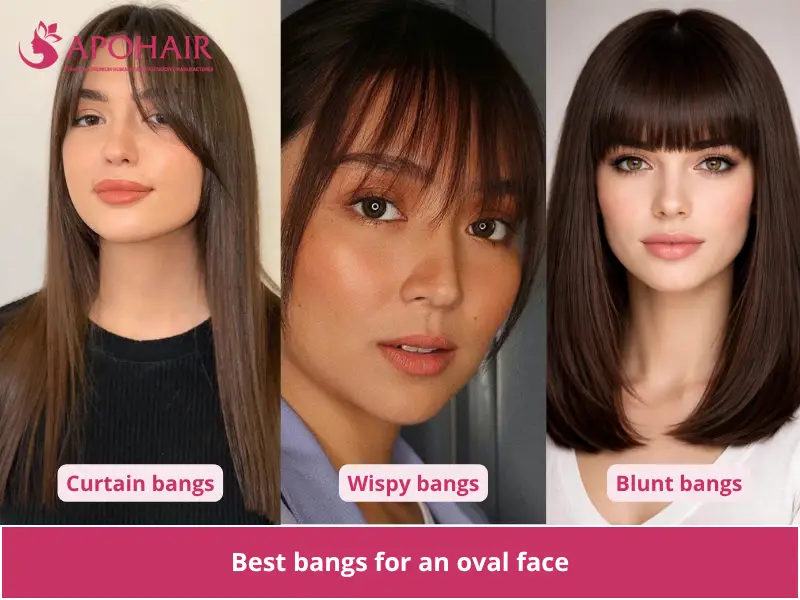
An oval face needs the least alteration, so choose bangs that preserve its existing balance instead of changing its width or length. This is the only shape that can take standard versions of curtain, wispy, and blunt bangs without moving the break point or endpoint to correct a proportion.
Best bangs for an oval face:
- Curtain bangs. Ask for the standard center break at the brow. The panels frame the cheekbones without adding corrective width or length. Keep both sides even unless you want deliberate asymmetry.
- Wispy bangs. Keep them on the brow and see-through, so part of the forehead remains visible and the fringe does not shorten the face too much. Even spacing prevents one dense patch from becoming the visual center.
- Blunt bangs. A full brow-level line gives an oval face a graphic change without exaggerating an existing imbalance. Keep the edge dense and stop near the brow arch; extending it to the temples would add width that the face does not need.
Bangs to avoid on an oval face: There is no broad avoid list because the proportions are already balanced. Treat micro bangs as the main caution: their high line can shorten the visible face without correcting anything. Styling preference, forehead height, and hair behavior should make the final choice.
Square Face
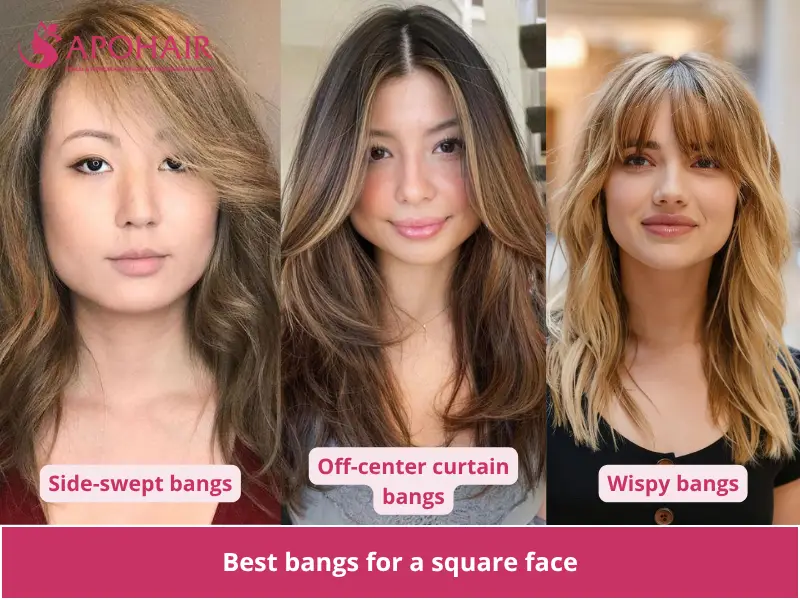
For a square face, the endpoint matters more than the top of the fringe. Use an off-center, diagonal, or curved line, and let longer pieces pass the jaw if you want them to soften its corners. A fringe that stops at the cheek cannot change the square jaw below it.
Best bangs for a square face:
- Side-swept bangs. Ask for one diagonal that ends below the jawline. It crosses the angular outline and reaches far enough to soften the lower corner. Keep weight through the mid-length so the sweep does not separate before reaching the jaw.
- Off-center curtain bangs. Move the part away from the middle and leave both panels past the jaw. Unequal panels break the symmetry that makes the face look boxier. A slight offset is enough; the two sides do not need dramatically different lengths.
- Wispy bangs. Ask for a soft arch with thinned outer edges. The curved perimeter avoids stacking another straight line above the jaw. Let the edges lengthen toward the temples so the arch remains visible.
Bangs to avoid on a square face:
- Blunt bangs stack a second hard horizontal above the straight jawline.
- Center-part curtain bangs reinforce the face’s equal, mirrored sides.
- Micro bangs expose the hairline corners and make the angular outline look sharper.
Heart-Shaped Face
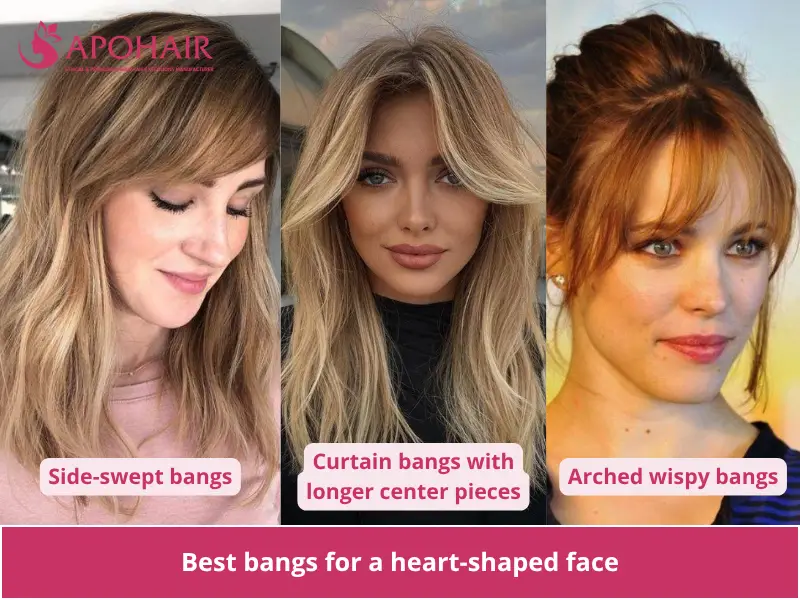
A heart-shaped face needs coverage across its wider forehead, but a widow’s peak can force a standard parted fringe into a sharp V. Keep the center pieces longer, or choose a diagonal or curved line that works with the peaked hairline instead of exposing it.
Best bangs for a heart-shaped face:
- Side-swept bangs. Ask for a diagonal ending at the cheekbone. The sweep covers forehead width and directs the eye toward the narrower lower face. Avoid lifting the root too high at the wide temple area.
- Curtain bangs with longer center pieces. Leave more length around the split so the widow’s peak cannot push the fringe apart into a hard V. This one adjustment separates the heart-face version from a standard curtain bang and keeps the split soft as it moves.
- Arched wispy bangs. A half-moon perimeter, shorter in the middle and longer at the sides, follows the hairline without spanning its full width. Paul Percival of Percy & Reed recommends this shape for a heart-shaped face. Keep the outer ends light at the temples.
Bangs to avoid on a heart-shaped face:
- Wide blunt bangs mark the forehead’s full span and make the upper face look broader.
- Micro bangs expose and trace the widow’s peak instead of covering it.
- Bardot bangs can split into a hard V where the dense center meets the peaked hairline.
Long (Oblong) Face
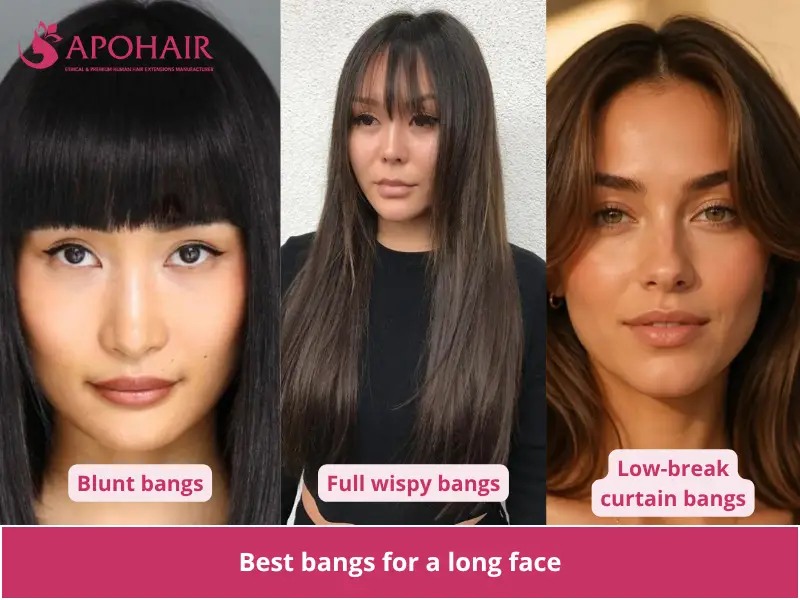
A long face needs a brow-level horizontal that reduces visible length. A high or narrow center split does the opposite, so even curtain bangs must open low and wide. This shape can take a full fringe because its density strengthens the shortening line.
Best bangs for a long face:
- Blunt bangs. Ask for a full line at brow level and no wider than the brow arch. It removes more visible forehead length than any split fringe. Connect the outer corners to the temples so gaps do not reopen the vertical line.
- Full wispy bangs. Keep the same brow-level line, but thin the body for a softer finish. The horizontal still shortens the face even when the fringe carries less weight. Avoid a large see-through gap at the center.
- Low-break curtain bangs. Place the break below the cheekbone and keep the opening wide. Two low diagonals create width instead of drawing a long line from the part to the chin. Direct the outer panels toward the temples rather than straight down.
Bangs to avoid on a long face: High, narrow curtain bangs, bottleneck bangs, and micro bangs share the same problem: they expose or extend the vertical space above the brow. None creates the low, broad horizontal this face needs, even when the fringe itself looks full.
Diamond Face
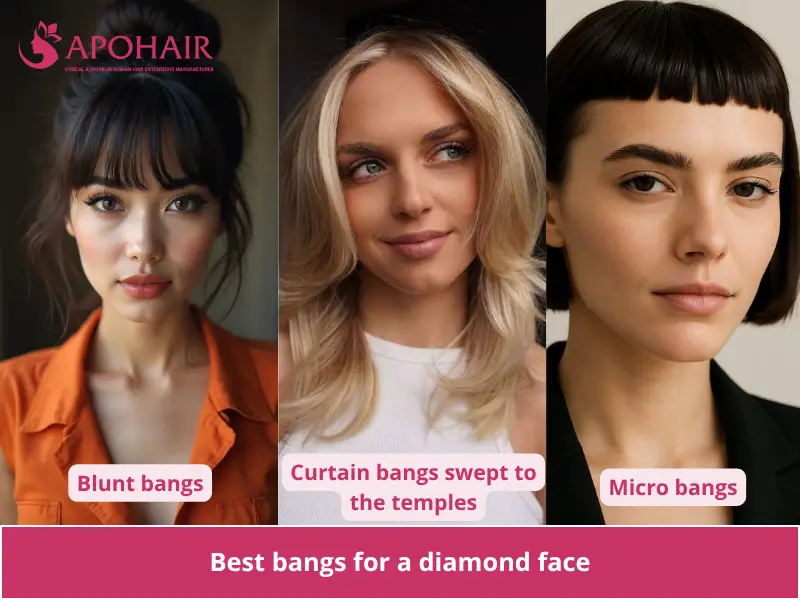
A diamond face is the only shape where micro bangs add useful forehead width. Other fringes should also build visual mass at the temples and stay away from the prominent cheekbones, which already form the widest part of the face.
Best bangs for a diamond face:
- Blunt bangs. Cut them to the full width of the temples, not just the brow arch. The horizontal makes a narrow forehead read wider.
- Curtain bangs swept to the temples. Direct the ends out and slightly up so they fill the narrow temple area rather than fall beside the cheekbones.
- Micro bangs. Keep the line short, dense, and wide. Straight to lightly wavy hair holds this precise edge more predictably than curls that spring above the planned length.
Bangs to avoid on a diamond face: Bottleneck bangs, long center-parted curtains, and very light see-through bangs all withhold width from the forehead or place attention beside the cheekbones. The result leaves the middle of the face dominant.
Rectangle Face
Unlike a long face with a soft jaw, a rectangle must shorten vertical length and soften corners at the same time. Choose a diagonal that passes the jaw or a brow-level horizontal with a curved, soft edge.
Best bangs for a rectangle face:
- Side-swept bangs. End the diagonal below the jaw to reduce forehead height and cross the lower corner.
- Full wispy bangs. Keep the brow line full, but soften its outer edges so it shortens without boxing in the face.
- Arched blunt bangs. Cut a curved perimeter that is longer at the outer corners. The arch keeps the horizontal from echoing the jaw.
Bangs to avoid on a rectangle face:
- Hard straight blunt bangs repeat the jaw’s straight edge even though they shorten the forehead.
- Center-part curtains and micro bangs preserve too much vertical space and sharpen the angular outline.

Triangle Face
A triangle face has an angular wide jaw beneath a narrow forehead, so its fringe should add temple-to-temple width. Unlike a pear shape, it does not also need long panels beside a rounded cheek.
Best bangs for a triangle face:
- Blunt bangs. Cut the line as wide as the temples to balance the wider jaw.
- Full wispy bangs. Keep temple-to-temple width while removing weight through the body.
- Wide-open curtain bangs. Leave the outer edges dense so the fringe adds width instead of tapering the forehead inward.
Bangs to avoid on a triangle face: Deep side sweeps, long jaw-length curtains, and bottleneck bangs narrow the upper face or frame the already-wide jaw. All three increase the top-to-bottom width difference.
Inverted Triangle Face
An inverted triangle has a broad forehead and narrow jaw, like a heart, but its straight hairline can support a dense fringe without splitting at a widow’s peak. The cut should cover the forehead edges rather than trace their width.
Best bangs for an inverted triangle face:
- Blunt bangs. Cut them wider than the brow so the outer forehead stays covered.
- Curtain bangs. Use a standard center break at the cheekbone; the straight hairline helps the split stay clean.
- Side-swept bangs. Choose a moderate part that covers the upper face without exposing the opposite temple.
Bangs to avoid on an inverted triangle face: Micro bangs, narrow fringes, and wide Bardot arches expose or outline the forehead edges. Each one makes the upper face look broader.
Pear-Shaped Face
A pear-shaped face needs more forehead width plus a long line beside its full, rounded jaw. That second requirement separates it from the more angular triangle shape, which can rely on width at the top alone.
Best bangs for a pear-shaped face:
- Wide-open curtain bangs. Sweep them to the temples and leave both panels past the cheekbone to add top width and side length.
- Long side-swept bangs. Finish the diagonal past the cheek, so it continues beside the fullest area.
- Wispy bangs. Keep them full-width but light, which widens a small forehead without covering most of it.
Bangs to avoid on a pear-shaped face:
- Short blunt bangs stop before they can add a vertical beside the full lower face.
- Bottleneck and micro bangs keep the top too narrow or place their flare beside the jaw.
What Matters Besides Face Shape?
Hair texture, density, forehead height, growth pattern, glasses, and styling commitment determine whether a recommended fringe will work in daily life. Review these factors after identifying the general line that suits your face shape.
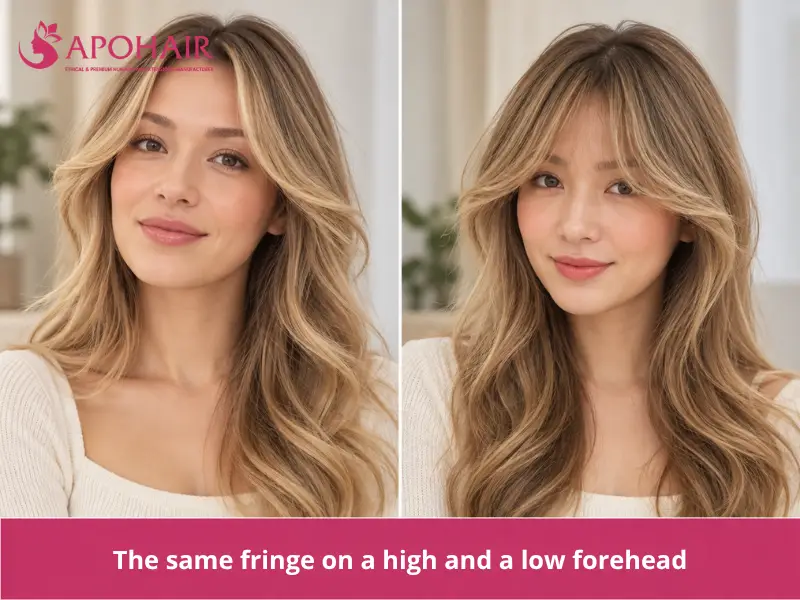
Forehead Height
Forehead height changes how deep and dense the fringe section can be before it crowds the brow or looks too thin.
- High forehead: A deeper section, taken farther back, gives the fringe enough hair and travel to cover the longer hairline-to-brow distance. A shallow section can look detached from the rest of the cut.
- Low or small forehead: Keep the section shallow and choose wispy, see-through, or side-swept bangs. A dense blunt fringe has too little vertical room and tends to sit directly on the eyebrows.
Facial Fullness And Scale
Soft-tissue fullness, overall face size, and cheekbone prominence change where a fringe should stop even when the underlying face-shape measurements stay the same.
- Full cheeks and a soft jawline: Leave curtain or side-swept bangs past the cheekbone. A cheek-level endpoint draws a horizontal across the fullest area, while a longer panel creates the vertical line used in face-slimming cuts.
- A small or narrow face: Use a shallower, narrower section so the fringe does not cover most of the visible face. Heavy blunt bangs can dominate this scale; a short graphic fringe is an option only when you want that deliberate contrast.
- High, sharp cheekbones: End the fringe above the cheekbone or well below it. A line that stops directly on the widest bone flattens its shape instead of framing it.
Hair Texture, Density, And Growth Pattern
Hair behavior determines whether the recommended line stays visible after the fringe dries and moves through the day.
- Fine, flat hair: Choose a shallow, intentionally wispy section instead of asking limited density to hold a heavy blunt edge. Remember that every strand moved into the fringe also reduces volume behind it.
- Curly or coarse hair, and cowlicks: Cut curls dry because spring-back makes a wet-cut fringe finish shorter than planned. A cowlick will continue pushing the hair in its natural direction, so place the part and sweep with that growth pattern rather than trying to cut through it. Paul Percival notes that a blunt fringe can conflict with naturally wavy hair for this reason.
Glasses
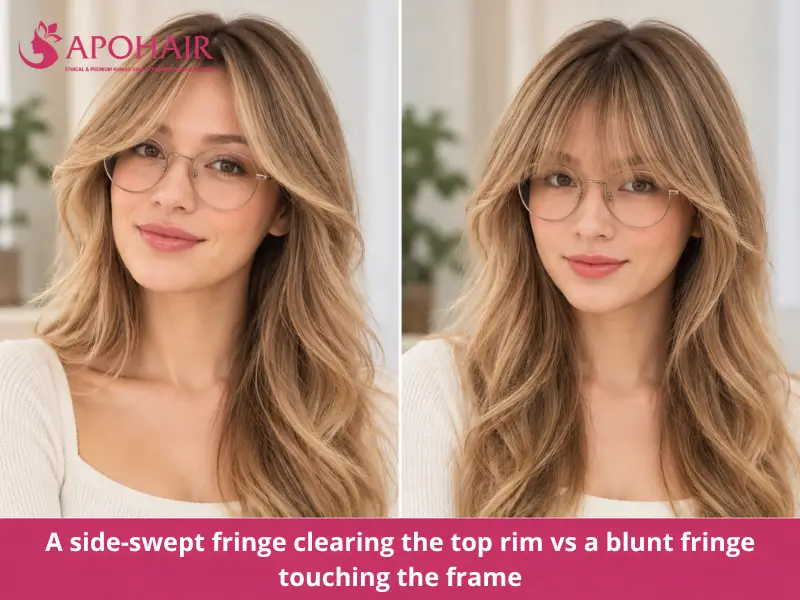
Glasses add a horizontal line at brow level, so bangs should clear the frame rather than rest on it. Keep the edge above the frame or leave the fringe long enough to pass beside it. Curtain and side-swept bangs usually provide that clearance; a brow-level blunt fringe often bunches against the top rim.
6 Common Mistakes When Getting Bangs
Most disappointing fringe results come from a mismatch between the reference image, natural hair behavior, and daily maintenance. These six mistakes affect the final length, width, direction, or upkeep of the bangs.
- Cutting too short while wet: Hair shrinks as it dries (especially wavy or curly textures). The fix: Always cut dry or leave extra length to trim down after blow-drying.
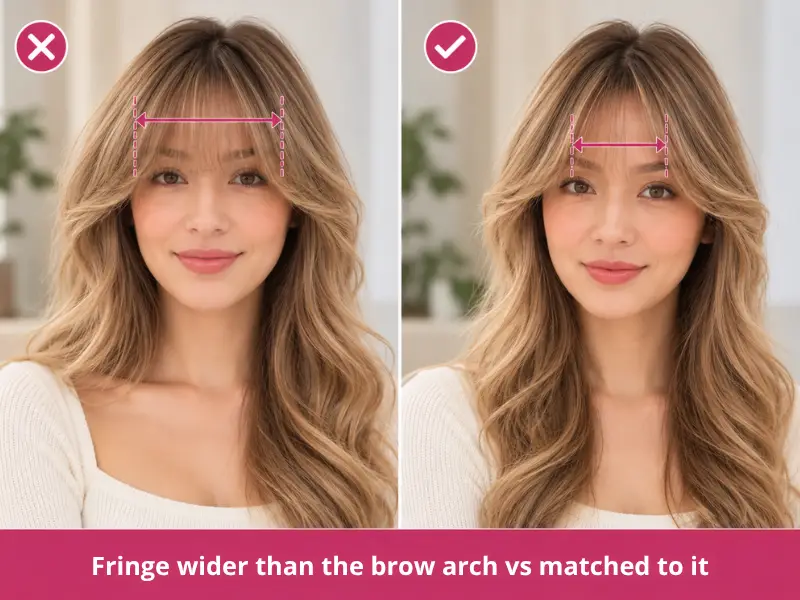
- Sectioning too wide: Width is determined at the crown, not the tips. Taking hair past the brow arch adds unwanted facial width. The fix: Keep the triangle section strictly within the outer edges of your eyebrows.
- Ignoring natural hair texture: A pin-straight blunt fringe in an inspo photo will look completely different on wavy or coarse hair. The fix: Prioritize your natural hair behavior over the photo reference.
- Pulling hair flat when DIY-trimming: Heads are curved; pulling hair taut and cutting straight across leaves the sides unevenly short. The fix: Cut hair in its natural fall using vertical point-cuts, not horizontal chops.
- Fighting hairline cowlicks: Cutting against a cowlick causes the fringe to lift and split immediately. The fix: Dry hair in its natural direction first, then work with the growth pattern (e.g., opting for a side-sweep).
- Underestimating daily styling time: Blunt and heavy bangs require daily blow-drying, while curtain or wispy bangs handle air-drying well. The fix: Choose a cut that fits your actual morning routine, not an aspirational one.
How Do You Keep Bangs Looking Good?
A fringe is the part of a haircut that shows first when it is neglected, because it is the only part sitting directly on skin. Four habits keep it looking cut.
- Wash the fringe more often than the rest of your hair: It rests on your forehead, so it picks up oil days before the length does. Rinsing and drying just the fringe takes about two minutes and saves washing everything, and dry shampoo belongs at the fringe roots only, never through the length.
- Dry it first, while it is still wet: The direction a fringe dries in sets where it falls for the rest of the day, so it gets dried before anything else. A fringe that has already air-dried in the wrong direction has to be re-wet, not restyled.
- Book the trim by fringe type, not by the calendar: Blunt fringes show growth first because the line is visible, while curtain and side-swept bangs hide it because the ends are already uneven. Most salons trim a fringe free between cuts, and a dry trim holds its line longer than a wet one.
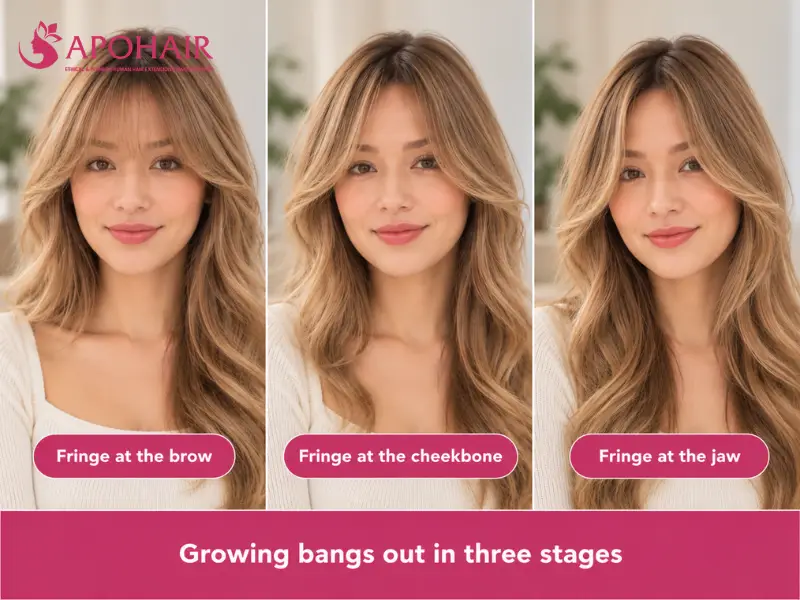
- Treat growing it out as three stages rather than a waiting period: The fringe reaches your brow, then your cheekbone, then your jaw. The middle stage is the awkward one, and the move there is to part it and blend it into the length rather than to trim it back into shape.
Frequently Asked Questions
Do Bangs Make You Look Younger Or Older?
A fringe reads younger when it is soft and moving, and older when it is heavy and static. The mechanism is the line it draws: a hard horizontal adds structure to a face, while a broken or swept one adds movement. Wispy, curtain, and side-swept bangs sit on the softer end of that scale, which is why they hold up well past 50 when a blunt fringe can start to look severe.
Are Bangs Still In Style In 2026?
Yes, though that is the less useful half of the answer. Curtain and side-swept bangs have outlasted every trend cycle since the seventies because they are shapes rather than trends, and a shape that flatters a face does not go out of fashion. The fringes that come and go are the graphic ones, micro and heavy blunt, so those are the ones worth thinking twice about.
Which Face Shape Should Not Have Bangs?
None of them. That is the honest answer, and it matches what Larry King says about tailoring a fringe to the features rather than ruling faces in or out. What changes between shapes is which type and how it is cut, not whether a fringe is possible. The two cases that come closest to a no are a very low hairline, where there is no room, and a fringe nobody is going to style.
Do Clip-In Bangs Work As A Way To Test A Fringe?
They work for width and length, which are the two decisions people regret most. They do not show you how your own hair will fall, since clip-in fringes are cut and pressed before they reach you. Apohair supplies clip-in fringes and toppers in 100% Vietnamese Human Hair for exactly this kind of trial. The better in-salon version is pinning your own front section forward before anything is cut.
Conclusion
The whole decision comes down to two ratios and one hairline. Read whether your face is longer than it is wide, read which line across it is widest, check what your hairline does, and the fringe that suits you is the one doing the opposite of what your face already does. Every fringe type on this page can be tailored to that reading. What changes is where it breaks, how wide it is cut, and where it is allowed to stop.
If you source hair for a salon or a wholesale business, our team can send samples and factory-direct pricing on clip-in fringes, toppers, and bulk hair so you can offer clients a way to try a fringe before they commit to one.
