




37 Best Women’s Hairstyles for Round Faces: Add Height, Slim the Sides
The best hairstyles for round faces add height on top, keep the sides slim, and create vertical or diagonal lines that make the face look longer. Long layers starting below the chin, collarbone-length lobs, deep side parts, curtain bangs, and crown-lifted pixies produce these effects without concentrating volume beside the cheeks. Round faces have similar facial length and width, so the placement of layers, volume, and perimeter lines matters more than hair length alone.
This guide presents 37 hairstyles for women with round faces: 30 long, medium, and short haircuts, four pulled-back styles, and three occasion-ready looks. Each option includes suitable hair textures, densities, stylist notes, and maintenance requirements, followed by the hairstyles that round faces should avoid.
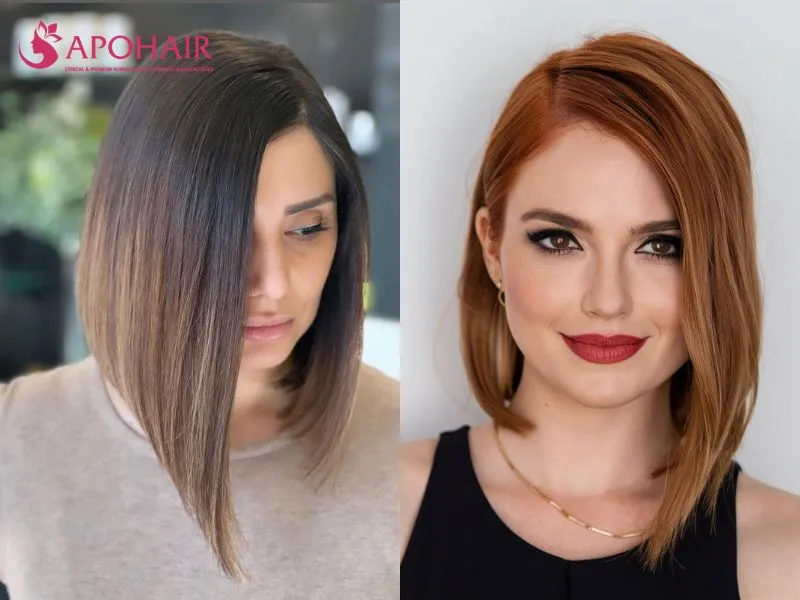
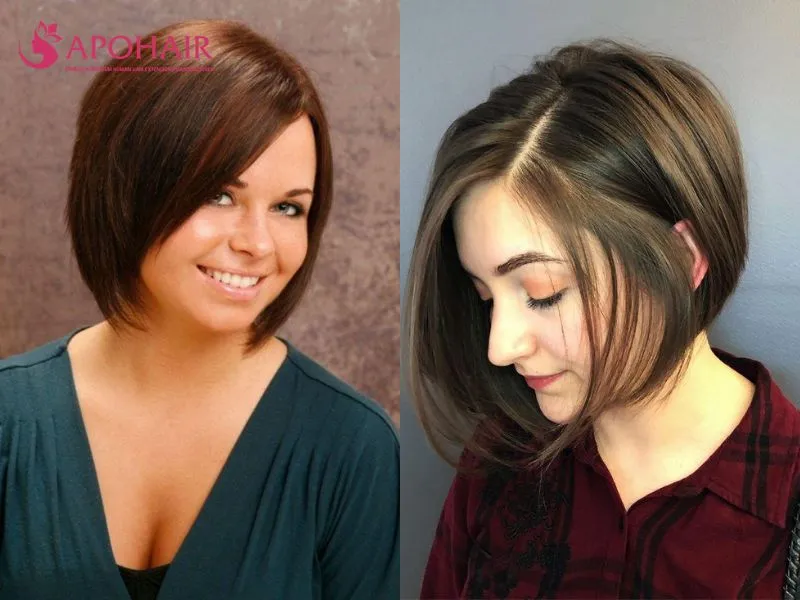
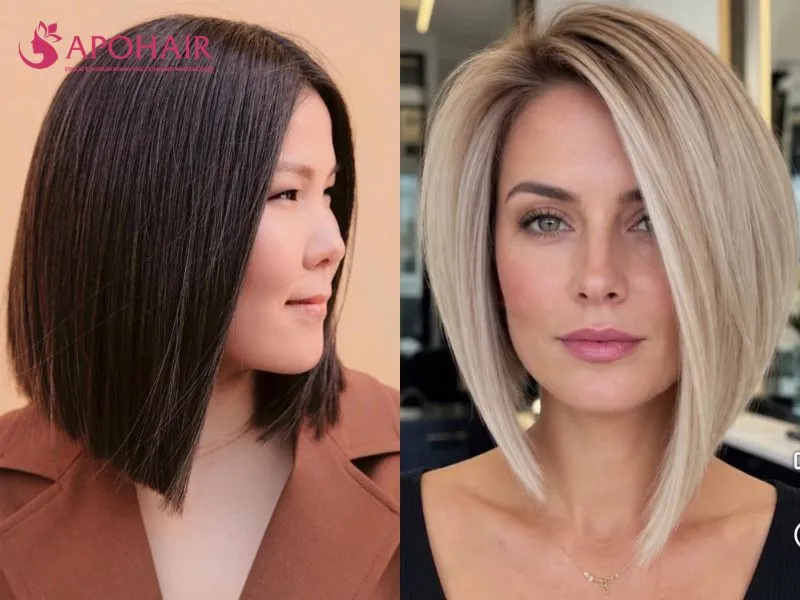
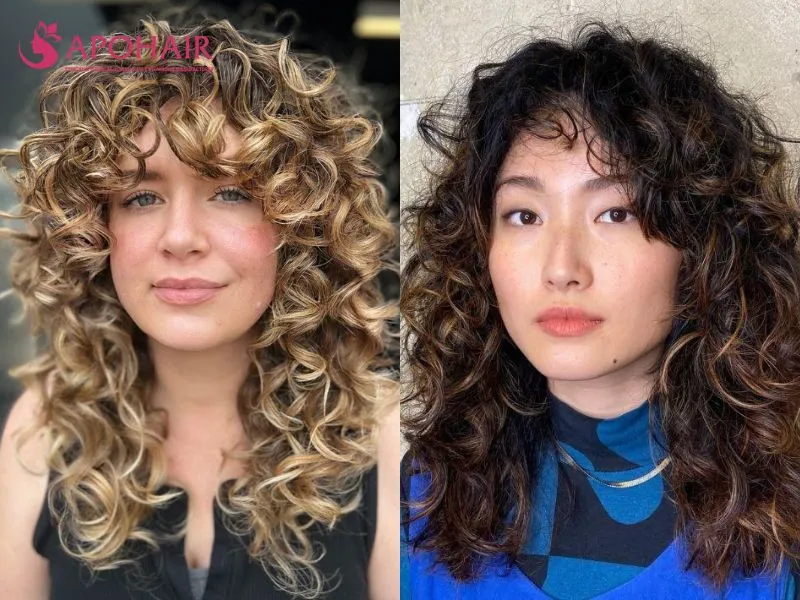
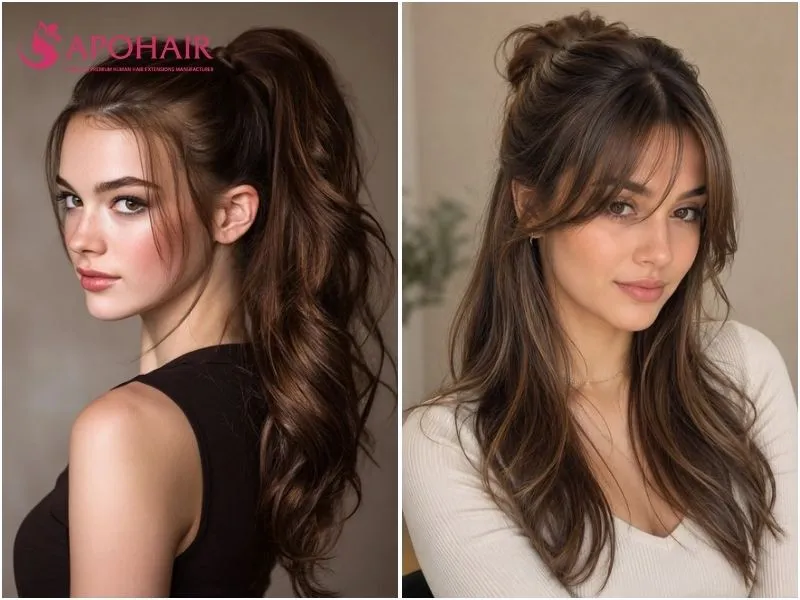
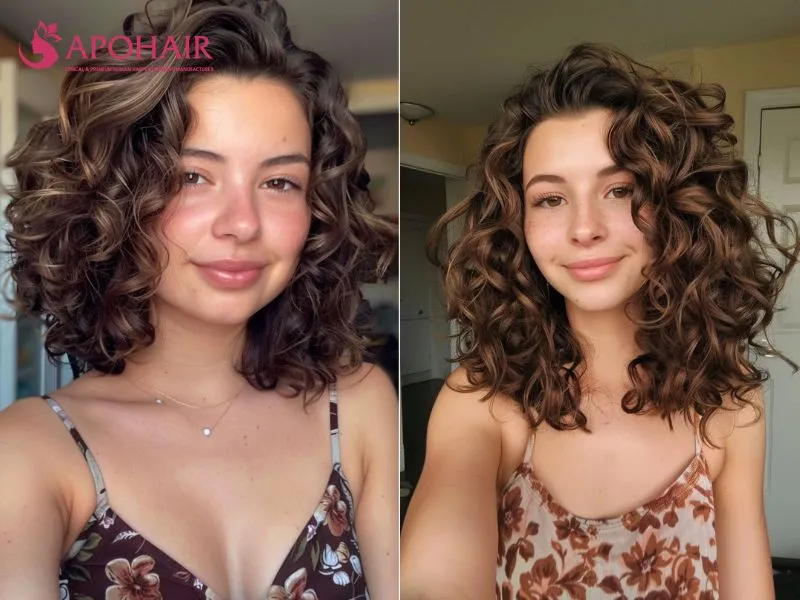
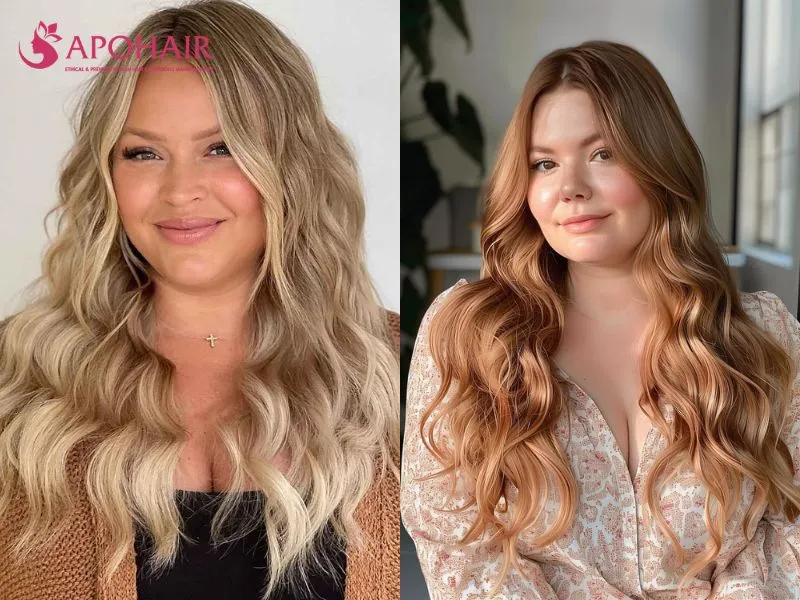
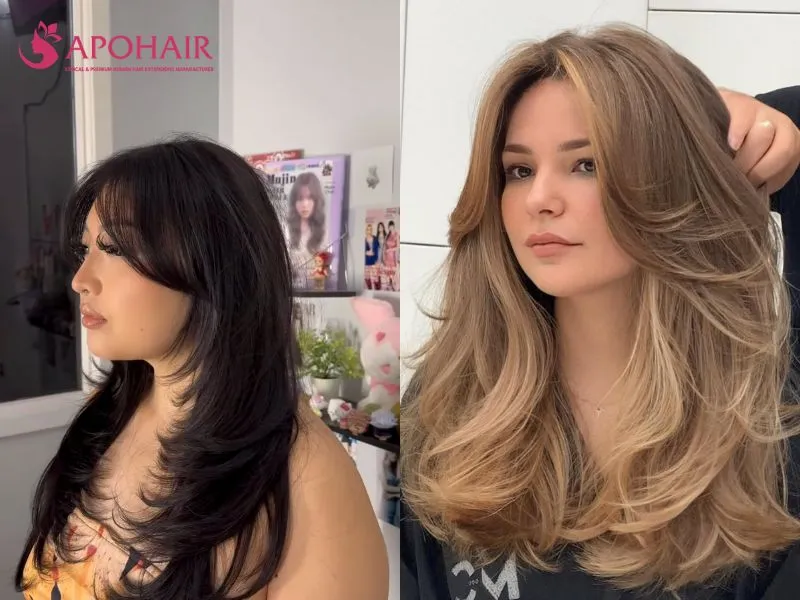
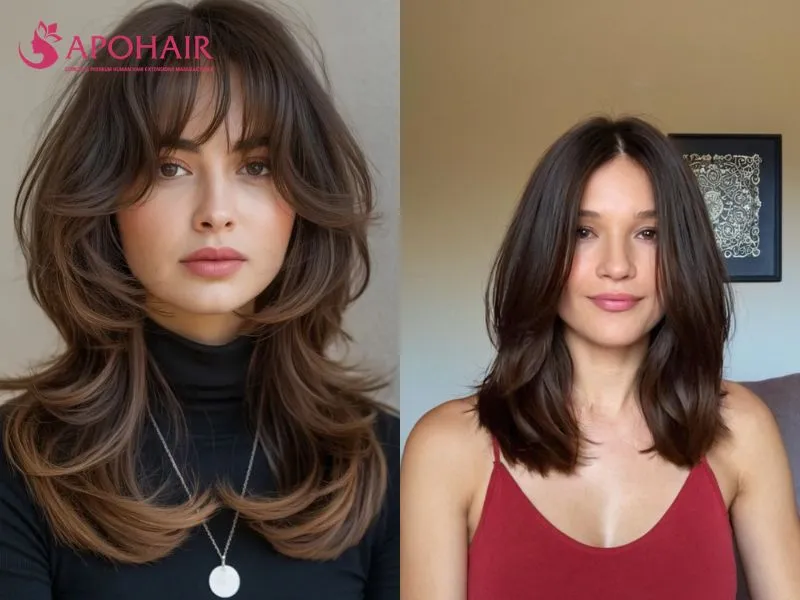
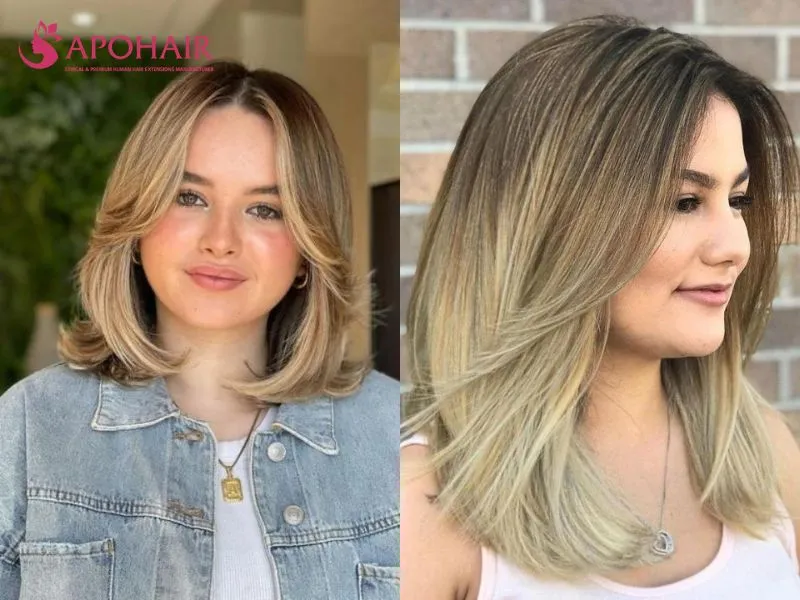
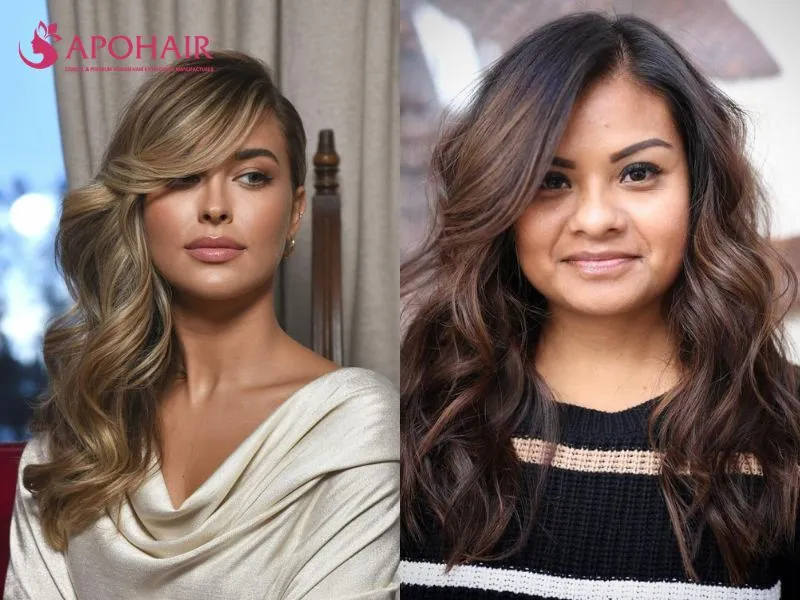
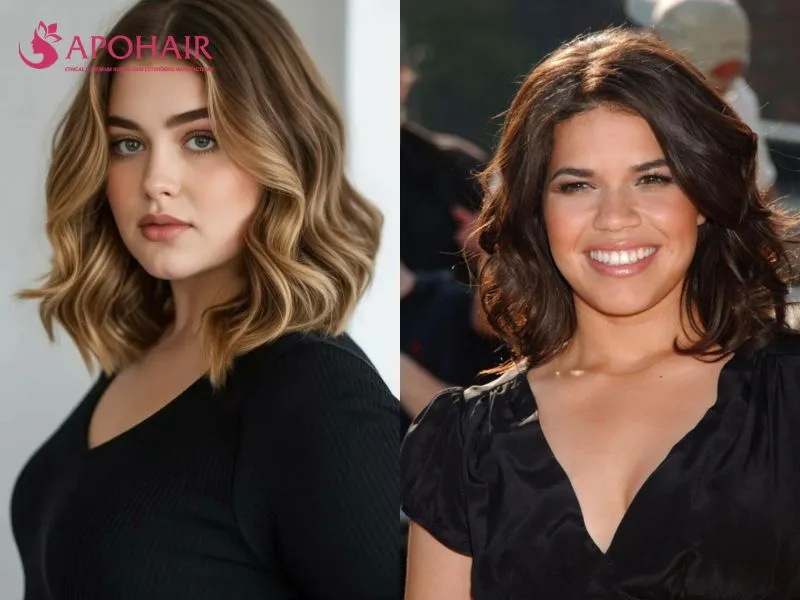
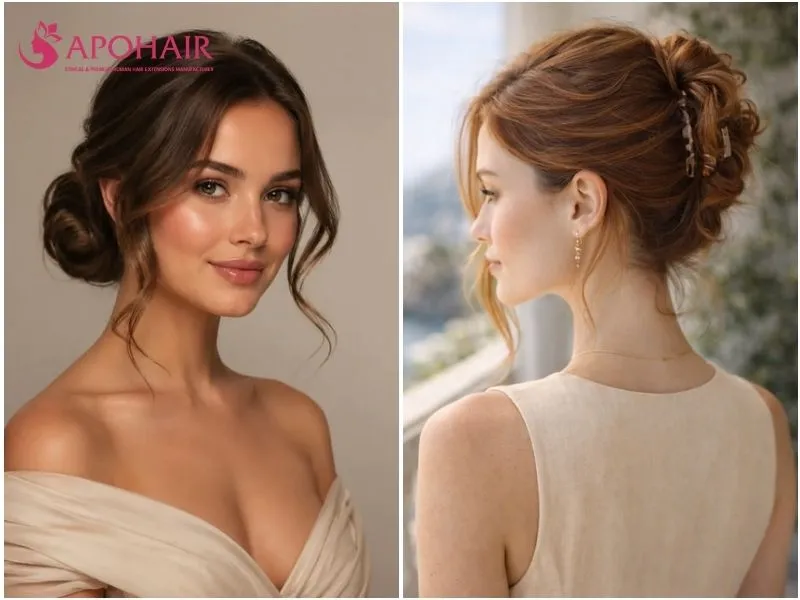
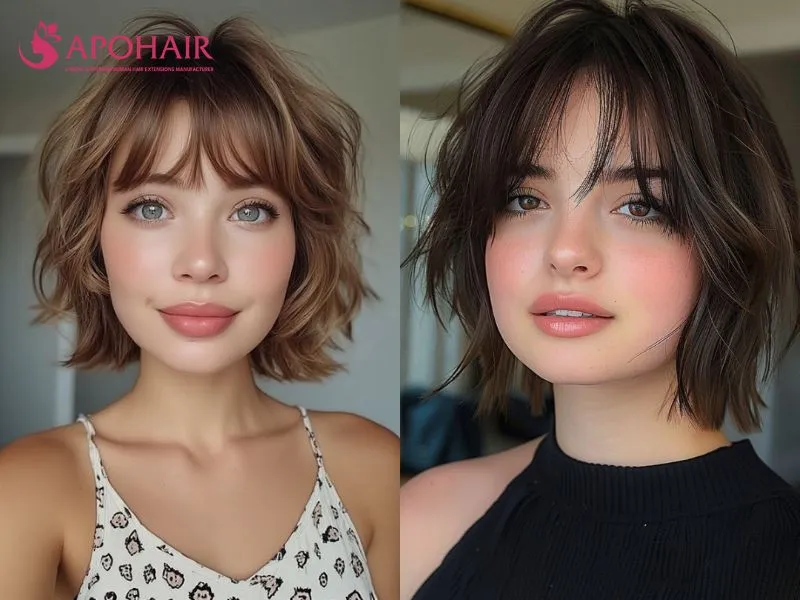
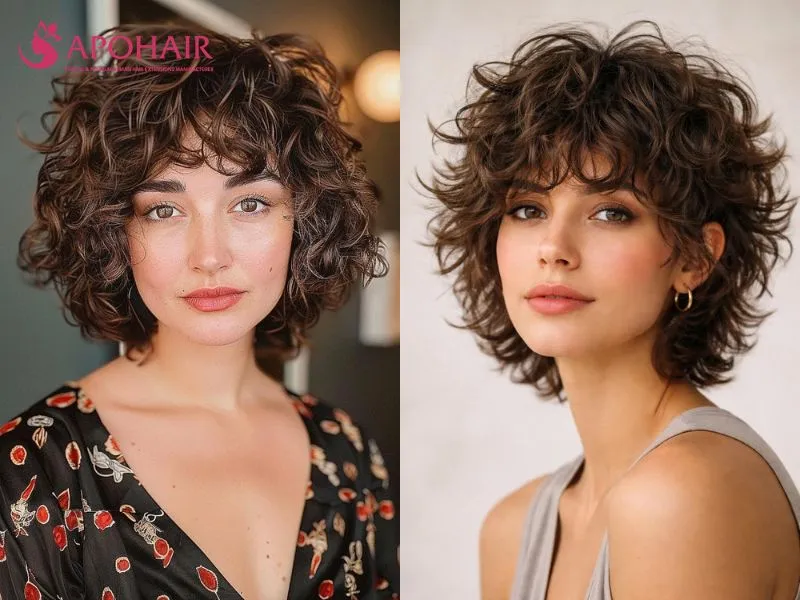
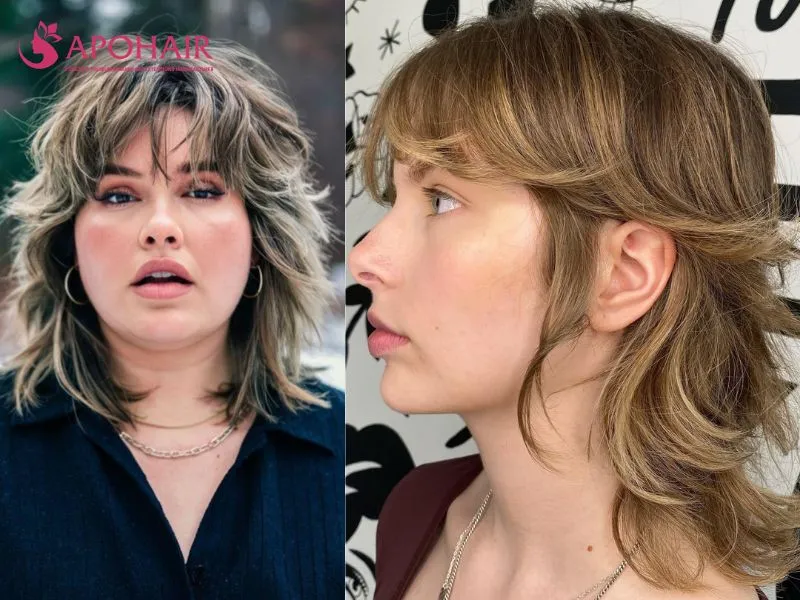
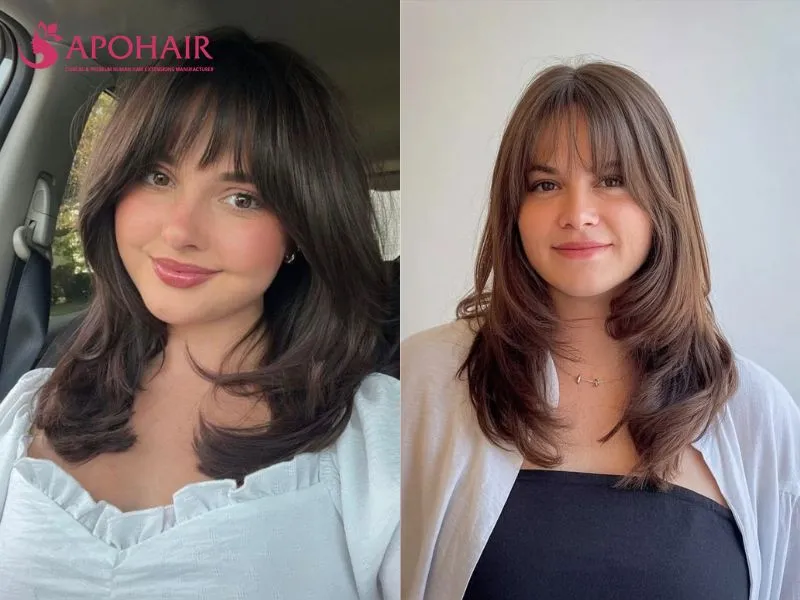
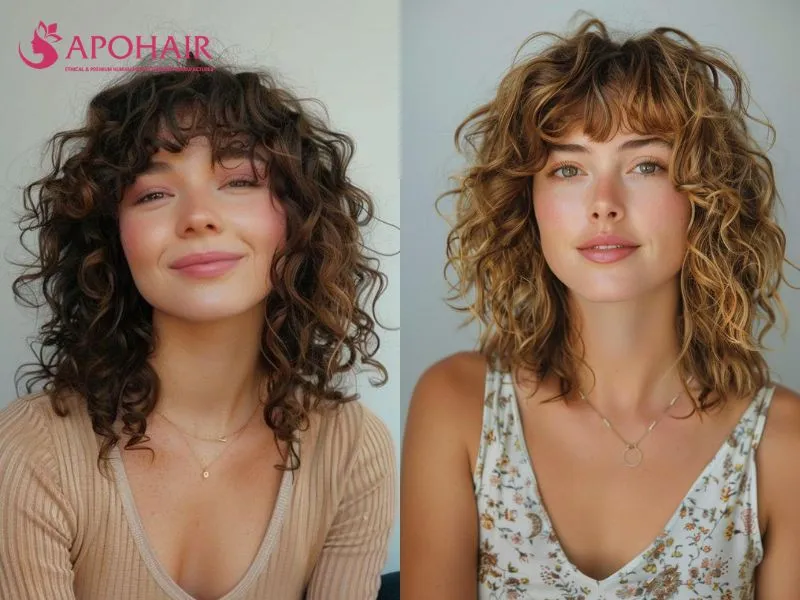
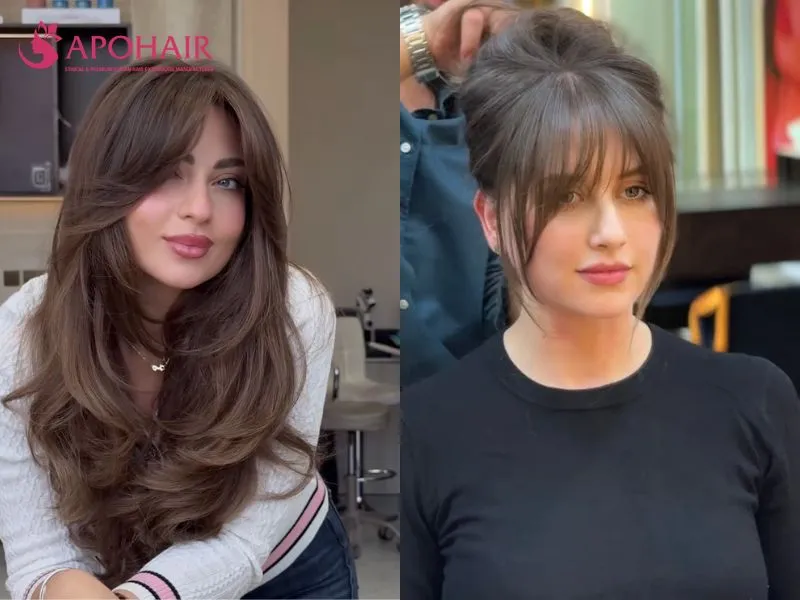
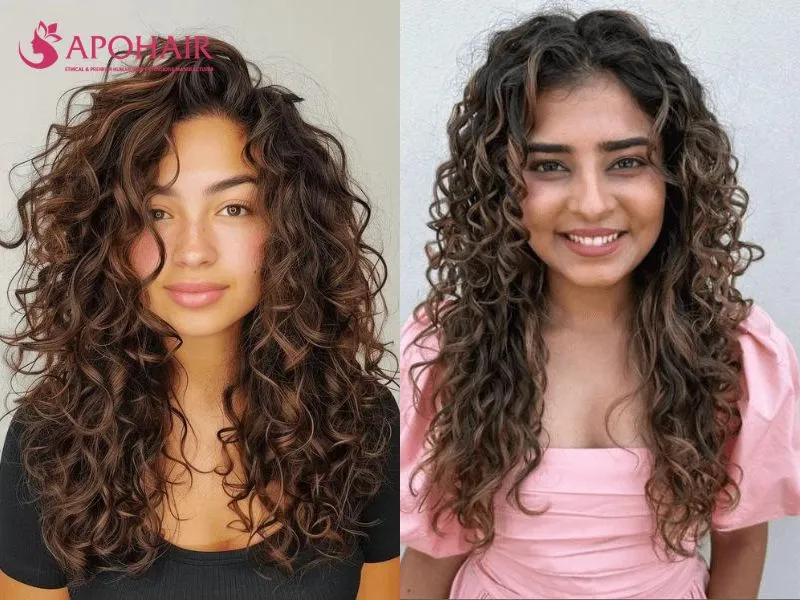
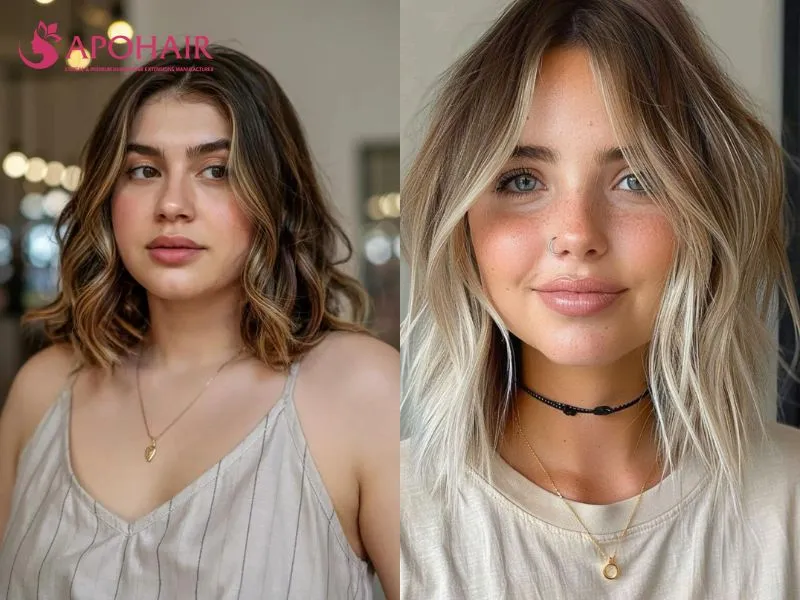
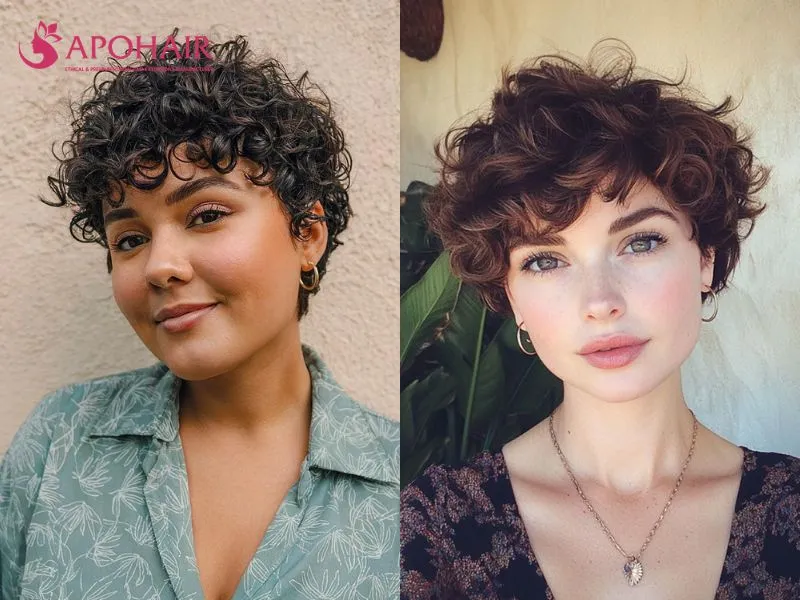
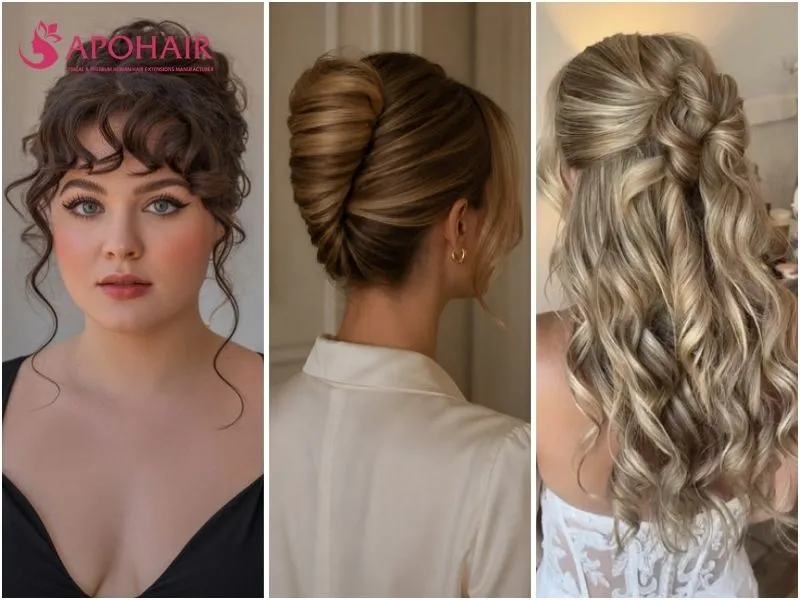
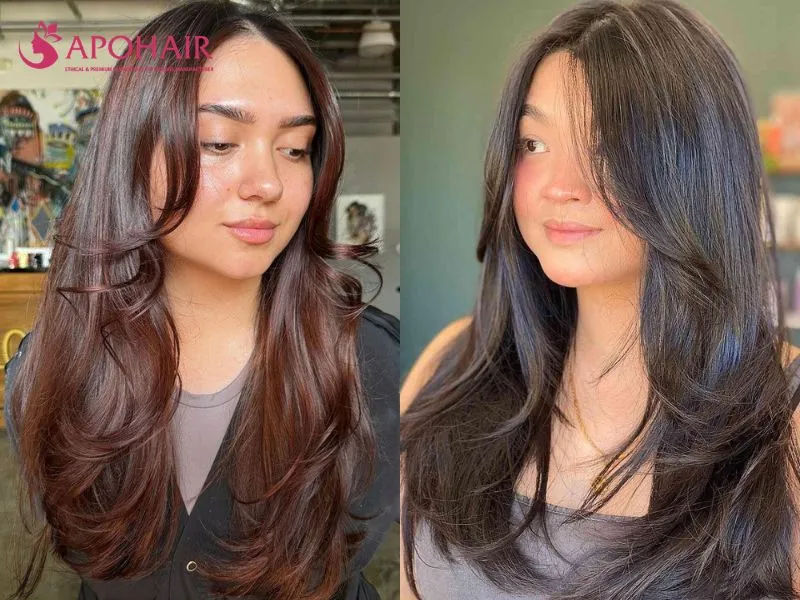
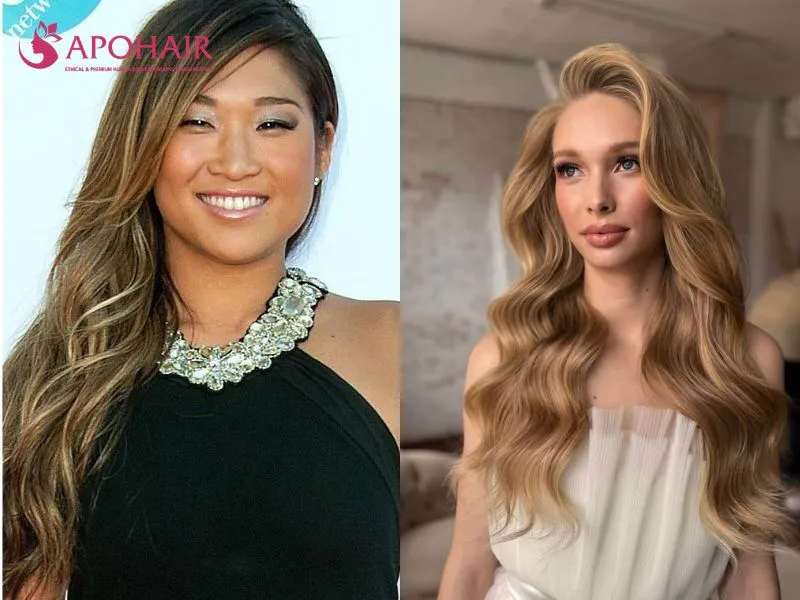
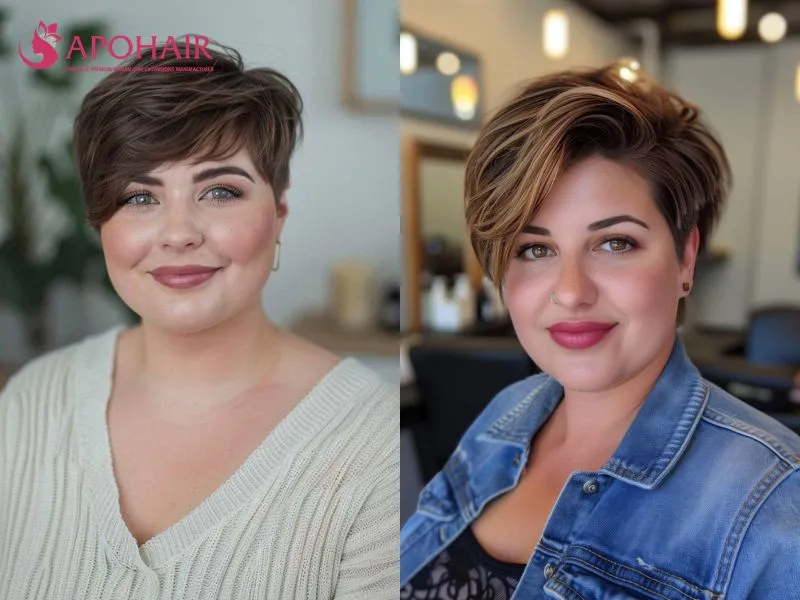
What Makes Hairstyles Flattering For Round Faces?
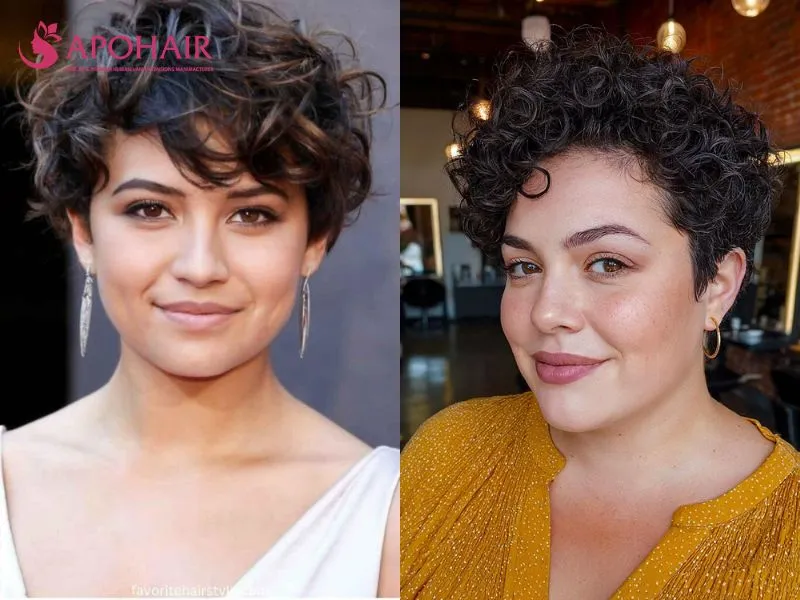
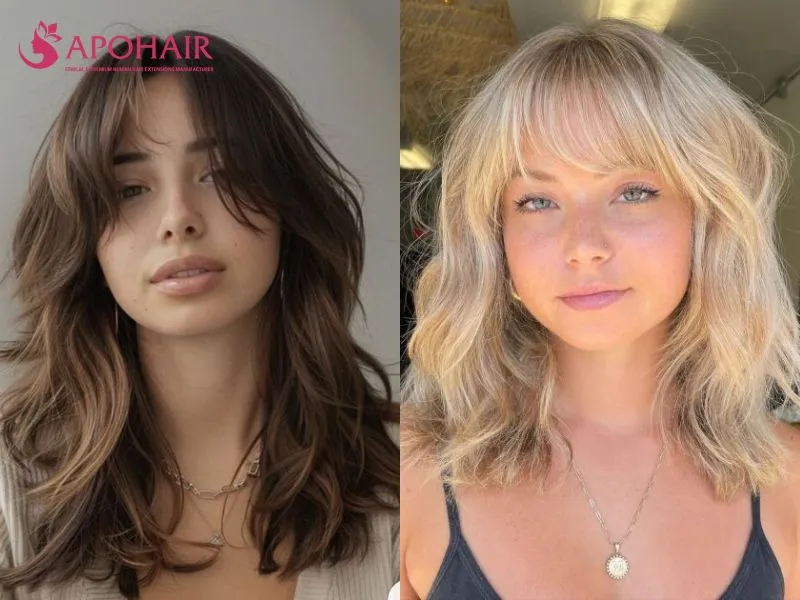
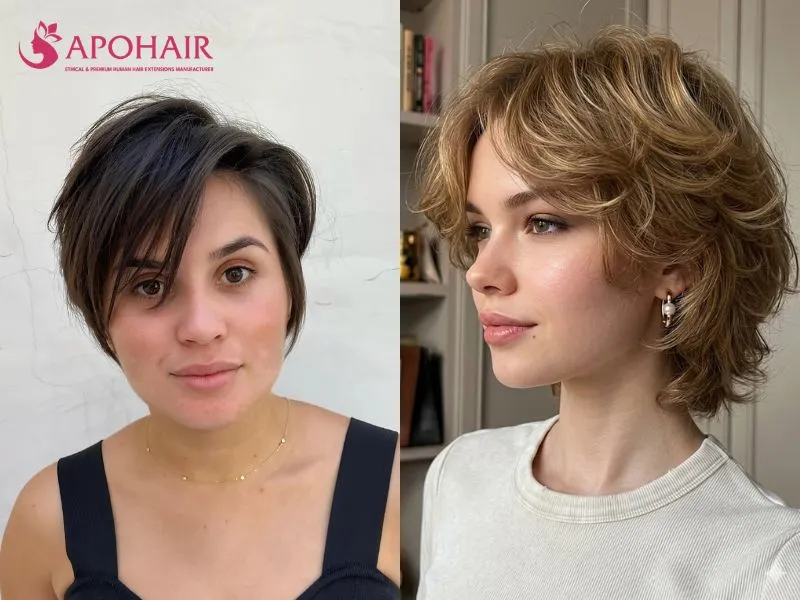
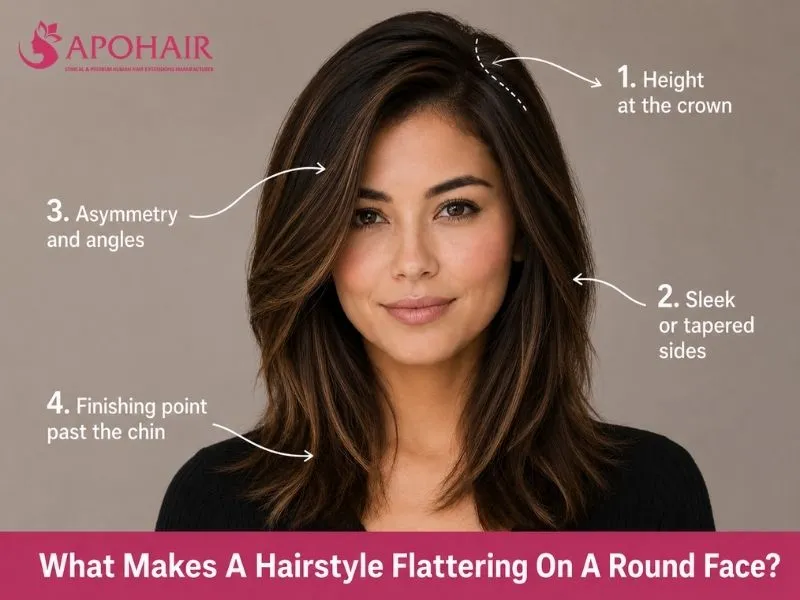
Hairstyles flatter round faces when they add height on top, reduce volume beside the cheeks, and introduce vertical, diagonal, or angular lines. These mechanisms redirect the eye upward or downward instead of allowing it to follow the face’s natural width. The most effective cuts combine at least two of the four mechanisms below.
- Height at the crown. Volume above the hairline lifts the eye upward and stretches the outline into something closer to an oval.
- Sleek or tapered sides. Keeping hair close to the head at ear and cheek level stops the cut from adding width at the face’s broadest point.
- Asymmetry and angles. A deep side part, an angled perimeter, or a diagonal fringe breaks the circular symmetry that defines the shape.
- A finishing point past the chin. Ending below the jaw draws two long vertical lines down the sides of the face and pulls the gaze downward.
Where the layers begin matters more than how many there are, and it is the point stylists return to most often. “Rounder face shapes need framing. You need shorter layers under the chin and then graduate them down just to lift it a little bit so it doesn’t feel super long and heavy around the face”, says Los Angeles celebrity hairstylist Joseph Chase.
The reverse also holds, and it explains most bad round-face haircuts: anything that adds bulk at ear level, or ends in a hard horizontal line at the chin, doubles the width the cut was meant to offset.
If your facial length and width are not similar, use our guide to hairstyles for different face shapes to identify the proportions and balancing principles that fit your face.
10 Best Long Hairstyles For Round Faces That Draw The Eye Downward
Long hair is the most forgiving category here, and the ten cuts below each solve the problem differently. The V-cut and butterfly build an angular perimeter; curtain bangs and face-framing layers work across the cheek; the deep side part and asymmetric curls disrupt symmetry; and the shag and beach waves control where volume sits. What they share is a rule about layers: none of them start above the chin.
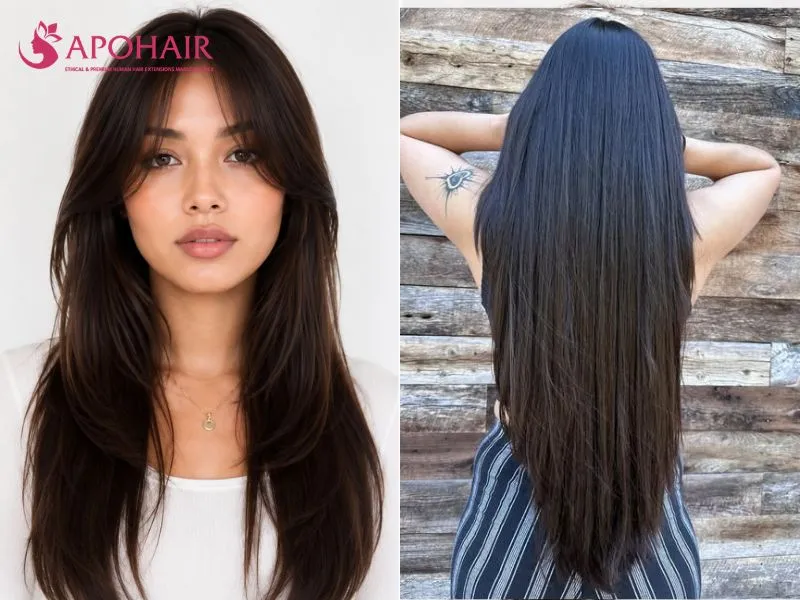
1. Long V-Cut Layers That End In A Point
Long hair cut so the back falls into a V, with the shortest layers landing below the chin and the longest reaching mid-back. The pointed perimeter gives the silhouette a corner it does not naturally have, and the eye follows that point downward rather than tracing the round outline of the face.
- Best on: a soft, undefined jawline that needs an angle from somewhere.
- Texture: Type 1A to 2B (straight to defined wave).
- Density: thick; the V tail goes stringy on fine hair.
- Stylist note: Pull the hair straight back and point-cut the V from the center outward. A blunt V reads as a costume, a point-cut V reads as a cut.
- Upkeep: low, trim every 10 to 12 weeks.
Why it works: A long V-cut’s pointed perimeter directs the eye downward, while layers beginning below the chin preserve vertical length without adding volume beside the cheeks.
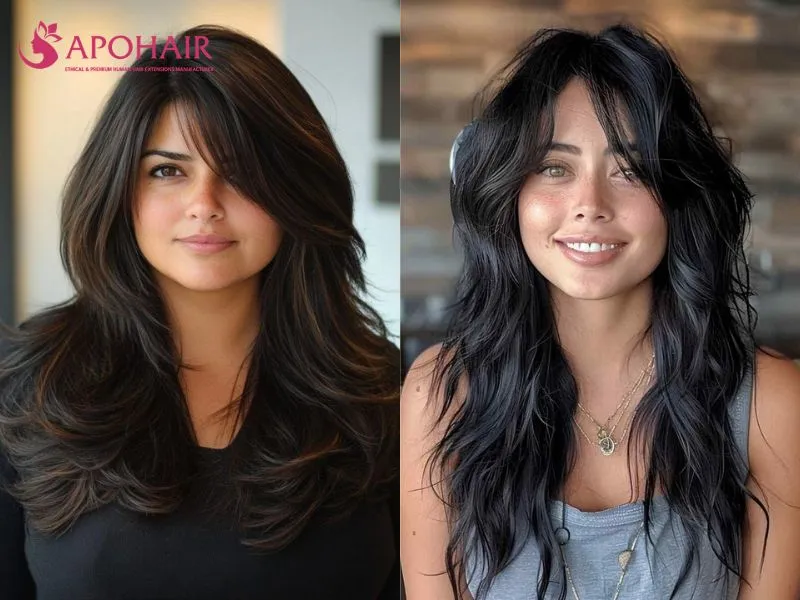
2. Long Hair With Curtain Bangs Cut At The Cheekbone
Flowing length paired with a center-split fringe whose shortest point sits at the cheekbone and sweeps outward to the jaw. The fringe crosses the face at its widest point and visually slices it, the most direct correction available without cutting length.
- Best on: full cheeks that sit high and wide.
- Texture: Type 1B to 2B (straight to defined wave).
- Density: medium to thick.
- Stylist note: Over-direct the fringe to the opposite side before cutting so it falls into a swoop instead of a flat curtain.
- Upkeep: medium; the fringe needs a daily round-brush.
Why it works: Curtain bangs keep the center of the forehead visible while their diagonal sides sweep past the cheekbones, maintaining vertical space and softening the transition from the cheeks to the jaw.
3. Deep Side-Parted Long Hair
Long hair swept hard to one side from a part set well off-center, so one side carries noticeably more weight than the other. The part line itself creates a diagonal across the top of the head, and diagonals are the one direction a round face has none of.
- Best on: a very symmetrical face, or a crown that lies flat.
- Texture: Type 1A to 2A (fine straight to loose wave).
- Density: fine; the shift builds an illusion of density at the roots.
- Stylist note: Cut with the hair fallen into the finished part, not the natural one. Face-framing pieces cut on a center part will hang wrong the moment the part moves.
- Upkeep: low, a comb and root spray.
Why it works: A deep side part divides the hair into unequal sections and creates a diagonal across the forehead, breaking the symmetry that otherwise reinforces a round outline.
4. Long Butterfly Cut With Two Tiers
Short face-framing layers cut to around chin length, disconnected from long layers that fall past the shoulders. The two tiers move separately, so the top adds lift while the bottom carries length, and the face sits between them rather than being framed by a single heavy curtain.
- Best on: a short neck, since the two tiers keep weight off the shoulders.
- Texture: Type 1B to 2B (straight to defined wave).
- Density: thick, the cut exists to remove weight.
- Stylist note: Keep the two tiers genuinely disconnected. Blending them turns the cut into an ordinary long layer and the whole effect disappears.
- Upkeep: high, a round brush to flip the top tier.
Why it works: A butterfly cut’s shorter tier adds lift and movement around the chin and crown, while its longer base maintains the downward line needed to visually lengthen the face.
5. Long Shag With Layers Starting Below The Jaw
Heavily textured long hair with choppy layers throughout, deliberately beginning below the jawline rather than at the cheek. Where the layering starts is the whole decision: begin it at the cheek and the cut widens the face, begin it below the jaw and the same cut narrows it.
- Best on: fullness along the jaw or under the chin.
- Texture: Type 2A to 3B (loose wave to springy curl).
- Density: medium to thick.
- Stylist note: Set the shortest interior layer below the jaw and texturize hard toward the ends. Resist the urge to lift the layers higher for movement.
- Upkeep: low, texturizer and air-dry.
Why it works: A long shag with layers beginning below the jaw moves texture away from the widest part of the face and concentrates its movement through the lower lengths instead.
6. Sleek Long Hair With Collarbone Face-Framing
Pin-straight length with front pieces that begin precisely at the collarbone and nowhere higher. Two uninterrupted vertical lines run down either side of the face, and because nothing breaks them at cheek level, there is no horizontal for the eye to catch.
- Best on: a double chin, where unbroken length past the jaw does the covering.
- Texture: Type 1A to 1C (fine to coarse straight).
- Density: medium to thick.
- Stylist note: Keep the perimeter blunt and razor-clean, and start the face-frame at the collarbone exactly. An inch higher and it becomes a widening layer.
- Upkeep: medium, flat iron and an anti-humidity finish.
Why it works: Sleek sides and collarbone-length front pieces create two uninterrupted vertical borders, allowing the eye to continue below the jaw without stopping at a cheek-level layer.
7. Long Beach Waves With Flat Roots
Loose irregular waves that begin at mid-length while the roots and top section stay straight. Volume is kept away from the ears entirely, so the wave adds movement down the body of the hair without adding any width where the face is widest.
- Best on: anyone with under ten minutes in the morning.
- Texture: Type 1B to 2C (straight to strong wave).
- Density: any.
- Stylist note: Leave the top section longer and less texturized than the mid-lengths so it lies flat rather than expanding at the cheek.
- Upkeep: low, a wand or overnight braids.
Why it works: Flat roots keep volume controlled beside the cheeks, while waves beginning through the mid-lengths add movement below the face’s widest point.
8. Long Layered Curls With Weight Removed At The Ends
Long natural curls cut with cascading layers that take weight out of the bottom so the curl pattern springs upward instead of pooling outward at the jaw. Length keeps the vertical line while the layering stops curls from stacking into a triangle at the widest point.
- Best on: a round face already carrying curl volume at the jaw.
- Texture: Type 2C to 3C (strong wave to tight corkscrew).
- Density: medium to thick.
- Stylist note: Cut dry, curl by curl, and remove weight from the ends rather than the interior. An interior-only layer leaves the perimeter heavy and the triangle forms anyway.
- Upkeep: medium, deep conditioning and a careful detangle routine.
Why it works: Long graduated layers distribute curl volume through a greater vertical distance and prevent the ends from collecting into a wide, bottom-heavy shape around the jaw.
9. Long Curly Shag With A Lifted Crown
Long textured curls with the crown section cut noticeably shorter to force height, finished with a soft curly fringe. The eye travels up to the lifted crown and then down through the lengths, and it never stops at the cheeks in between.
- Best on: a flat crown and a low hairline.
- Texture: Type 3A to 4A (loose curl to soft coil).
- Density: thick.
- Stylist note: Isolate the crown and cut it short enough to stand up, then slice it into the lengths so the transition disappears once the curl springs.
- Upkeep: low, mousse and a diffuser.
Why it works: A curly shag’s shorter crown layers build height above the face, while its longer curls preserve a downward line below the shoulders.
10. Voluminous Curls Weighted To One Side
Long curls cut and set so the mass sits unevenly, heavier on one side of the head than the other. The imbalance draws a diagonal line across the forehead and down one cheek, which does the same work as a side part but with curl volume rather than a parting.
- Best on: a fuller frame, where slimming matters but losing volume does not.
- Texture: Type 3A to 4B (loose curl to tight zigzag).
- Density: any.
- Stylist note: Leave the heavier side slightly longer at the perimeter to hold the balance once shrinkage pulls it up.
- Upkeep: low, diffuse at the roots on the heavy side.
Why it works: Curls weighted to one side create diagonal movement across the forehead and down the heavier section, preventing the hairstyle from repeating the face’s circular symmetry.
Length gives the most room to work with, but it also asks for the most patience growing into it. The next group covers the range where most people actually sit.
10 Best Medium-Length Hairstyles For Women With Round Faces That Skip The Widest Point
Everything in this section clears the chin without reaching the shoulder blades, and each cut handles the danger zone differently. The textured and asymmetrical lobs use the perimeter, the collarbone shag and layered midi use where the layers begin, curtain bangs and wispy fringes work across the forehead, and the wolf cut and feathered shoulder cut redistribute volume upward. All ten finish below the jaw, and that is the non-negotiable part of the length.
11. Textured Lob Cut At The Collarbone
A long bob resting at the collarbone with subtle interior layering that removes weight without breaking the perimeter. It ends past the chin, so it never draws a line at the widest point, and it holds a clean shape with almost no styling, which is why it is the default recommendation for a round face.
- Best on: anyone unsure where to start, and anyone growing out a short cut.
- Texture: Type 1A to 3B (straight through springy curl).
- Density: any.
- Stylist note: Use invisible interior layers to take out bulk while keeping the outline solid. The cut fails the moment the perimeter goes wispy.
- Upkeep: low, air-dry or a quick wand.
Why it works: A collarbone lob’s perimeter clears the chin and creates two longer lines beside the face, while subtle interior layers remove bulk without weakening the structured edge.
12. Asymmetrical Lob With One Longer Side
A collarbone cut set noticeably longer on one side than the other. The uneven perimeter shifts the visual weight off-center, and an off-center outline cannot read as circular no matter how full the cheeks are.
- Best on: fullness that sits mostly on one side of the jaw.
- Texture: Type 1B to 2B (straight to defined wave).
- Density: medium.
- Stylist note: Establish the asymmetry from the parting and let the longer side drop sharply. A gentle difference reads as an uneven trim.
- Upkeep: medium, flat iron to keep the length difference visible.
Why it works: An asymmetrical lob’s sloping perimeter directs the eye toward the longer side and replaces a balanced circular outline with a distinct diagonal.
13. Collarbone Shag With Angled Curtain Bangs
A layered mid-length cut with crown texture and a fringe angled from the cheekbone outward. Crown layers lift the top of the silhouette while the angled fringe cuts a diagonal across the widest section, so the cut works on both halves of the face at once.
- Best on: wide cheekbones sitting under a flat crown.
- Texture: Type 2A to 2C (loose to strong wave).
- Density: medium to thick, fine hair goes sparse under this much layering.
- Stylist note: Start the curtain at the cheekbone and blend it deeply into the crown layers so the fringe and the shag read as one shape.
- Upkeep: low, dry shampoo and texturizer.
Why it works: A collarbone shag combines crown height, diagonal curtain bangs, and below-jaw length, balancing cheek-level width from the top, front, and lower perimeter.
14. Face-Framing Layered Midi Curving Inward
Mid-length hair past the shoulders with layers cut to curve inward toward the chin. The inward curl acts like a pair of parentheses around the face, covering the outer edge of each cheek and narrowing the visible width of the whole outline.
- Best on: a wide jaw you would rather cover than expose.
- Texture: Type 1A to 2A (straight to loose wave).
- Density: medium to thick.
- Stylist note: Slide-cut the face-framing sections so they curve rather than step, and start them below the cheekbone.
- Upkeep: high, a round-brush blow-dry to hold the inward curve.
Why it works: A layered midi’s inward-curving front pieces guide attention toward the chin and reduce the visual emphasis on the outer cheeks, while the longer base preserves vertical length.
15. Side-Parted Medium Waves
Shoulder-length hair set in loose waves from a deep side part, with lift built at the roots on the heavier side. The root lift adds the height a round face wants and the parting supplies the diagonal, so a single styling decision covers two mechanisms.
- Best on: fine hair on a full face, where volume has to be manufactured.
- Texture: Type 1B to 2B (straight to defined wave).
- Density: fine, the wave pattern creates the density illusion.
- Stylist note: Wave in vertical sections and keep the root on the heavy side lifted. Flat roots collapse the whole effect.
- Upkeep: high, daily heat.
Why it works: Side-parted waves combine a diagonal across the forehead with root height on the heavier side, while keeping the main wave pattern below cheek level.
16. Medium Length With Curtain Bangs
Shoulder-resting hair with a center-split fringe that fans outward at the cheekbones. The fringe opens across the face rather than sitting flat on the forehead, which highlights the cheekbones as structure instead of letting them read as width.
- Best on: a high forehead paired with full cheeks.
- Texture: Type 1C to 2C (coarse straight to strong wave).
- Density: medium to thick.
- Stylist note: Point-cut the fringe so the ends fan and soften. A blunt curtain sits as a solid block and closes the face in.
- Upkeep: medium, the fringe needs daily shaping.
Why it works: Curtain bangs preserve visible forehead length through their center opening and frame the cheekbones diagonally when their outer sections blend below the jaw.
17. Medium Wolf Cut
A shag-mullet hybrid with a heavily layered voluminous crown tapering to wispy ends, and sides that sit close to the head. The contrast between a full top and flat sides is the most aggressive height-versus-width trade in this guide, which is why it changes a round silhouette faster than anything else at this length.
- Best on: a creative workplace and a low tolerance for styling.
- Texture: Type 2A to 2C (loose to strong wave).
- Density: thick.
- Stylist note: Razor the sides close and leave the crown disconnected and choppy. The cut lives on that disconnection.
- Upkeep: low, styling cream and nothing else.
Why it works: A medium wolf cut shifts volume toward its layered crown and tapers into lighter sides and ends, creating height without forming a wide block around the cheeks.
18. Feathered Shoulder-Length Cut
Shoulder-length hair with steep front layers feathered back and away from the face. The layers move outward and upward rather than falling forward, which pulls attention off the cheeks and toward the outer corners of the eyes.
- Best on: a mature face where the crown has flattened.
- Texture: Type 1B to 2A (straight to loose wave).
- Density: thick, fine hair goes sparse.
- Stylist note: Start the face-framing layers around the nose and feather them so they flip back naturally under a round brush.
- Upkeep: high, blow-dry backward every wash.
Why it works: Feathered layers move backward and upward from the face, opening the cheek area and directing attention toward the eyes and crown instead of the outer facial width.
19. Layered Curly Lob With A Rounded Interior
A collarbone-grazing curly bob with interior layers shaped into a rounded silhouette so curl volume spreads evenly instead of massing at the ends. Length carries the outline past the chin while the interior shaping prevents the pyramid that makes curly bobs widen a round face.
- Best on: curl that widens at the jaw instead of falling past it.
- Texture: Type 2C to 3C (strong wave to tight corkscrew).
- Density: thick.
- Stylist note: Shape the interior into a rounded form and keep the perimeter length past the chin. A curly lob cut to the jaw is a different cut with the opposite effect.
- Upkeep: medium, curl cream and a detangle routine.
Why it works: A curly lob moves the curl mass below the chin, while its interior layers distribute volume evenly and prevent a bottom-heavy triangular perimeter.
20. Medium Curly Shag With Wispy Bangs
A shoulder-length layered curly cut with a light curly fringe. Crown layers supply the height, and a wispy rather than solid fringe breaks up the forehead without laying a hard horizontal line across it.
- Best on: a wide forehead on naturally curly hair.
- Texture: Type 3A to 3C (loose curl to tight corkscrew).
- Density: medium to thick.
- Stylist note: Cut the fringe dry and leave it longer than the finished length. Curl shrinkage will take an inch or more once it dries.
- Upkeep: low, mousse and air-dry.
Why it works: A medium curly shag uses crown layers for height and a light fringe to define the forehead without creating a dense horizontal line above the cheeks.
Cutting shorter than the chin means giving up the vertical line that length provides, so a short cut has to replace it with height instead.
10 Best Short Hairstyles For Round Faces That Add Height And Slim The Sides
Short cuts stop above the jaw, which removes the downward pull entirely, so every cut here rebuilds the vertical from the top. The pixies and the undercut build crown height, the asymmetrical and A-line bobs draw an angled perimeter, the bixie and shag use texture to keep the sides quiet, and the two curly cuts tackle the hardest version of the problem. The failure mode is the same for all of them: any short cut that finishes level with the cheek makes a round face wider.
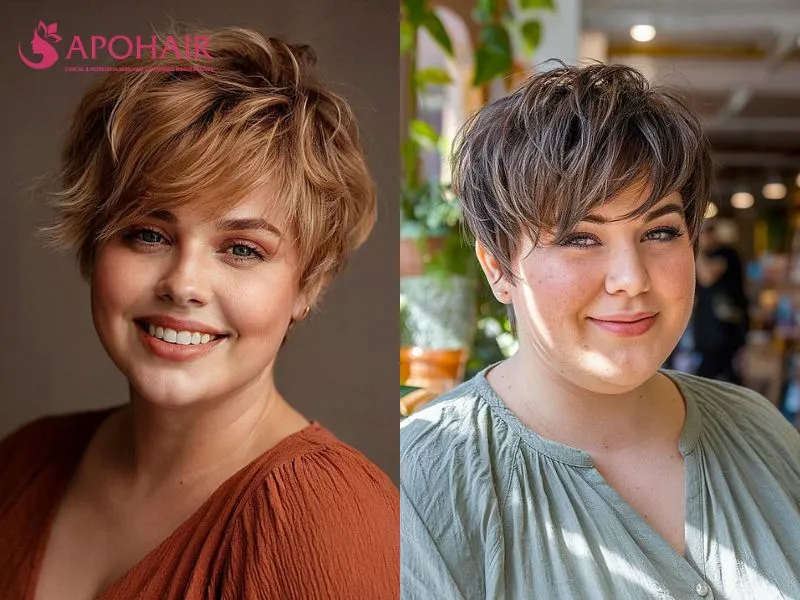
21. Textured Pixie With A Lifted Crown
A short cut with cropped sides and longer piecey layers on top, styled upward. The height sits directly above the face while the sides stay tight, and that vertical stretch is the whole reason a pixie can work on a round face at all.
- Best on: a double chin on a short neck, since the tapered nape opens the neckline.
- Texture: Type 1B to 1C (medium to coarse straight).
- Density: thick, fine hair will not hold the crown.
- Stylist note: Point-cut the crown for separation and taper the sides tight. A uniform-length pixie will round the head and defeat the cut.
- Upkeep: medium, wax or clay daily, trim every 4 to 6 weeks.
Why it works: A textured pixie’s closely tapered sides control width around the temples and cheeks, while its lifted top creates a vertical extension above the forehead.
22. Side-Swept Pixie With A Long Fringe
A pixie parted deeply to one side with a long fringe sweeping across the forehead. The fringe lands as a diagonal, and a diagonal across the top of the face is the fastest angular correction available at this length.
- Best on: a high forehead on fine hair.
- Texture: Type 1A to 2A (fine straight to loose wave).
- Density: fine, the sweep builds a density illusion.
- Stylist note: Slice the fringe diagonally rather than cutting it straight and sweeping it after. A sliced fringe holds the angle without daily fighting.
- Upkeep: low to medium, a quick fringe style each morning.
Why it works: A side-swept pixie’s long fringe crosses the forehead diagonally, interrupting facial symmetry and directing attention toward the eyes and upper cheekbone.
23. Asymmetrical Bob With A Diagonal Perimeter
A bob cut noticeably longer on one side, with a sharp diagonal running from the short side to the long. That single line does more narrowing than the length of the cut would suggest, because it is the only straight edge anywhere near a round face.
- Best on: a soft jawline that needs one hard line somewhere.
- Texture: Type 1A to 2A (straight to loose wave).
- Density: medium, very thick hair resists the smooth finish.
- Stylist note: Cut a clean blunt diagonal toward the front with a smooth transition and no choppy interior. The line is the cut.
- Upkeep: medium, round-brush the edges.
Why it works: An asymmetrical bob places a sharp diagonal beside the face’s softer curves, and its longer side prevents the perimeter from ending at the widest cheek-level point.
24. A-Line Bob Angled Past The Chin
An A-line bob is one of the most reliable bob hairstyles for round faces because it stays shorter at the back and becomes progressively longer toward the front, with both front points finishing below the chin. The forward angle creates definition beside a softly curved jaw, while the longer front prevents the perimeter from drawing a horizontal line across the widest part of the face.
- Best on: a receding or undefined chin.
- Texture: Type 1A to 1B (fine to medium straight).
- Density: fine to medium.
- Stylist note: Over-direct backward while cutting the perimeter to build a strong forward angle. Check that the front points clear the chin before you finish.
- Upkeep: medium, blow-dry to keep the angle sharp.
Why it works: An A-line bob’s front points extend below the chin and form two forward diagonals, defining the lower face without adding a blunt horizontal edge at the jaw.
25. Short Shag With A Wispy Fringe
A heavily layered short cut with texturized ends and a light fringe. Choppy layers pile volume at the crown while the broken-up ends keep the sides from reading as a solid block of width.
- Best on: anyone who wants short hair without a polished routine.
- Texture: Type 2A to 2C (loose to strong wave).
- Density: medium.
- Stylist note: Razor or thin the ends to remove bulk and keep the finish airy. Weight left at the perimeter turns this into a widening cut.
- Upkeep: very low, sea salt spray.
Why it works: A short shag moves volume toward its choppy crown, while separated ends and a wispy fringe prevent the sides and forehead from forming solid horizontal blocks.
26. Bixie Cut With Face-Framing Pieces
Shorter than a bob and longer than a pixie, with layered texture and pieces left long enough to sit against the cheekbones. It delivers pixie-level root volume while keeping just enough length around the ears to shape the face rather than expose it.
- Best on: anyone moving from a bob toward a pixie for the first time.
- Texture: Type 1B to 2B (straight to defined wave).
- Density: medium to thick.
- Stylist note: Blend the short voluminous crown into the longer face-framing lengths so there is no visible step at the ear.
- Upkeep: medium, texturizing spray.
Why it works: A bixie’s textured crown creates height, while front pieces extending past the cheekbones form a narrow vertical frame without ending at the face’s widest point.
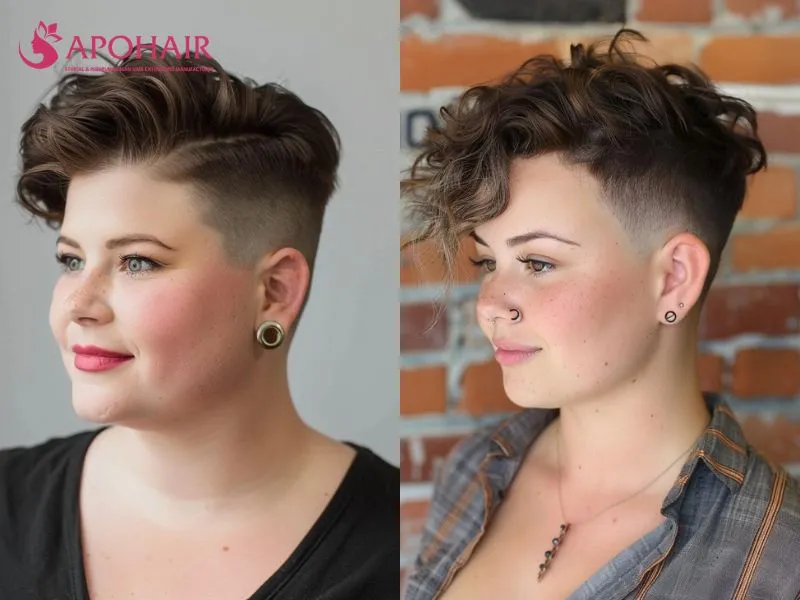
27. Undercut Pixie With A Voluminous Top
Buzzed or faded sides and back under a long, heavily textured top. The contrast is extreme, and extreme contrast between a flat side and a full crown is the strongest vertical stretch available in a short cut.
- Best on: a long neck and strong features that carry contrast.
- Texture: Type 1C to 2B (coarse straight to defined wave).
- Density: thick, fine hair cannot carry the top.
- Stylist note: Fade the sides clean and texturize the top hard so it stands without product fighting it.
- Upkeep: high, salon every 2 to 3 weeks for the fade.
Why it works: An undercut pixie’s close sides remove cheek-level volume, while its longer textured top gives the short silhouette a pronounced upward direction.
28. Curly Pixie With Volume On Top
A pixie shaped for natural curl, with sides cropped close and the curl mass concentrated on the crown. Lift comes from the curl pattern itself rather than from product, and the tight sides stop the curl from expanding at the cheek.
- Best on: a high forehead above a defined jaw.
- Texture: Type 3A to 4C (loose curl to densely packed coil).
- Density: any.
- Stylist note: Cut the top curl by curl, dry, so the volume is shaped without disrupting the pattern.
- Upkeep: low, curl cream and air-dry.
Why it works: A curly pixie concentrates natural volume at the crown to create height, while closely shaped sides prevent the same curls from expanding beside the cheeks.
29. Tapered Curly Crop With Crown Volume
A very short curly cut tapered tight through the sides and nape with the length kept on top. Curl volume is the hardest thing to control on a round face, and tapering removes it at exactly the height where it would otherwise widen the face, right at the cheek line.
- Best on: curl volume that keeps landing level with the cheek.
- Texture: Type 2C to 4B (strong wave to tight zigzag).
- Density: medium to thick.
- Stylist note: Taper the sides progressively from the temple down and leave the crown long enough to sit up once the curl springs. Cut dry to see the finished shape.
- Upkeep: low, refresh spray, trim every 6 to 8 weeks.
Why it works: A tapered curly crop reduces volume progressively from the temples toward the nape and retains enough crown length to keep the silhouette upright.
30. Short Curly Shag With A Curly Fringe
A short heavily layered cut that lets the curl fall naturally, finished with a soft curly fringe that pulls attention to the eyes. Layering keeps the curl from expanding sideways, and the fringe adds a break across the forehead so the outline is interrupted at the top as well as the sides.
- Best on: a wide forehead, and eyes you want brought forward.
- Texture: Type 3A to 3C (loose curl to tight corkscrew).
- Density: medium to thick.
- Stylist note: Keep the face-framing layers long enough to allow for shrinkage and texturize the interior heavily to remove weight.
- Upkeep: low, scrunch with gel or mousse.
Why it works: A short curly shag separates the curl mass through layering, while its airy fringe highlights the eyes without placing a heavy horizontal edge across the forehead.
If none of these ten cuts matches your hair texture, density, or styling routine, our broader collection of short hairstyles for round faces includes more pixies, bobs, shags, curly crops, and low-maintenance options.
Fullness under the chin changes which of these lengths are safe, and it is common enough alongside a round face to deserve its own set of cuts.
4 Best Pulled-Back Hairstyles For Women With Round Faces
Pulling hair back removes the frame around the face, and on a round face that frame does most of the work, so the rule here is what stays out. Leave two long pieces falling past the cheekbones on every one of these, and build the volume above the crown rather than around the ears.
- High ponytail with a lifted crown. The strongest option, because height above the hairline continues the vertical line the face lacks, and a high ponytail pulls the whole silhouette upward. Backcomb the crown lightly before securing.
- Half-up top knot. Does the same work while keeping the lower length down, which makes it the safer version for anyone not ready to expose the full face. It is also the only look here that leaves the cheek frame fully intact.
- Low bun under a deep side part. Works because the parting supplies the diagonal that the low placement takes away. The same bun under a center part reads as a wide, symmetrical circle.
- Claw-clip twist with loose tendrils. The everyday version: quick, and forgiving as long as the tendrils reach past the cheekbone rather than curling up beside the ear.
The one to skip is a slicked-back low bun with a center part, since it removes the frame, the height and the diagonal at once and puts the full width of the face on display.
Why it works: Pulled-back hairstyles flatter a round face when they retain at least one elongating element after exposing the facial outline: crown height in a high ponytail or top knot, diagonal direction in a side-parted low bun, or vertical lift and long tendrils in a claw-clip twist.
The four styles above keep the lengths controlled without flattening the entire silhouette; more hairstyles that keep hair out of the face can follow the same rule by retaining crown height, an off-center part, or long tendrils.
3 Best Special-Occasion Hairstyles For Women With Round Faces
Occasion styles carry constraints that an everyday look does not. A veil or a hair accessory has to sit somewhere, a neckline changes the proportion of face to shoulder, the style has to survive eight hours, and it will be seen from the side and back as often as head-on.
- Loose chignon with height built at the crown. The safest formal choice. Accessory placement decides whether it works: a veil or comb pinned behind the crown volume preserves the height, while anything pinned on top flattens the one element doing the correcting.
- French twist. The only formal style with a built-in vertical line, since the seam runs up the back of the head. It also photographs well in profile, where a chignon can read as a round mass.
- Half-up bridal style with cascading curls. Keeps the cheek frame intact all day, which makes it the least risky option for a long event.
Necklines matter more than most people expect. A V-neck or sweetheart continues the vertical line down from the face, while a straight strapless or bateau neckline draws a horizontal across the shoulders that echoes the width of the cheeks. If the dress is already chosen and the neckline is horizontal, add height with your hair and pin the accessory low and to one side.
Why it works: Special-occasion hairstyles flatter a round face when their structure directs the eye vertically: a loose chignon adds crown height, a French twist creates an upright seam, and a half-up style combines top lift with cascading length below the shoulders.
How Should Women With Round Faces Choose A Hairstyle?
The face shape sets the goal and the length sets the frame, but which of the 37 looks above actually survives depends on your own hair: its texture, its density, and whether the fullness sits in the face or under the chin. Use the five factors below to narrow the list.
What Hairstyles Suit Women With Round Faces And A Double Chin?
When there is fullness under the jaw, the cut has to commit in one direction: either well above the jaw or below the neck. A perimeter ending between these points draws attention across the fullest area. The three options that work hardest are the sleek long cut with collarbone face-framing, the asymmetrical lob with one longer side, and the textured pixie with a lifted crown.
For readers who prefer cropped lengths, short hairstyles for round faces and a double chin require a tapered neckline, controlled side volume, and either crown height or a perimeter that clears the jaw.
What Hairstyles Suit A Round Face With Curly Hair?
The best curly hairstyles for a round face place curl volume above the crown or below the jaw instead of concentrating it beside the cheeks. A tapered curly crop controls width through the temples, a layered curly lob moves the curl mass below the chin, and long layered curls distribute volume through a greater vertical distance.
A chin-length curly bob still works when its internal layers prevent a wide triangular perimeter and its longest curls extend below the jaw. The stylist should cut according to the dry curl pattern because shrinkage changes where each layer and perimeter line finishes.
Do Fine And Thick Hair Need Different Cuts On A Round Face?
Fine hair loses its outline the moment it is over-layered, so the vertical line has to come from a solid edge instead. The textured lob and the A-line bob both hold their shape without relying on density.
Thick hair has the opposite problem: left solid, it becomes a wide block, so the weight has to come out from inside while the perimeter stays intact. Long V-cut layers and the butterfly cut are built for that.
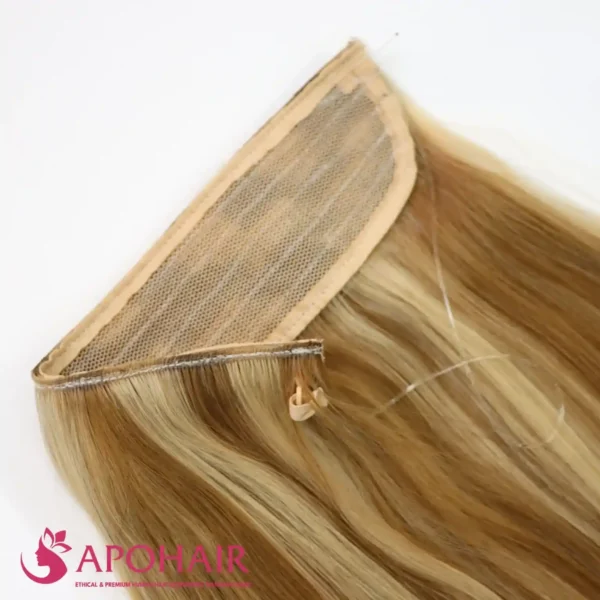
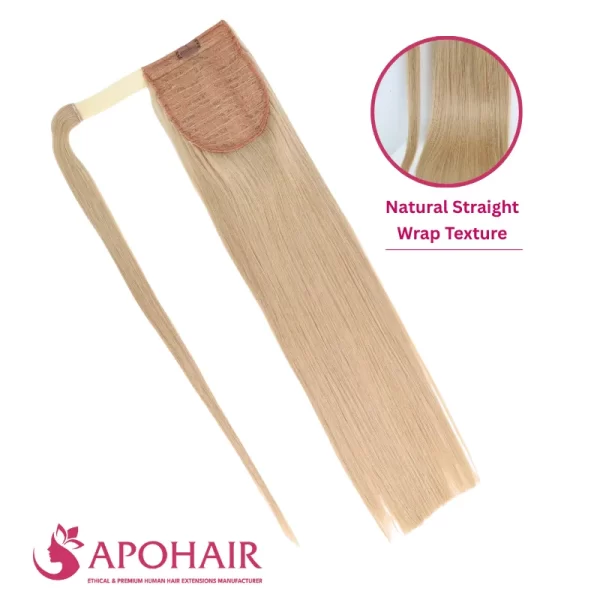
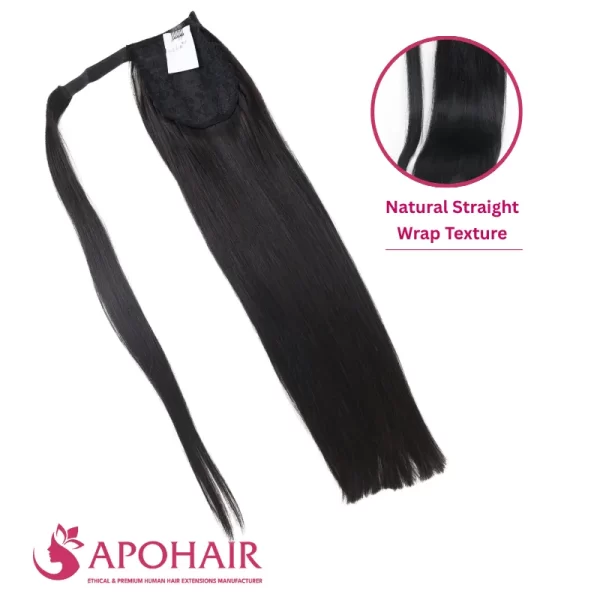
If your natural hair does not reach collarbone length, clip-in hair extensions matched to your texture let you test a longer face-framing cut before committing to growth.
What Are The Best Hairstyles For Women Over 50 With Round Faces?
The best hairstyles for a round face over 50 include textured lobs, collarbone shags, feathered shoulder-length cuts, and lifted pixies. These cuts create shape through their perimeter and layer placement, so they do not depend on heavy daily styling.
When density has decreased around the crown, excessive layering can make the top appear thinner. In that case, retain a structured perimeter, use fewer graduated crown layers, and create lift through a light root product or controlled blow-drying. Long hair remains suitable when its weight does not flatten the roots or concentrate volume below the jaw.
What Are The Best Low-Maintenance Hairstyles For A Round Face?
A cut that needs a round brush every morning will not stay flattering on the mornings it does not get one, and a collapsed blowout on a round face falls straight back into width at the cheeks. Choose shapes that hold without heat: the short shag, long beach waves, and the curly pixie all air-dry into their intended silhouette. Leave the feathered cut and the face-framing midi to anyone who genuinely styles daily.
Hairstyles To Avoid For Round Faces
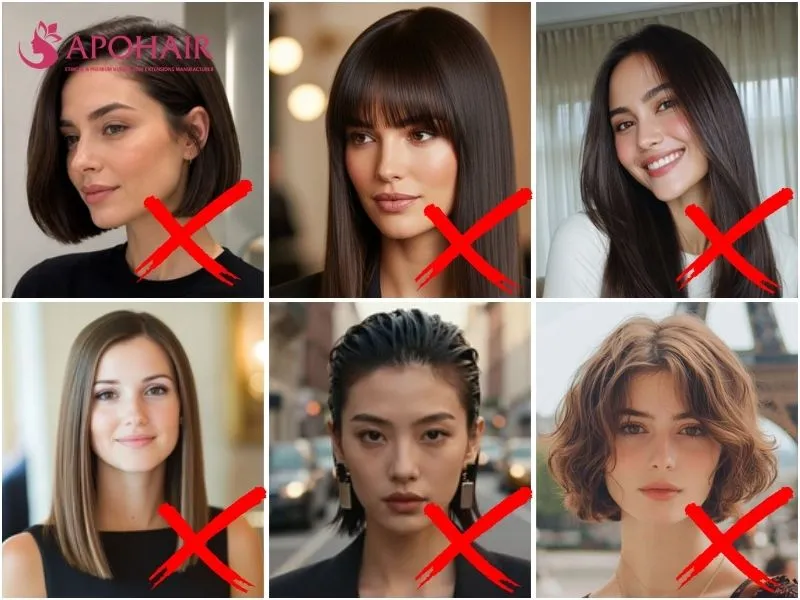
Six styles work against this face shape regardless of texture or density, and each fails for a reason that has nothing to do with personal taste.
- A blunt bob ending at the chin. It draws a hard horizontal line across the widest part of the face and stops the eye there. Adding an inch (2.5 cm) of length past the chin, or angling the perimeter forward, removes the problem without changing the cut.
- Straight-across heavy bangs. A solid fringe adds a second horizontal above the first, framing the face between two parallel lines and compressing its visible length. Curtain or side-swept versions do the same forehead coverage on a diagonal.
- A center part with no layers. It splits the face into two matching halves and confirms the symmetry the cut is supposed to break. Shifting the part off-center by an inch is often the entire fix.
- One-length mid-length hair sitting at cheek level. The perimeter lands exactly on the widest measurement and the hair hangs as a flat plane on either side, adding width rather than length.
- Slicked-back flat styles. Removing all volume removes the vertical mechanism entirely and leaves the full circular outline exposed, with nothing to offset it.
- A chin-length curly bob. Curl volume expands sideways at precisely the height where the face is already widest, the worst-case combination of length and texture on this shape.
Frequently Asked Questions About Hairstyles For Round Faces
What bangs suit a round face best?
The most flattering bangs for round faces include side-swept, curtain, and wispy styles. Side-swept bangs cross the forehead diagonally, and curtain bangs split at the center and sweep outward to frame the cheekbones rather than covering them. Both add forehead coverage without laying a horizontal line across the face. Wispy bangs work as a lighter alternative for anyone who wants minimal fringe or has fine hair that a full fringe would thin out elsewhere.
Is A Bob Good For A Round Face?
Yes, a bob suits a round face when its perimeter finishes below the chin, angles toward the front, or introduces asymmetry. A collarbone lob, asymmetrical bob, and A-line bob create vertical or diagonal lines instead of placing a solid horizontal edge beside the cheeks. A blunt chin-length bob requires more careful styling because its perimeter can emphasize facial width.
Do women with round faces look better with short or long hair?
Both work, and the cut’s structure matters far more than its length. A short pixie with crown volume stretches the face upward; long layers with face-framing pieces stretch it downward. The genuinely unflattering option is neither. It is one-length, mid-length hair with no layers that sits at cheek level and adds width where a round face doesn’t need it.
Can hair extensions make a round face look slimmer?
Hair extensions can make a round face appear longer by adding length below the collarbone and supplying enough density for long layers or face-framing pieces. For clients who prefer a sewn-in installation, weave hairstyles for round faces work best when the added length continues below the jaw and the installed volume stays away from cheek level.
Extensions should not be placed close to the visible crown solely to create root height because the attachment points can become exposed. Crown lift should come from the haircut, root styling, or lightweight volumizing products, while extensions provide the length and density required for the chosen silhouette.
Should a round face avoid a center part?
A center part is only a problem when it sits on flat, one-length hair, where it mirrors the face’s symmetry and reinforces it. Paired with layers, waves, or curtain bangs, it works because the movement supplies the asymmetry the parting itself does not. If your hair is straight and unlayered, shifting the part off-center is the cheapest improvement you can make.
Conclusion
Every flattering cut for a round face does the same thing: it builds a vertical or diagonal line the face does not naturally have, and it keeps volume away from the cheekbones. Length past the collarbone gives the most room to do that, which is why the long and medium sections carry the strongest options here. But a well-tapered short cut with real crown height achieves the same balance from the opposite direction.
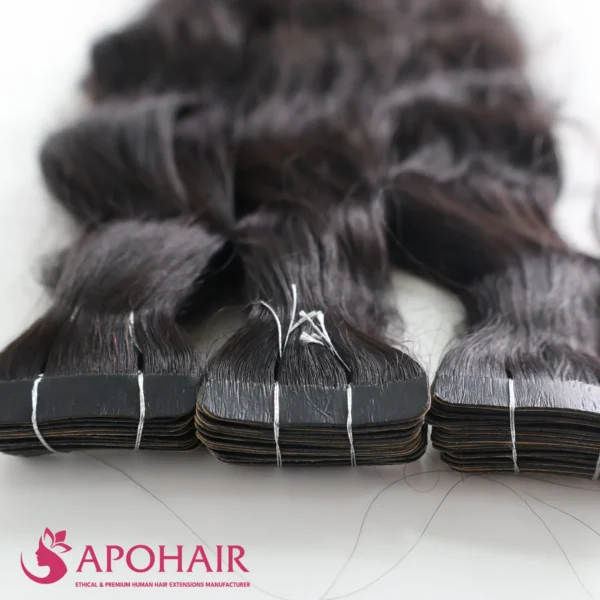
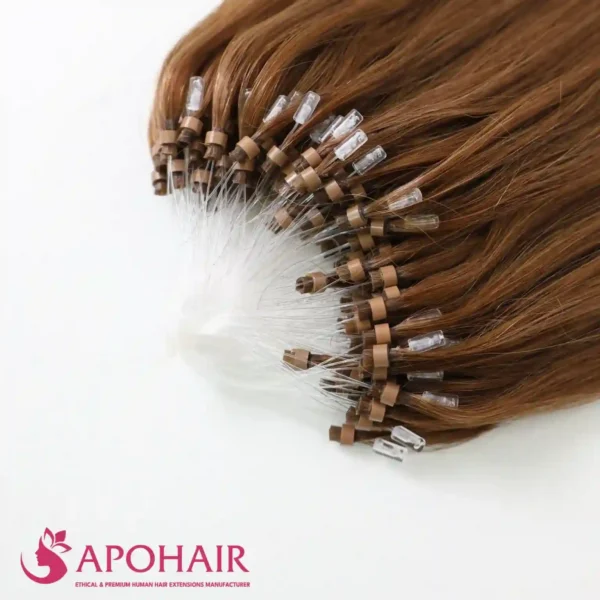
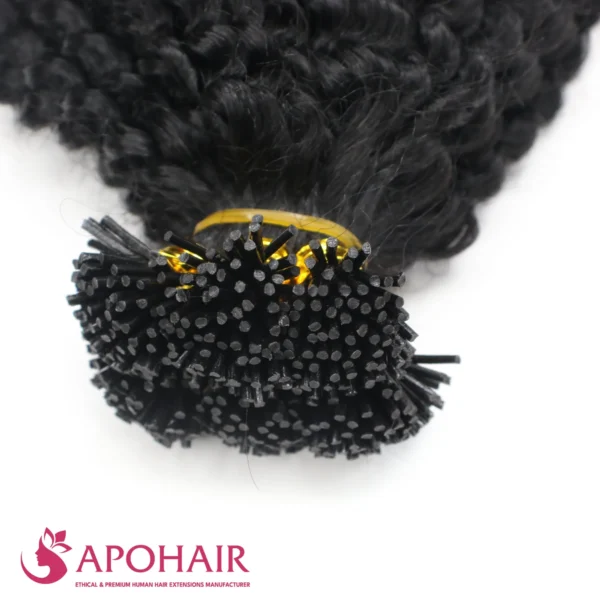
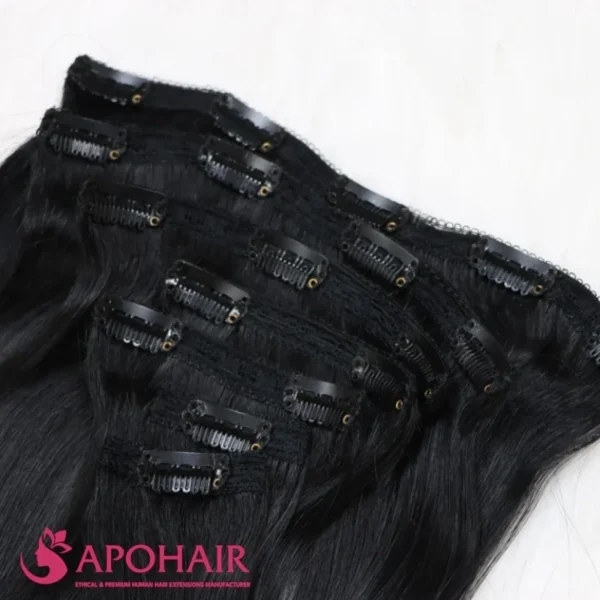
Hair extensions help salons recreate the long V-cuts, collarbone frames, and cascading occasion styles in this guide when a client’s natural hair lacks the required length or density. APOHAIR supplies human hair extensions wholesale in clip-in, tape-in, and weft formats across straight, wavy, and curly textures.
APOHAIR — ETHICAL & PREMIUM HUMAN HAIR EXTENSIONS AND WIGS MANUFACTURER
- Address: Building 3A, Lane 82 Duy Tan, Cau Giay, Hanoi, Vietnam
- Factory: Minh Luong, Yen Luong Ward, Ninh Binh, Vietnam
- WhatsApp: +84 862 132 366
- Email: [email protected]
- Website: https://apohair.com/
