Loose Wave vs Body Wave Hair Differences And Which To Choose?
Loose wave hair produces more volume than body wave at the same bundle weight, requires slightly more daily upkeep, and adapts better to defined styling situations. Its larger, farther-set curls create more air between strands, which gives each bundle a fuller, more lifted appearance straight out of the packaging. Body wave, by contrast, offers a sleeker, lower-maintenance finish that suits polished everyday looks. Loose wave hair also holds wand curls, flexi-rod sets, and wash-and-go styles longer than body wave, making it the stronger pick for textured, defined styling without constant restyling.
This guide breaks down the wave pattern, volume, maintenance, style aesthetic, and versatility of both textures side by side. You will also find face shape guidance, occasion-based recommendations, and hairstyle ideas to help you pick the right hair for your look, your lifestyle, and your clients.

What Is Loose Wave Hair?
Loose wave hair is a hair texture defined by large, bouncy, open curls that sit farther apart on the strand, producing high volume, natural movement, and a full-bodied appearance. Its curl pattern is made up of wide, open loops spaced at generous intervals along each strand, giving every curl a distinct, rounded shape rather than a compressed or flat wave. The hair feels light and airy. Strands spring back when shaken and move freely with body rotation rather than pressing flat against the head.
Loose wave hair sits between Type 2C and Type 3A on the Andre Walker curl classification system, bridging the gap between wavy and lightly curly territory. Its wide curl diameter and low strand density per wave cycle scatter light across the surface, creating a full, textured appearance rather than a sleek one. Salon professionals and individual wearers most often use loose wave hair in sew-in weaves, lace front wigs, and clip-in extensions for volume-forward styles, beach wave looks, or natural-textured wigs.

What Is Body Wave Hair?
Body wave hair is a hair texture defined by a continuous, uniform S-shaped wave pattern that runs from root to tip, producing a smooth, polished, and moderately voluminous appearance. Its curl pattern is made up of a consistent S-curve that repeats at regular intervals along the entire strand, with no irregular spacing or variation in wave size. Body wave hair feels silky and soft to the touch. Strands lie closer together and move in a controlled, flowing arc rather than springing outward.
Body wave hair corresponds to Type 2B to Type 2C on the Andre Walker curl classification system, sitting firmly in the wavy range with minimal curl definition. The tight, repeated S-pattern reflects light evenly across the surface, producing a glossy, smooth finish rather than a textured or voluminous one. Stylists and wearers most commonly use body wave hair in sew-in weaves, closure wigs, and lace front wigs for sleek, natural-looking styles that require minimal daily manipulation.

What Is the Difference Between Loose Wave and Body Wave Hair?
The main differences between loose wave and body wave hair are curl size, volume output, wave definition, maintenance demand, and how each texture holds its shape over time. The table below compares these two popular textures across five key aspects so you can identify the right match at a glance.
| Aspect | Loose Wave Hair | Body Wave Hair |
| Wave Pattern | Large, open circular curls with a diameter of 2.5 cm to 4 cm (1 to 1.5 inches), spaced farther apart | Continuous, compressed S-shape with a wave cycle of 1.5 cm to 2.5 cm (0.6 to 1 inch), repeating evenly root to tip |
| Volume & Density | Higher volume at the same weight; wider curls create more air between strands | Moderate volume; strands lie closer together for a sleeker, denser mass |
| Maintenance | More daily upkeep; hydration every 2 to 3 days, product application 3 to 4 times per week | Lower upkeep; product once per week, pattern holds 5 to 7 days between applications |
| Style Aesthetic | Bold, textured, beach-wave, free-spirited | Smooth, polished, salon-finish, refined |
| Best For | Volume-forward looks, natural curl styles, editorial shoots | Sleek everyday wear, formal events, professional settings |
Wave Pattern
Loose wave hair has a wider, more open curl loop while body wave hair has a tighter, more uniform S-pattern that repeats consistently from root to tip. Loose wave hair forms large, open circular curls with a diameter ranging from approximately 2.5 cm to 4 cm (1 to 1.5 inches), spaced farther apart along each strand. Body wave hair forms a continuous, compressed S-shape with a wave cycle of approximately 1.5 cm to 2.5 cm (0.6 to 1 inch), repeating evenly from root to tip.
Place both textures side by side, and loose wave appears fuller and more textured while body wave lies flatter and more uniform. The curl gaps on loose wave are visibly wider, measuring roughly 2.5 cm to 4 cm (1 to 1.5 inches) per cycle, compared to body wave’s tighter 1.5 cm to 2.5 cm (0.6 to 1 inch) per cycle.

Volume & Density
Loose wave hair gives more volume than body wave hair at the same bundle weight because its wider curl structure creates more air between strands and lifts away from the scalp more aggressively. Loose wave builds volume through wide, open curls that hold strands apart from each other, creating visible space between waves and pushing the hair outward from the head. Body wave builds volume through its consistent S-pattern, adding a moderate lift and movement without separating strands as far apart, producing a softer, more controlled fullness.
At the same bundle weight of 100 grams (3.5 oz), loose wave hair appears fuller because its curl diameter takes up more spatial volume, while body wave compresses into a sleeker, denser mass.
At lengths above 50 cm (20 inches), loose wave gains more visible body as the curl weight stretches slightly, while body wave at the same length tends to relax and lie closer to the body, reducing its original volume output.

Maintenance
Loose wave hair requires more maintenance than body wave hair because its open curl structure is more prone to frizz, tangles, and curl distortion without regular hydration and detangling.
A standard loose wave routine includes detangling with a wide-tooth comb from ends to roots, applying a leave-in conditioner after every wash, and air-drying to preserve curl shape, taking approximately 20 to 30 minutes per session. A standard body wave routine includes wrapping the hair with a silk scarf at night, washing once per week with a sulfate-free shampoo, and applying a light serum to maintain the S-pattern, taking approximately 10 to 15 minutes per session.
The effort gap between the two appears most clearly in daily frizz management: loose wave hair needs product application 3 to 4 times per week while body wave typically needs product once a week. Loose wave requires hydration every 2 to 3 days, while body wave can go 5 to 7 days between applications without visible pattern loss. After washing, loose wave requires scrunching with a curl cream and air-drying for 30 to 45 minutes before the curl pattern fully resets, while body wave resets its S-pattern naturally within 15 to 20 minutes with no additional product.

Style Aesthetic
Loose wave hair projects a bold, free-spirited, high-volume aesthetic while body wave hair projects a smooth, refined, and effortlessly polished look.
Loose wave carries a carefree, textured visual identity associated with beach waves, natural volume, and an expressive, full-bodied style that reads as confident and relaxed in equal measure. Body wave carries a classic, controlled visual identity associated with salon-finish blowouts, soft glamour, and a put-together elegance that reads as professional and versatile. Loose wave aesthetics serve casual outings, outdoor events, editorial shoots, and natural protective styles well, while body wave aesthetics serve office settings, formal occasions, bridal looks, and everyday polished wear more effectively.
When wet, loose wave tightens into more defined, compact curls with visible clumping, while body wave tightens into a crisper S-pattern. Once dry, loose wave expands into a fuller, airier shape while body wave dries into a smooth, flowing finish.

Versatility
Loose wave hair is more versatile than body wave hair for defined styling, while body wave hair is more versatile for transitioning between wavy and straight looks with minimal effort.
Loose wave supports beach wave styles, wash-and-go looks, flexi-rod sets, wand curls, and protective updos. Its defined curl structure holds heat-set styles longer than body wave. Body wave supports silk press styles, half-up half-down looks, low ponytails, and casual wavy wear. Its S-pattern provides a consistent base that requires little manipulation between wears. Loose wave adapts to more defined and textured styling situations without restyling, while body wave transitions between straight and wavy more efficiently after flat ironing.
Both textures can be straightened with a flat iron or restyled into other wave patterns using heat tools, provided the hair is 100% human hair with cuticles intact.

Popular Hairstyles with Loose Wave Hair
Loose wave hair works across a wide range of styled and natural looks because of its defined curl structure and high volume. Here are 15 hairstyles that pair well with this texture:
- Beach wave half-up: Pull the top section back while the loose curls cascade freely at the sides and back.
- Middle-part loose curls: Part the hair at center and let the wide, open curls frame both sides of the face.
- Side-swept waves: Sweep all the hair to one side for a dramatic, red-carpet silhouette with visible volume.
- High ponytail with curl ends: Gather the hair into a high pony and let the loose wave curls fan out at the tail.
- Messy bun with loose tendrils: Pull the hair into a relaxed bun and leave curly face-framing pieces out.
- Bohemian braids with loose wave ends: Braid sections at the crown and let the unbraided loose curls flow below.
- Wash-and-go natural curls: Apply curl cream and let the loose wave pattern air-dry for a no-fuss textured look.
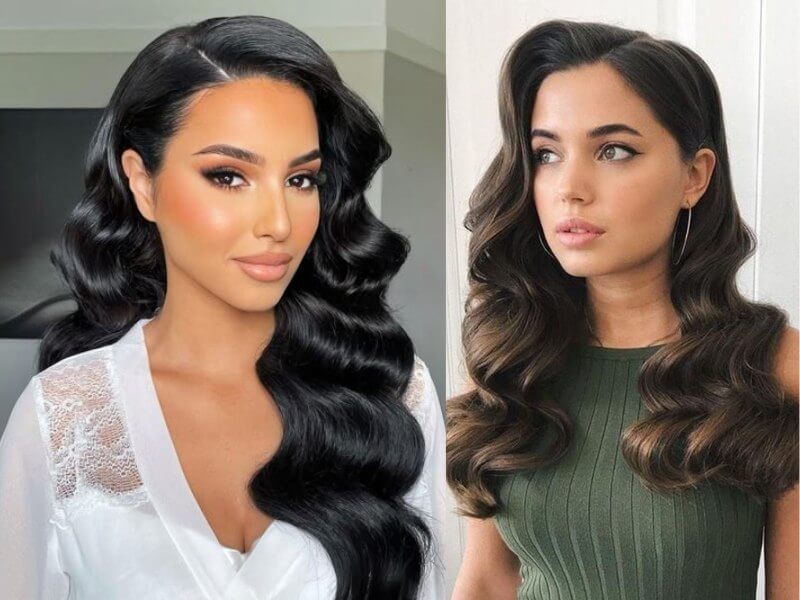
- Deep side-part glamour waves: Create a deep side part for vintage-inspired volume that catches light across each curl.
- Loose wave lob (long bob): Cut the hair to shoulder length and let the curls add fullness and movement.
- Space buns with wavy base: Divide the hair into two high buns while loose wave texture adds volume underneath.
- Braided crown with free curls: Braid a section across the crown and let the remaining loose waves fall naturally.
- Low chignon with textured pieces: Twist the hair into a low, relaxed chignon and pull out curly strands at the front.
- Headband style with volume: Place a headband over the loose waves for a casual, carefree day look.
- Wand curl refresh: Re-define any stretched-out sections with a 1-inch (2.5 cm) wand for tighter, bouncier curls.
- Layered cut with face-framing curls: Add layers throughout to let the loose wave pattern create movement at every level.

Popular Hairstyles with Body Wave Hair
Body wave hair suits polished, flowing styles because of its smooth S-pattern and controlled movement. Here are 15 hairstyles that complement this texture:
- Classic blowout finish: Brush the body wave hair smooth with a round brush for a salon-quality, voluminous blow-dry look.
- Sleek middle part: Part the hair down the center and let the soft S-waves frame the face with controlled elegance.
- Low ponytail with S-wave tail: Secure a low pony and let the body wave pattern flow through the tail for a polished finish.
- Half-up half-down: Pull the top half back while the lower body wave sections add soft movement below the shoulders.
- Bridal updo with soft wave accents: Pin the hair into an updo and leave a few body wave strands loose at the neckline.
- Curtain bangs with body wave lengths: Add face-framing curtain bangs that blend into the soft, flowing body wave hair.
- Silk press transformation: Flat iron the body wave for an ultra-sleek, glossy silk press look.
- Side-part Hollywood waves: Part to one side and finger-wave the front section for a retro glamour effect with the body wave base.
- Loose bun with flowing pieces: Tie a soft, low bun and let wisps of body wave hair fall around the face and neck.
- Straight-to-wavy ombre style: Straighten the roots and let the body wave pattern kick in from mid-length down for a gradient effect.
- Wrapped ponytail: Secure the body wave hair in a ponytail and wrap a strand around the elastic for a clean, refined finish.
- Deep side sweep: Push all hair to one side and let the uniform S-waves create a flowing, uninterrupted cascade.
- Layered cut for movement: Add long layers throughout so the body wave pattern creates subtle dimension at each tier.
- Headband tuck: Fold the front sections behind a wide headband and let the body wave lengths drape at the back.
- Twisted half-crown: Twist two sections from each temple, pin them at the back, and let body wave hair flow underneath.

How to Choose Between Loose Wave and Body Wave Hair Extensions
You choose between loose wave and body wave hair extensions based on five primary factors: your preferred style aesthetic, face shape, daily maintenance capacity, occasion type, and natural hair texture for blending. A simple rule that covers most buying decisions: choose loose wave if you want more volume and defined texture, and choose body wave if you want a sleeker, lower-maintenance finish that transitions easily between wavy and straight.
Go for a Style That Matches Your Look
Loose wave hair fits bold, expressive, and textured personal styles, while body wave hair fits classic, polished, and minimally styled aesthetics. Selecting the right texture means identifying whether your daily look gravitates toward high-volume, defined texture or smooth, controlled movement, then choosing the wave pattern that reinforces that identity without daily restyling. Loose wave reinforces free-spirited, natural, and expressive style identities by adding visible texture and volume that reads as confident and effortless. Body wave complements refined, professional, and understated aesthetics with its smooth, flowing finish.
If your style changes day to day, body wave is more adaptable because it transitions from wavy to straight with a single flat iron pass, while loose wave requires more effort to fully straighten and reset. If your style leans toward volume, beach texture, or natural curl looks, choose loose wave. If it leans toward sleek, polished, or low-manipulation looks, choose body wave.

Take Your Face Shape Into Account
Loose wave hair suits round, square, and heart-shaped faces, while body wave hair suits oval, oblong, and diamond-shaped faces best. Curl tightness and volume add or soften facial dimension differently because wider curls draw the eye vertically and outward, balancing wider face shapes, while smoother waves elongate and slim, which suits longer or narrower face shapes.
Round and square faces benefit most from loose wave hair because the outward volume at the sides and vertical lift at the crown create the illusion of length and reduce the appearance of facial width. Oval and oblong faces benefit most from body wave hair because the smooth, flowing S-pattern adds width without the excessive volume that could overpower natural proportions.
For oval faces, the most neutral face shape, body wave is the safer choice because its moderate volume and controlled movement complement the balanced proportions without adding disproportionate width or height.

Keep Up with Your Daily Routine
Body wave hair suits active and low-maintenance daily routines better than loose wave hair because it requires less frequent product application and holds its pattern longer between washes. Loose wave hair requires daily or every-other-day scrunching with a curl refresher spray or leave-in conditioner to maintain curl definition. Body wave needs only a light serum application once or twice per week to maintain its S-pattern. Loose wave realistically takes 15 to 20 minutes of daily maintenance in a morning routine, including detangling, refreshing curls, and managing frizz. Body wave takes 5 to 10 minutes, primarily a quick comb-through and light product application.
For active lifestyles involving gym sessions, outdoor work, or humid climates, body wave holds up better because its tighter, flatter S-pattern is less prone to frizz expansion and curl distortion when exposed to sweat and humidity than the wider, more open curls of loose wave.

Dress Up for the Right Occasion
Loose wave hair suits editorial, casual, and expressive occasions better, while body wave hair suits formal events, bridal settings, and professional environments more effectively. Curl definition matters differently for photography versus workplace settings because defined loose wave curls photograph with more dimension and visual interest under studio or natural light, while body wave’s smooth S-pattern reads as cleaner and more professional under office lighting or at close interpersonal distances.
Both textures work equally well for social events such as dinners, parties, and casual outings where the dress code falls between casual and semi-formal. If the occasion calls for editorial shots, natural looks, beach events, or expressive styling, choose loose wave. If the occasion calls for bridal wear, corporate settings, or formal events, choose body wave.

Build Up the Volume and Length
Loose wave hair gives more volume overall, and both textures perform differently at longer lengths, with loose wave expanding outward and body wave relaxing into a softer flow past 50 cm (20 inches). Loose wave performs at its best between 35 cm and 56 cm (14 to 22 inches), where the curl structure holds its full shape without the weight of extra length pulling the curls looser. Body wave performs consistently across lengths from 30 cm to 71 cm (12 to 28 inches) because its flatter wave pattern is less affected by gravity.
At lengths above 50 cm (20 inches), loose wave begins to elongate slightly as the curl weight increases, producing a stretched wave pattern, while body wave relaxes into an even softer, more flowing wave that lies closer to the body. For fine or thin natural hair needing density, loose wave compensates better because its wider curl structure creates air between strands and builds visual fullness at the scalp and mid-lengths where fine hair appears most flat. If you want maximum volume and defined texture at medium lengths, choose loose wave. If you want consistent, manageable wave performance at longer lengths, choose body wave.

Blend with Your Natural Hair Texture
Loose wave hair blends more naturally with Type 2C to Type 3A natural hair, while body wave hair blends more naturally with Type 2A to Type 2B natural hair and relaxed or chemically processed hair. Blending means achieving a seamless visual and textural match between the extension’s wave pattern and the natural hair’s curl pattern at the leave-out or parting area, so the two appear as a single, uniform texture.
Curl pattern proximity between the extension and natural hair affects seamlessness because when wave diameters and curl frequencies are mismatched, the leave-out reads as flatter or tighter than the extension, creating a visible line of demarcation at the root.
A blending technique that improves blend quality for loose wave extensions is curling the leave-out with a 1-inch (2.5 cm) wand before install, while for body wave extensions, a light blowout or flat-wrap of the leave-out section creates a smoother match with the S-pattern. For relaxed, color-treated, or chemically processed natural hair, body wave extensions blend better because the smoother, more elongated wave pattern is closer in texture to the looser curl pattern produced by chemical relaxing or color processing.

APOHAIR’s Loose Wave and Body Wave Hair Extensions and Wigs
APOHAIR carries both loose wave and body wave textures across multiple extension types and wigs, sourced from 100% Vietnamese human hair with cuticle alignment for consistent, professional-grade performance. These textures are available in clip-in sets, seamless clip-in sets, hand-tied weft bundles, machine weft bundles, lace closure wigs (5×5), and lace frontal wigs (13×4, 13×6), as well as full lace, U-part, and V-part formats, with lengths from 25 cm to 76 cm (10 to 30 inches).
Choosing the right hair texture builds client trust and repeat bookings. APOHAIR’s Vietnamese human hair gives salons a reliable, customizable supply chain.
- 100% Vietnamese Human Hair: Single-donor collection with intact cuticle layers for consistent texture and color that accepts dye treatment well.
- Cuticle-Aligned Technology: All cuticles face the same direction, which eliminates tangling and matting during daily wear.
- Ethical Sourcing: Direct collector network in Vietnamese villages with fair, verified compensation for every donor.
- Factory-Direct Pricing: No middlemen between you and the factory, with wholesale rates 30% to 40% below retail market.
- 15+ Year Track Record: Over 700+ well-trained, skilled workers, 100+ sales staff, and 15+ years of manufacturing hair extensions.
- State-of-the-Art Manufacturing: Operates a 33,000 m² factory in Ninh Binh, Vietnam, with modern production lines.
- Global Distribution: Ships to the US, UK, EU, Australia, Africa, and Asia within 24 hours of order confirmation.
- Quality Guarantee: 7-day warranty with free replacement policy on all orders.
APOHAIR transforms authentic raw Vietnamese hair into premium extensions trusted by salon owners and wholesalers worldwide. Our commitment: global leader in the hair industry through ethical practices, manufacturing excellence, and customer success.
Ready to stock loose wave or body wave hair for your salon or store? Contact APOHAIR for wholesale pricing and samples today.
APOHAIR ETHICAL & PREMIUM HUMAN HAIR EXTENSIONS MANUFACTURER
- Address: Building 3A, Lane 82 Duy Tan, Cau Giay, Hanoi, Vietnam
- Factory: Minh Luong, Yen Luong Ward, Ninh Binh, Vietnam
- Phone number: (+84) 862 132 366
- Email: [email protected]

FAQs Related to Loose Wave vs Body Wave Hair
Can loose wave or body wave hair be used for boho braids?
Yes, both textures work for boho braids. Loose wave produces a more textured, voluminous result that complements the free-spirited, natural boho aesthetic, while body wave produces a smoother, more controlled finish at the loose ends. Loose wave is the more common choice because its curl definition blends well with braided sections and adds visible movement at the tips.
Does body wave hair turn straight over time?
Yes, body wave hair gradually relaxes toward a straighter appearance over time. Repeated washing and heat styling cause the original S-pattern to lose definition as the cuticle structure adjusts to manipulation. Regular air-drying and minimal heat use slow this process and keep the wave pattern intact longer.
Which texture lasts longer with proper care?
Both loose wave and body wave hair last 6 to 12 months with proper care. Longevity depends on washing frequency, heat exposure, and product use rather than the wave pattern itself. Body wave may retain a wearable shape slightly longer because its flatter pattern is less prone to frizz-related deterioration.
Conclusion
Loose wave hair and body wave hair serve different styling goals. Loose wave delivers higher volume, more defined curls, and a textured, free-spirited aesthetic that holds styled looks longer. Body wave delivers a smooth, polished, lower-maintenance finish with a uniform S-pattern that transitions between wavy and straight with minimal effort.
Your ideal choice depends on your style identity, face shape, daily routine, occasion needs, desired volume, and natural hair texture. Both textures perform at a professional grade when sourced from 100% cuticle-aligned Vietnamese human hair, and APOHAIR carries both across clip-ins, wefts, and wigs for salon and wholesale buyers worldwide.
APOHAIR – ETHICAL & PREMIUM HUMAN HAIR EXTENSIONS MANUFACTURER
- Address: Building 3A, Lane 82 Duy Tan, Cau Giay, Hanoi, Vietnam
- Factory: Minh Luong, Yen Luong Ward, Ninh Binh, Vietnam
- WhatsApp: +84 862 132 366
- Email: [email protected]
- Website: https://apohair.com/