



37 Best Hairstyles For A Long Face That Add Width At The Sides And Break Up Vertical Length
On a long face, forehead, cheekbone, and jaw widths sit close to equal while face length runs half again as far, all under a softly rounded jaw. The cost is width: cheeks read flat, the forehead looks tall, the face reads drawn. A flattering cut has to add width at the cheekbones.
This guide covers 37 flattering hairstyles for long-faced women: 30 cuts across medium, short, and long lengths, plus 4 pulled-back styles and 3 built for occasions. Each is judged on how it reads against the face shape, which textures hold it, and what it costs to maintain, and a closing list covers what to skip. By the end you will know which length bracket is yours.
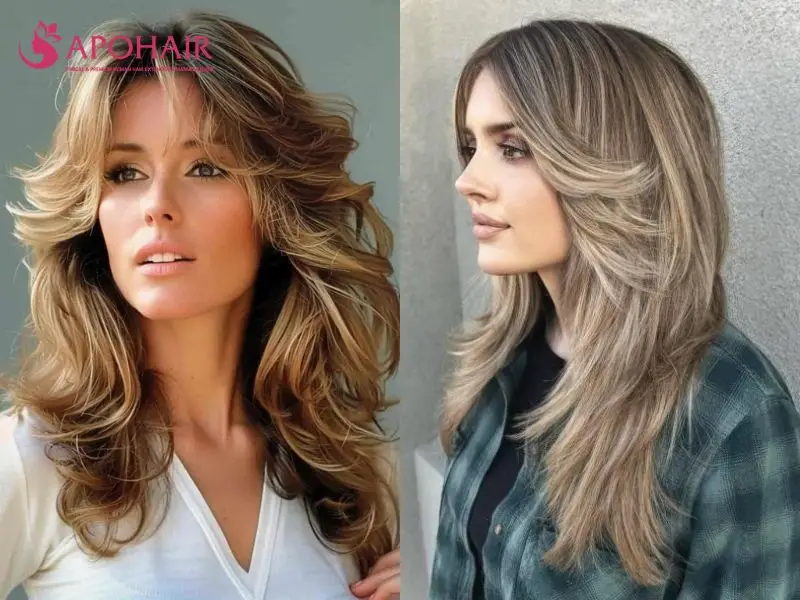
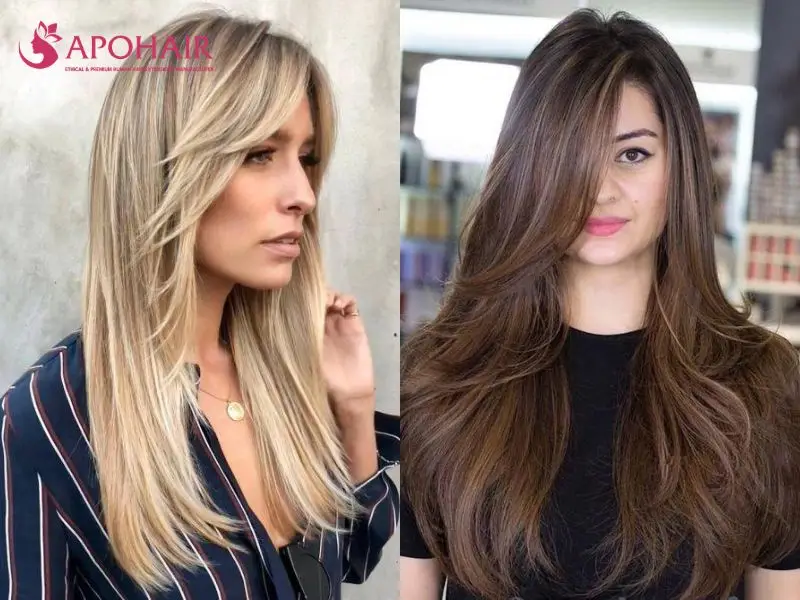
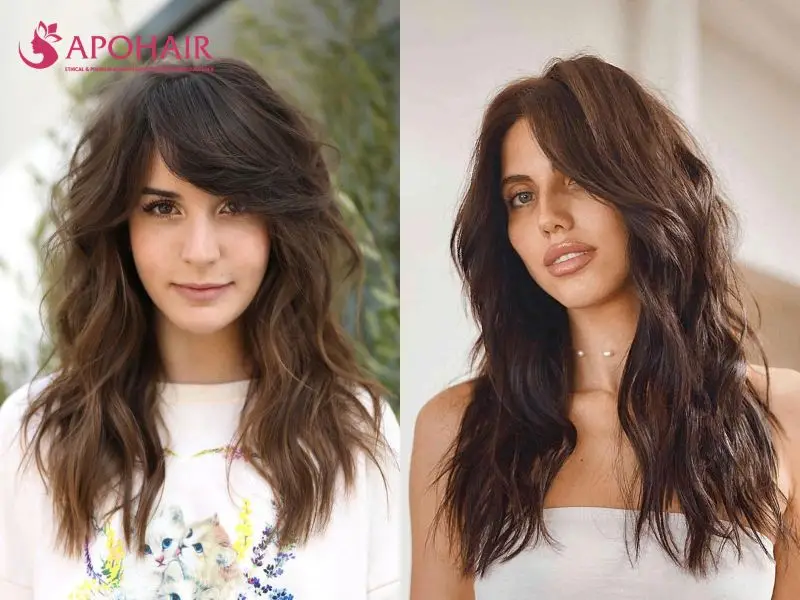

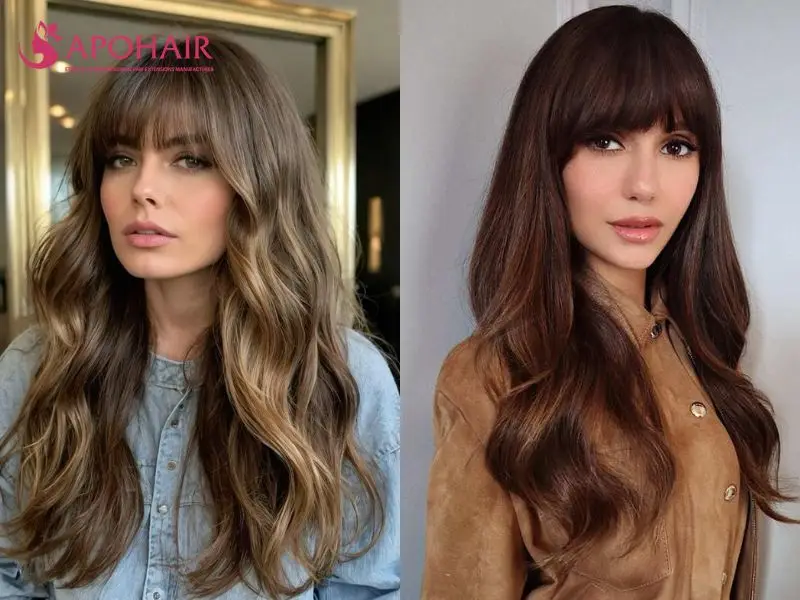
What Makes A Hairstyle Flattering On A Long Face?
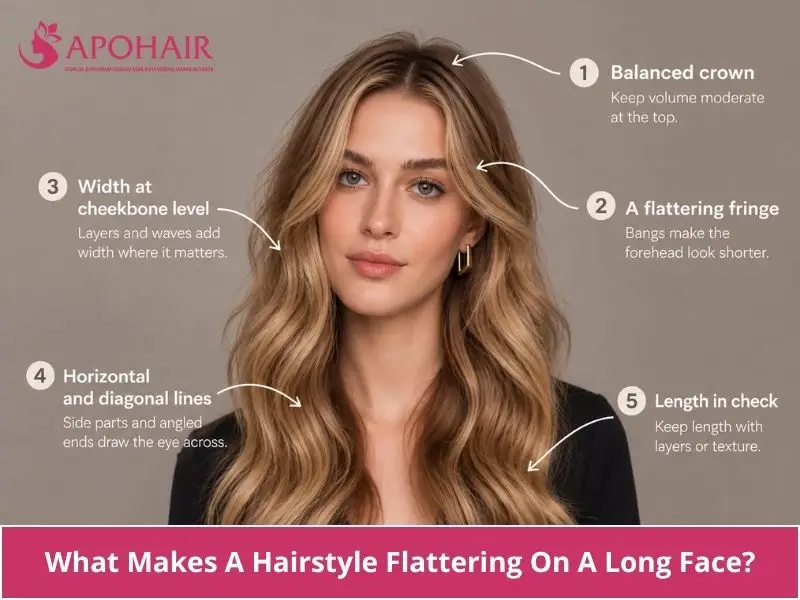
A cut flattens a long face when it moves volume sideways and shortens the visible run from hairline to chin. Five mechanisms do that, and every look in this guide uses at least two.
- Width at cheekbone level. Layers, waves and curls that expand horizontally at the mid-face are the single most effective correction available, because they widen the exact line the face is narrowest across.
- A fringe that shortens the forehead. Bangs cut away the visible upper third. Curtain bangs suit almost any length; side-swept versions handle a tall forehead best, and a blunt fringe gives maximum coverage.
- Restraint at the crown. Height on top extends the face further. Root volume stays moderate and shifts to the sides instead.
- Horizontal and diagonal lines. Side parts, angled perimeters and flipped-out ends pull the eye across rather than down.
- Length kept in check. Length works, but only with layers or texture. One solid curtain of hair stretches the proportions it hangs beside.
One clarification worth making early, because it decides which advice applies to you. A long face and a rectangular face share the same proportions, and the difference is the jaw: a long face curves softly at the jawline, while a rectangular face corners off with visible angles. Everything below is written for the rounded version.
Medium-Length Hairstyles For A Long Face That Widen The Mid-Face
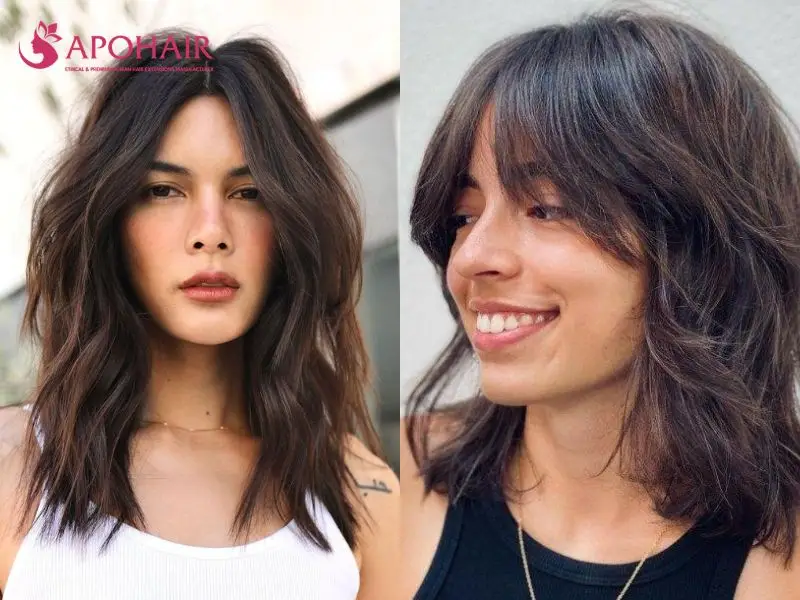
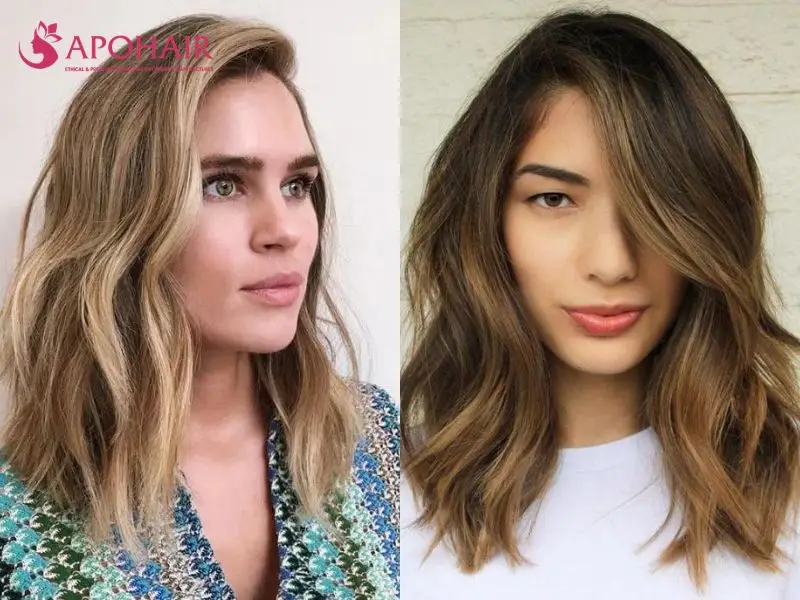
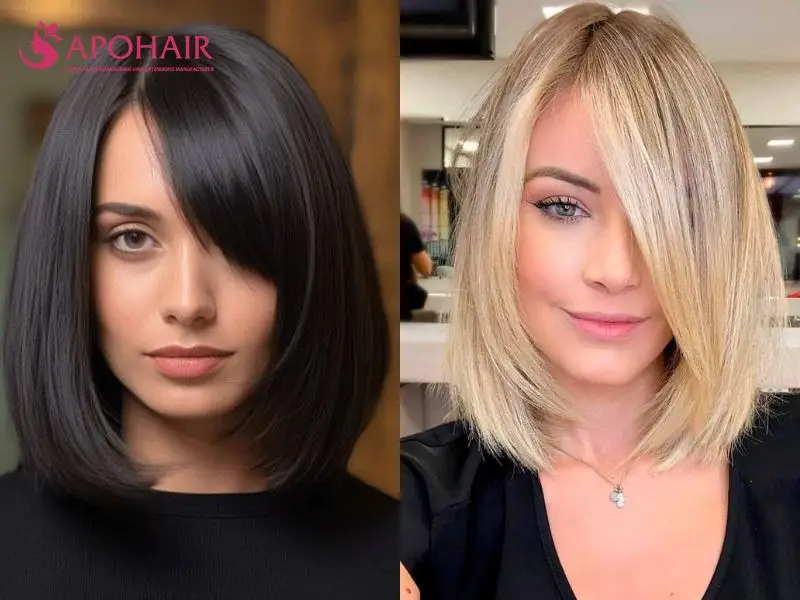
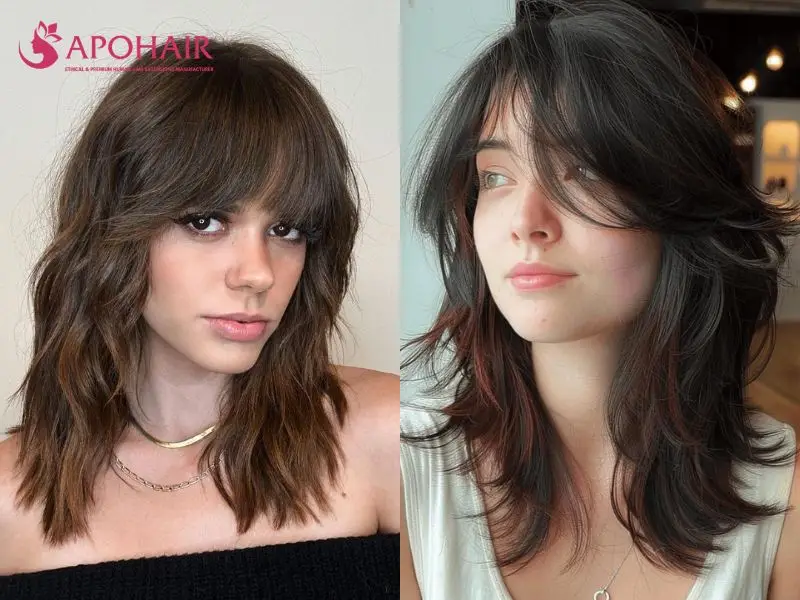
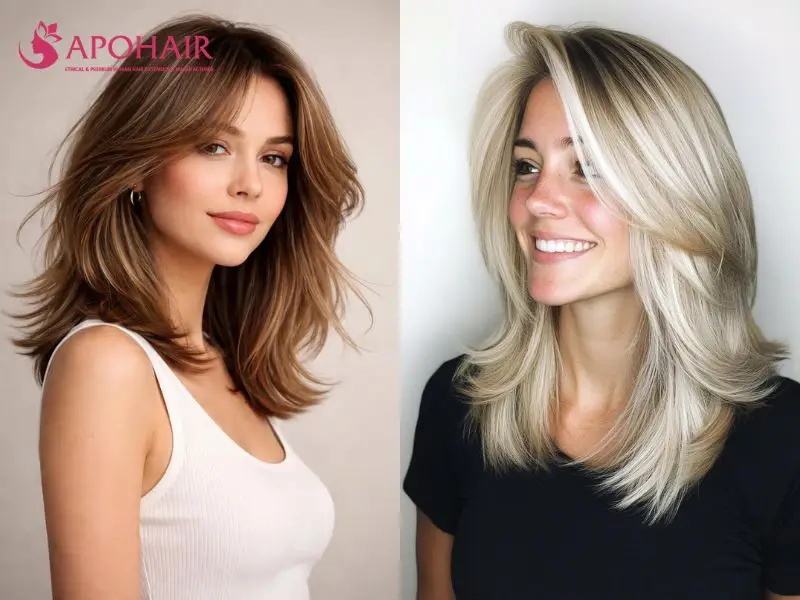
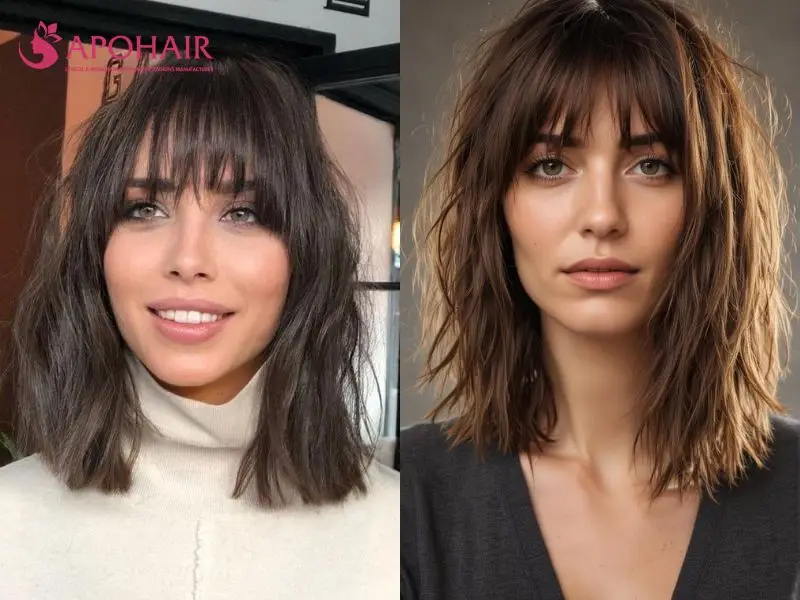
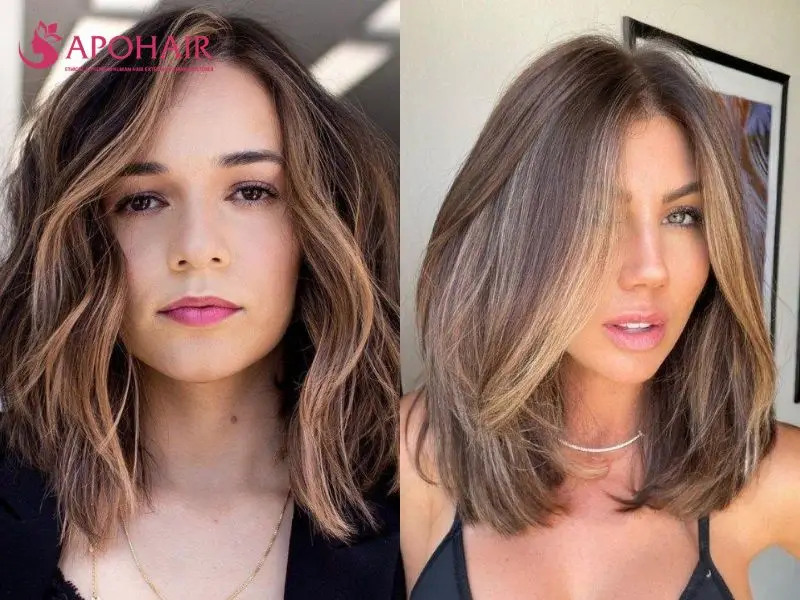
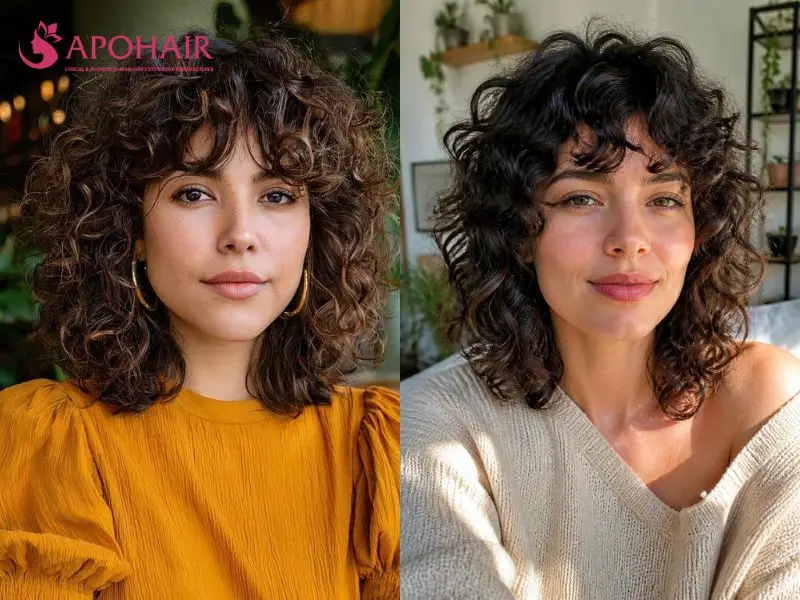
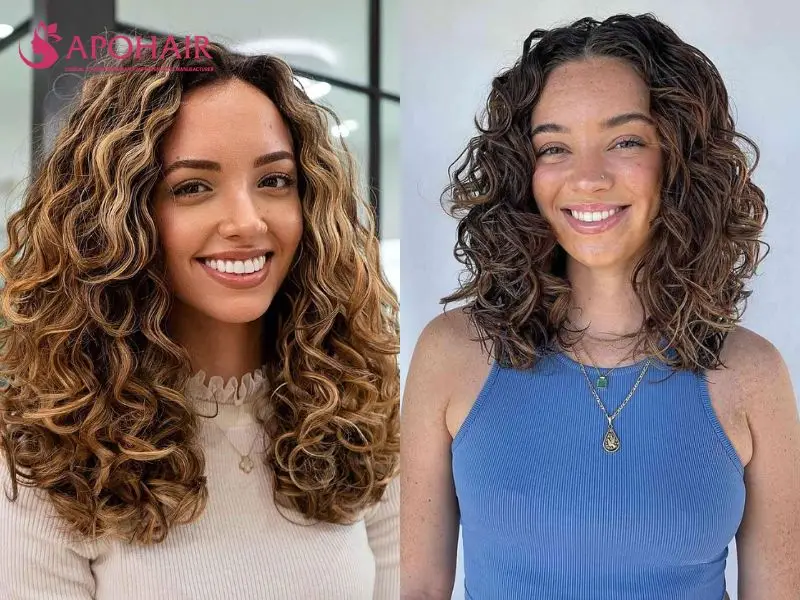
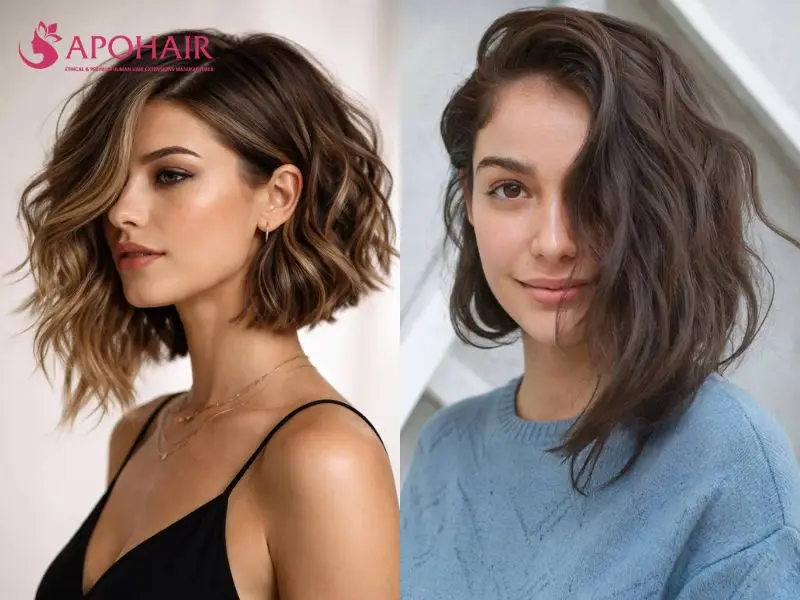
Medium length sits in the natural sweet spot here, since anything falling between the jaw and the collarbone lands right where width does the most good. The shag, wolf cut and feathered layers push volume outward at the cheekbones; the curtain and blunt-fringe lobs work on the forehead instead; the deep side part and the soft face-framing lob attack the vertical line; and the two curly cuts let the texture do the widening on its own. What ties them together is that none of them ask for height on top.
1. Collarbone-Length Shag
A textured mid-length cut with choppy ends and distinct face-framing pieces. Heavy layering fans the hair outward at the cheekbones, so the eye travels sideways instead of tracing the length of the face, which makes it the most effective width builder in this bracket.
- Best on: flat cheeks that need width without a blow-dryer.
- Texture: Type 1B to 2C (straight to strong wave).
- Density: medium; fine hair loses too much bulk under this much layering.
- Stylist note: Pair curtain bangs with heavily razor-cut layers and keep the ends wispy rather than blocky.
- Upkeep: low, trim every 8 to 10 weeks.
Why it works: A collarbone-length shag’s heavy, razor-cut layers fan outward at the cheekbones, so the eye travels sideways instead of following the face vertically, which adds width through the midface and balances a long face’s length.
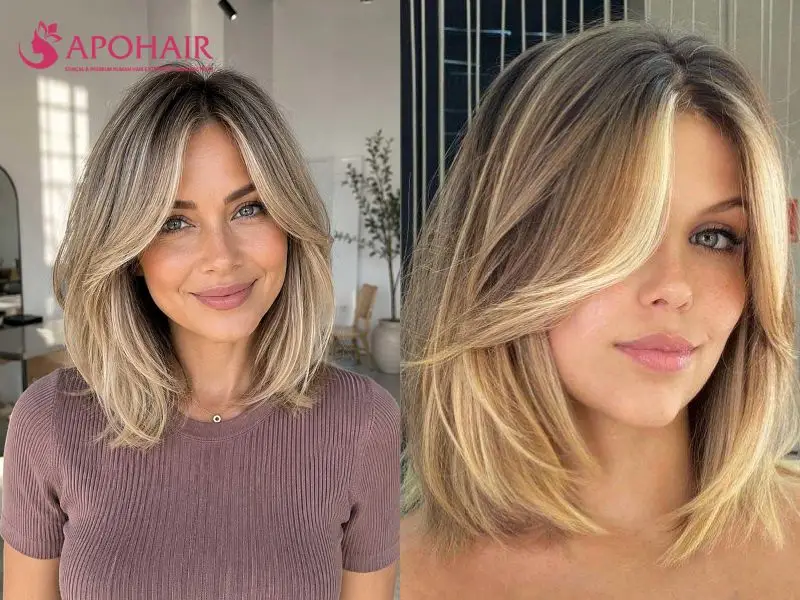
2. Layered Lob With Curtain Bangs
A long bob with a center-split fringe and soft interior layers. The fringe covers the upper forehead while the layers break the drop from cheek to shoulder into stages, so the face reads in sections rather than one continuous run.
- Best on: a high forehead, on almost any hair type.
- Texture: Type 1A to 3B (straight through springy curl).
- Density: any.
- Stylist note: Position the bangs to hit precisely at the cheekbone and sweep them outward into the face-framing layers.
- Upkeep: medium; the fringe wants a daily round-brush.
Why it works: A layered lob’s center-split curtain bangs cover part of the upper forehead while cheekbone-length pieces flow into soft layers toward the shoulders, so the eye reads the face in sections rather than one continuous vertical line, which makes a long face appear shorter and more balanced.
3. Wavy Midi With A Deep Side Part
Mid-length hair set in flowing waves from a part placed well off-center. The asymmetry breaks the face’s vertical center line, and the waves build horizontal volume around the cheekbones at the same time.
- Best on: a prominent nose sitting on the center line.
- Texture: Type 1B to 2C (straight to strong wave).
- Density: medium to thick.
- Stylist note: Build long invisible layers so the waves stack outward without collapsing the baseline.
- Upkeep: high, a wand or hot rollers every wash.
Why it works: A wavy midi’s deep side part disrupts the face’s vertical center line while flowing waves widen the cheekbone area, so the eye moves diagonally and sideways, which makes a long face appear shorter and more balanced.
4. Blunt Midi With Side-Swept Bangs
A structured collarbone cut with thick blunt ends and a heavy sweeping fringe. The side sweep draws a diagonal across the forehead while the blunt hem anchors weight at the collarbone, so the upper and lower thirds get corrected at once.
- Best on: a tall forehead above a narrow jaw.
- Texture: Type 1A to 1C (fine to coarse straight).
- Density: thick, fine hair cannot hold a blunt hem.
- Stylist note: Cut the ends at zero elevation to keep maximum thickness at the perimeter, and part the fringe deeply.
- Upkeep: low for thick hair; the rigid shape holds itself.
Why it works: A blunt midi’s side-swept bangs draw a diagonal across the forehead while its thick, collarbone-length hem adds weight below, so the cut shortens the upper third and broadens a narrow jaw, balancing a long face at both ends.
5. Medium Wolf Cut
An edgy hybrid with chunky bangs, short heavily textured top layers and tapered wispy ends. Volume gathers right at cheekbone height while the fringe cuts the forehead, which shifts the proportions harder than anything else at this length.
- Best on: a long face that has not responded to gentler cuts.
- Texture: Type 1C to 2C (coarse straight to strong wave).
- Density: medium to thick; thin hair goes stringy at the tapered ends.
- Stylist note: Cut distinct disconnected layers at the crown for lift, then blend the heavy bangs into the textured sides.
- Upkeep: low, styling cream for the piecey texture.
Why it works: A medium wolf cut’s chunky bangs interrupt the forehead while its short, textured layers concentrate volume at the cheekbones, so the eye moves across rather than down the face, which makes a long face appear shorter and wider.
6. Feathered Mid-Length Layers
A retro cut with soft layers starting at the cheekbones and flipping outward as they fall. The outward motion creates width and fullness exactly where the face reads flattest, and the movement keeps the silhouette from hanging straight.
- Best on: fine flat hair with no natural width at the cheek.
- Texture: Type 1A to 1B (fine to medium straight).
- Density: fine; the layering manufactures volume the hair does not have.
- Stylist note: Texturize the face-framing pieces aggressively so they flip out under a round brush instead of falling forward.
- Upkeep: high, daily blow-dry.
Why it works: Feathered mid-length layers begin at the cheekbones and flip outward as they fall, so the eye follows the hair sideways instead of down, which adds fullness through the midface and makes a long face appear wider and more balanced.
7. Textured Lob With Blunt Bangs
A long bob with messy pieced-out interior texture under a stark straight-across fringe. The blunt fringe conceals the upper third of the face while the undone body adds width through the middle, and the contrast between the two keeps the cut from reading severe.
- Best on: a very tall forehead you want covered outright.
- Texture: Type 1B to 2B (straight to defined wave).
- Density: medium.
- Stylist note: Razor-cut the body for the undone finish, then switch to sharp scissors for the fringe. The two need different tools.
- Upkeep: Medium; trim the fringe every 3 to 4 weeks.
Why it works: A textured lob’s blunt bangs conceal the upper forehead while its piecey interior texture builds width through the midface, so the eye reads a shorter, broader silhouette, which balances a long face without making the cut appear severe.
8. Soft Layered Lob With Face-Framing
An elegant mid-length cut with cascading layers that curve inward around the face. The face-framing pieces cut across the vertical drop while keeping enough body to soften the outline, and it is the most universally safe cut in this guide.
- Best on: anyone who wants the safest option on this shape.
- Texture: Type 1A to 3A (straight through loose curl).
- Density: any.
- Stylist note: Slide-cut the layers starting around the nose and blend them down to the collarbone, avoiding any hard step.
- Upkeep: low, air-dries or blow-dries equally well.
Why it works: A soft layered lob’s face-framing pieces curve inward from the nose to the collarbone, so they interrupt the face’s vertical drop while preserving fullness at the sides, which softens the outline and makes a long face appear shorter and more balanced.
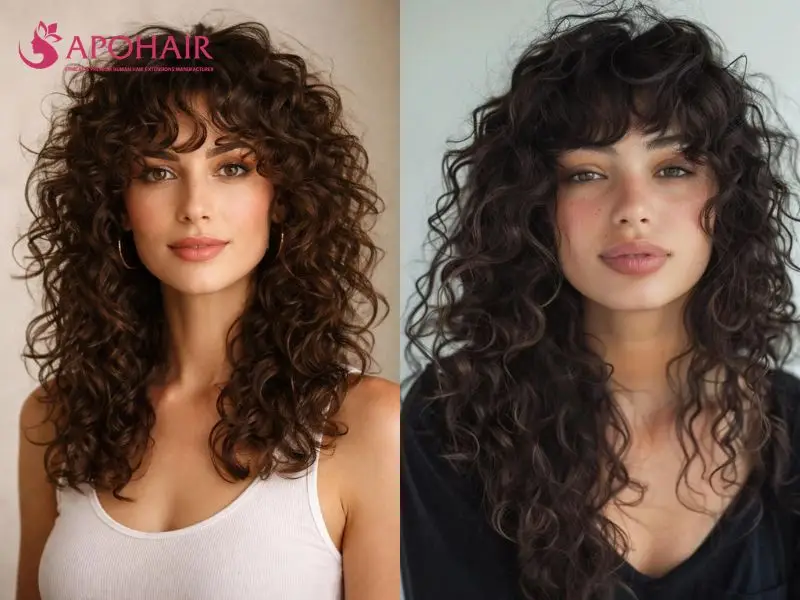
9. Medium Curly Shag With Bangs
A layered mid-length curly cut with voluminous fringe. Curly bangs shorten the face at the top while the layers let the curl expand sideways at the cheekbones, so the natural texture supplies the width instead of a styling tool.
- Best on: a high forehead on naturally curly hair.
- Texture: Type 2C to 3B (strong wave to springy curl).
- Density: medium to thick.
- Stylist note: Cut the bangs longer when wet. Curl shrinkage will take them well above the intended line once they dry.
- Upkeep: low, a high-moisture routine and air-dry.
Why it works: A medium curly shag’s voluminous bangs shorten the forehead while layered curls expand outward at the cheekbones, so the eye follows the hair sideways instead of vertically, which adds natural width and makes a long face appear shorter and more balanced.
10. Voluminous Curly Midi Cut
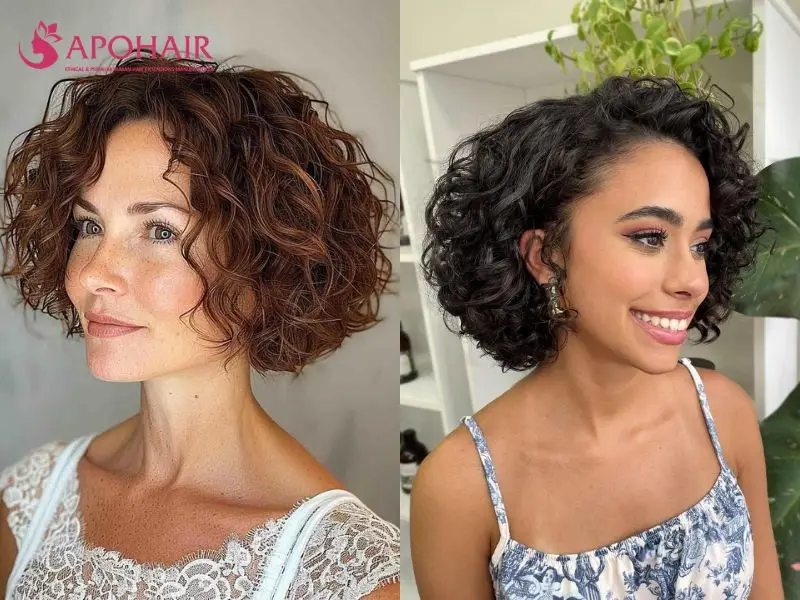
A shoulder-grazing cut shaped for thick natural curl, with the perimeter rounded into a U and the interior layered to let each curl sit apart. The curl mass spreads outward at cheek and jaw level rather than hanging down, which does the widening work with no heat at all.
- Best on: a narrow jaw that curl volume can fill out.
- Texture: Type 3A to 4A (loose curl to soft coil).
- Density: thick.
- Stylist note: Shape the perimeter into a U to prevent a boxy bottom, and cut the layers dry so the horizontal spread is visible as you go.
- Upkeep: low, wet detangle and air-dry.
Cutting shorter than the jaw removes the length entirely, which is a more direct correction than adding width to it.
Why it works: A voluminous curly midi’s rounded perimeter and separated interior layers let curls expand at the cheeks and jaw instead of hanging vertically, so the added horizontal volume broadens the lower face and balances its length without heat styling.
Short Hairstyles For A Long Face That Stop At The Cheekbone
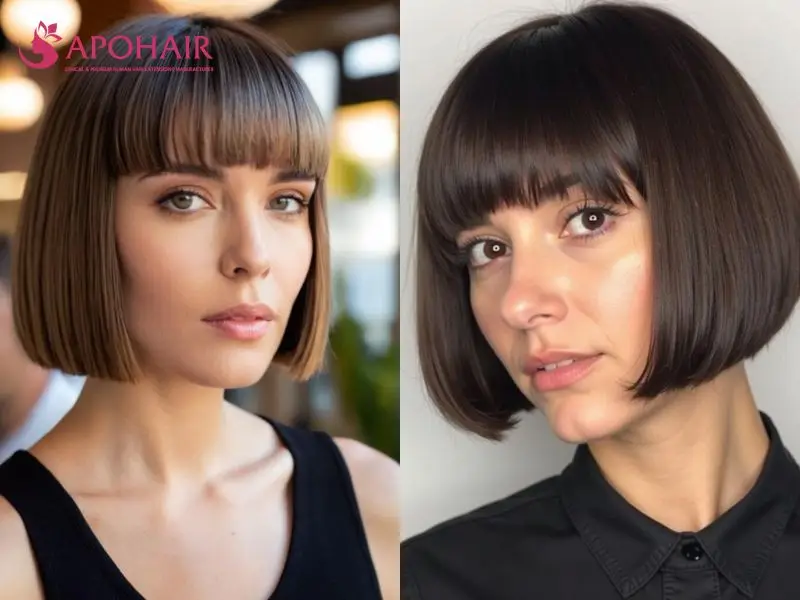
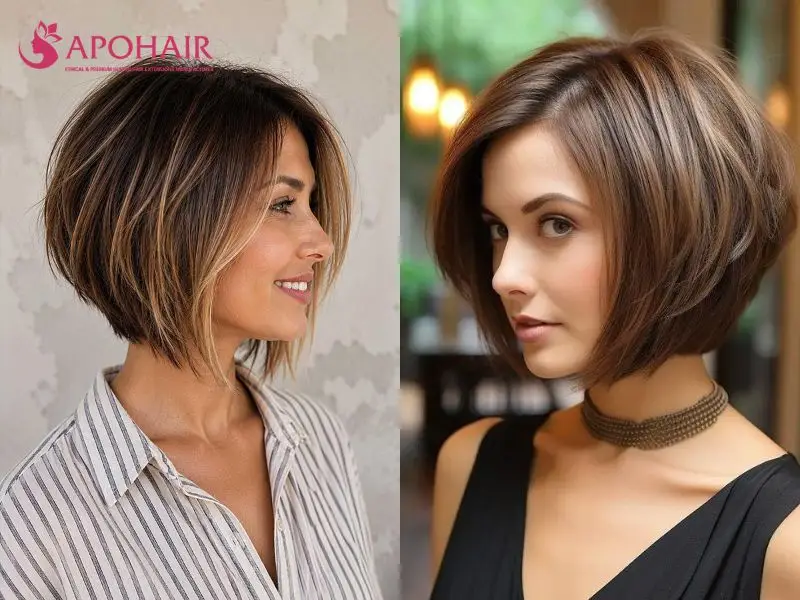
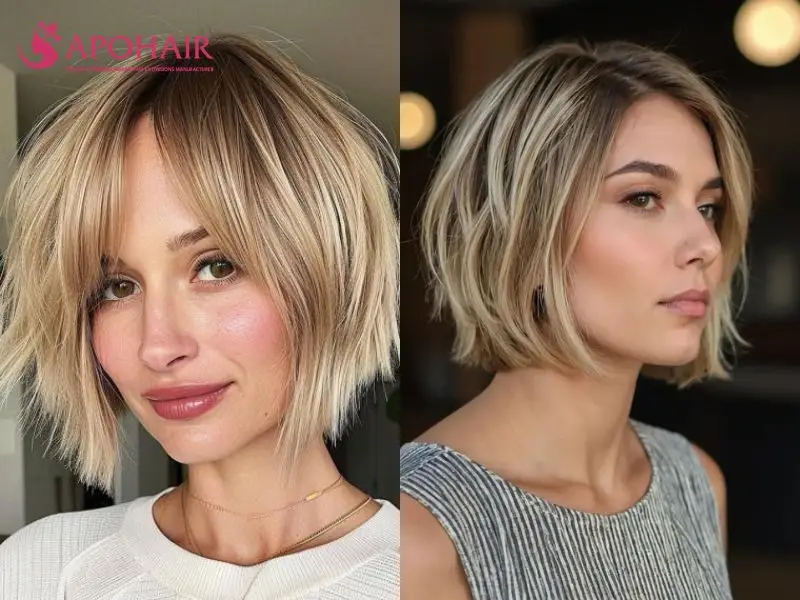
Short cuts work by ending the face early: a hem at or above the jaw stops the eye before it finishes the vertical run. The French bob and micro-bob use the hem itself, the blunt and A-line bobs add weight at the jaw, the wavy and curly bobs widen through texture, and the two short cuts with fringe handle the forehead. The failure mode here is the same every time: a short cut with no fringe and no side volume.
11. Classic French Bob With Bangs
A chin-length cut with sharp blunt ends under a straight-across fringe. The fringe covers the forehead and the blunt hem draws a firm horizontal at the jaw, so the face is bracketed top and bottom and reads noticeably shorter.
- Best on: a long neck and a tall forehead together.
- Texture: Type 1A to 1B (fine to medium straight).
- Density: fine to medium; coarse hair fights the smooth finish.
- Stylist note: Cut it precise and unlayered, with the fringe resting just above the eyebrows.
- Upkeep: medium, trim every 4 to 6 weeks.
Why it works: A classic French bob’s straight-across bangs cover the forehead while its blunt, chin-length hem forms a horizontal line at the jaw, so the face is bracketed at both ends, which makes a long face appear noticeably shorter and more balanced.
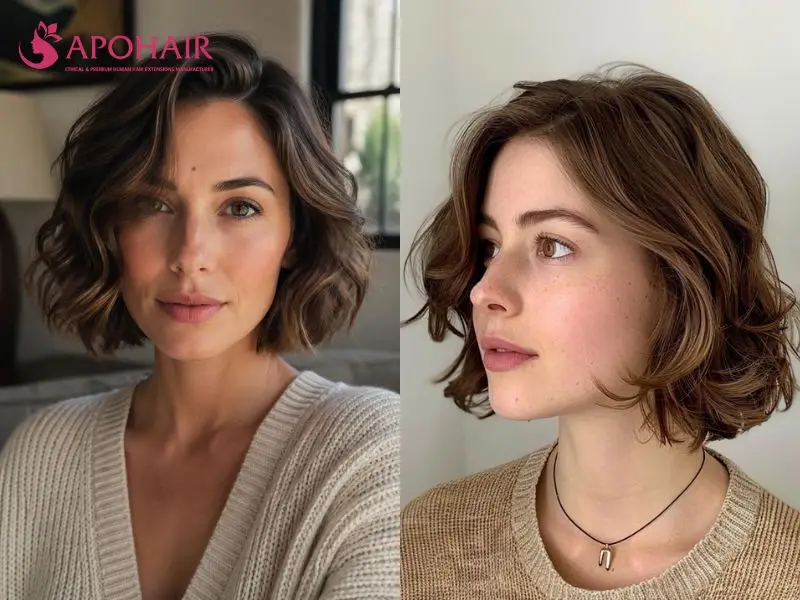
12. Textured Wavy Bob
A relaxed bob falling just below the chin with tousled textured waves. The waves introduce horizontal volume right at the cheekbones, and because the texture is cut in rather than styled in, the width survives a wash-and-go morning.
- Best on: flat cheeks and a morning with no styling time.
- Texture: Type 2A to 2C (loose to strong wave).
- Density: medium.
- Stylist note: Point-cut or razor the ends to remove bulk and build the internal movement that lets the wave form on its own.
- Upkeep: low, texturizing spray and scrunch.
Why it works: A textured wavy bob’s tousled waves expand outward at the cheekbones while its length stops below the chin, so the eye follows the added width instead of the face’s vertical line, which makes a long face appear broader and more balanced.
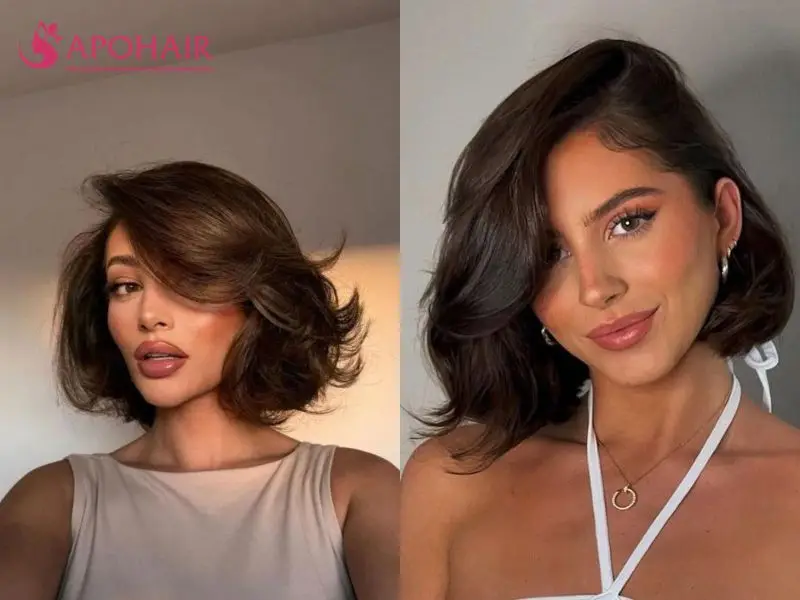
13. Voluminous Jaw-Length Bob
A blowout-style bob resting exactly at jaw length with a dramatic deep side part. Volume gathers at the jawline where the face tapers, rounding out the lower third and shortening the overall silhouette.
- Best on: a narrow jaw that needs filling out.
- Texture: Type 1A to 1C (fine to coarse straight).
- Density: medium to thick.
- Stylist note: Build invisible internal layers for root lift while keeping the blunt baseline intact.
- Upkeep: high, a round-brush blowout after every wash.
Why it works: A voluminous jaw-length bob’s deep side part creates asymmetry while its rounded blowout concentrates fullness where the face tapers, so the lower third appears wider and the eye stops at the jaw, which makes a long face look shorter and more balanced.
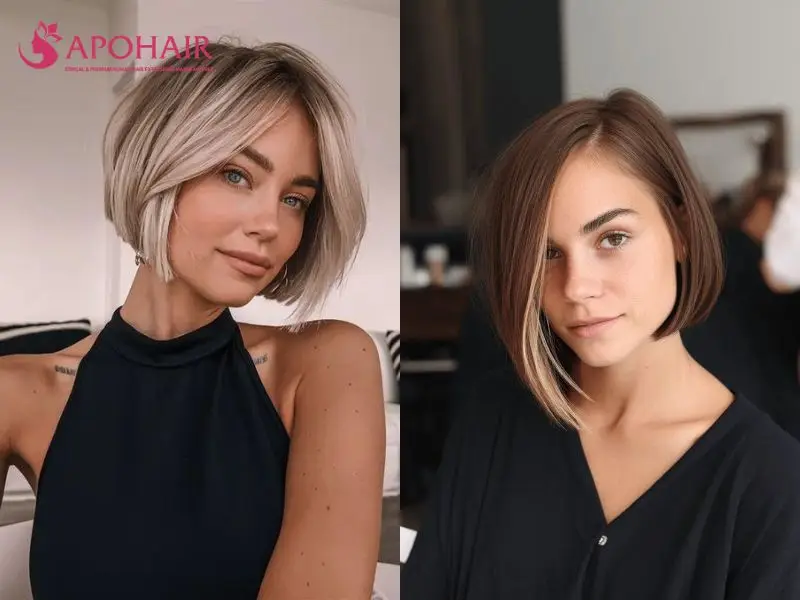
14. Blunt Bob With Side-Swept Bangs
A structured bob cut straight across, paired with a heavy side fringe. The diagonal fringe interrupts the vertical length, while the blunt ends concentrate weight at the jaw, adding width where the face needs it most.
- Best on: a tall forehead with thick hair.
- Texture: Type 1A to 1C (fine to coarse straight).
- Density: thick.
- Stylist note: Blend the heavy side fringe into the length, and thin the interior subtly if the hair runs thick.
- Upkeep: medium, thinning appointment every 6 to 8 weeks.
Why it works: A blunt bob’s heavy side-swept fringe draws a diagonal across the forehead while its straight ends concentrate weight at the jaw, so the eye moves sideways and the lower face appears wider, balancing a long face at both ends.
15. Asymmetrical Wavy Bob
A bob cut shorter at the back and longer toward the front, finished with soft waves. The uneven perimeter forces the eye side to side rather than up and down, and the waves fill out the mid-face while it travels.
- Best on: a symmetrical narrow face.
- Texture: Type 2A to 2B (loose to defined wave).
- Density: medium.
- Stylist note: Keep the A-line angle subtle so the back and front connect, and leave enough front length to curl.
- Upkeep: Medium; trim every 6 weeks to prevent an awkward grow-out.
Why it works: An asymmetrical bob’s uneven perimeter directs the eye from side to side while soft waves expand around the cheekbones, so the cut interrupts vertical length and adds midface width, making a long face appear shorter and more balanced.
16. Layered A-Line Bob
A geometric cut with stacked layers at the back angling down toward the chin. Stacking removes bulk from the back and pushes it forward to the jawline, building structured width across the lower face.
- Best on: coarse hair that needs weight removed from the back.
- Texture: Type 1B to 1C (medium to coarse straight).
- Density: thick, fine hair lets the stacked layers fall flat.
- Stylist note: Stack precisely at the back and set the face-framing pieces at cheekbone level for the strongest effect.
- Upkeep: medium, trim every 5 to 6 weeks.
Why it works: A layered A-line bob’s stacked back shifts volume forward toward the cheeks and jaw, so the angled silhouette builds structured width across the lower third, which balances a long face without adding unnecessary height at the crown.
17. Chin-Length Curly Bob
A bob cropped at the jawline that lets the natural curl pattern show. Curl provides side volume no cutting technique can match, and at jaw length it puts that volume exactly where a narrow face needs filling out.
- Best on: a narrow jaw on naturally curly hair.
- Texture: Type 2B to 3C (defined wave to tight corkscrew).
- Density: any.
- Stylist note: Cut on dry hair to account for shrinkage and to prevent the triangle shape that wet-cut curls produce.
- Upkeep: low to medium, curl cream and a diffuser.
Why it works: A chin-length curly bob lets natural curls expand around the cheeks and jaw, so the eye follows the hair outward instead of down, which fills a narrow lower face and balances its length with natural horizontal volume.
18. Choppy Micro-Bob
A cut cropped precisely at ear or cheekbone level with heavily textured choppy ends. It stops at the face’s widest measurement, which cuts the visible length short and maximizes width across the mid-face in a single decision.
- Best on: a long face wanting the most direct correction available.
- Texture: Type 1B to 2B (straight to defined wave).
- Density: medium to thick.
- Stylist note: Use heavy point-cutting on the ends so the micro-length reads as deliberate rather than accidental.
- Upkeep: low daily, but trim every 4 weeks to hold the length.
Why it works: A choppy micro-bob ends at the ears or cheekbones, so its short perimeter stops the eye at the face’s widest point while textured ends spread outward, which reduces visible length and maximizes width across the midface.
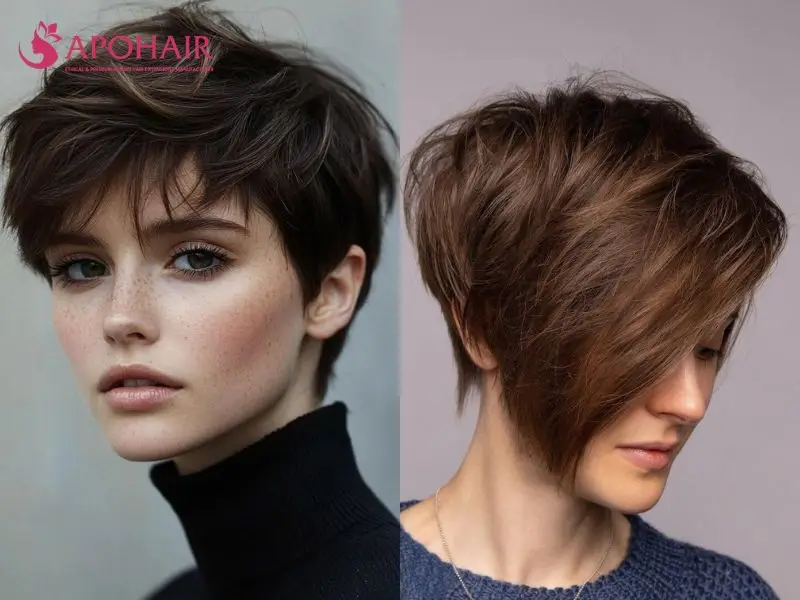
19. Shaggy Pixie With A Soft Fringe
A short layered cut with piecey texture and a soft fringe falling over the forehead. The fringe removes the tall upper third while the layers stay wide at the sides rather than lifting at the crown, which is the balance a pixie has to strike on this shape.
- Best on: a tall forehead where a full fringe would feel too heavy.
- Texture: Type 1A to 1B (fine to medium straight).
- Density: fine to medium.
- Stylist note: Keep the sides long enough to sit away from the head at the temples. Tapering them tight adds height and undoes the cut.
- Upkeep: low, a matte paste, trim every 4 to 6 weeks.
Why it works: A shaggy pixie’s soft fringe covers part of the forehead while piecey side layers stay wide at the temples, so the cut shortens the upper third without adding crown height, which balances a long face’s vertical proportions.
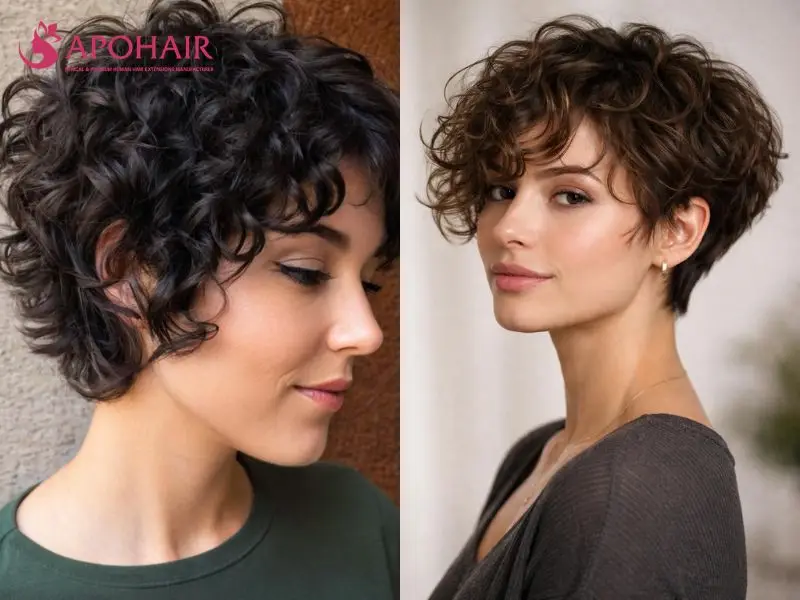
20. Curly Bixie Cut
A cut between a bob and a pixie shaped for natural curl, with the curl mass held at ear and cheek level. The width sits at the mid-face while the length stays short, so the face is both shortened and widened by the same shape.
- Best on: a narrow face on coily hair.
- Texture: Type 3A to 4A (loose curl to soft coil).
- Density: medium to thick.
- Stylist note: Cut dry and shape the sides curl by curl, keeping the weight at the temples rather than the crown.
- Upkeep: low, refresh spray, trim every 6 to 8 weeks.
Long hair carries a reputation on this face shape that is only half deserved, and the distinction is worth spelling out.
Why it works: A curly bixie holds its curl mass at ear and cheek level while keeping the overall length short, so the same shape widens the midface and reduces visible vertical length, making a long, narrow face appear more balanced.
Long Hairstyles For A Long Face That Break The Vertical Line
Long hair works here, and the myth that it does not comes from one specific scenario: pin-straight, one-length, no fringe, no layers. That combination does drag the face downward. Add any of the four corrections below and the arithmetic changes. The heavy curtain and blunt fringes handle the forehead, the butterfly cut and 70s feathering fan width out at the cheekbones, the V-cut and side-swept shag work on diagonals, and the blowout, curls and mermaid waves widen through sheer volume.
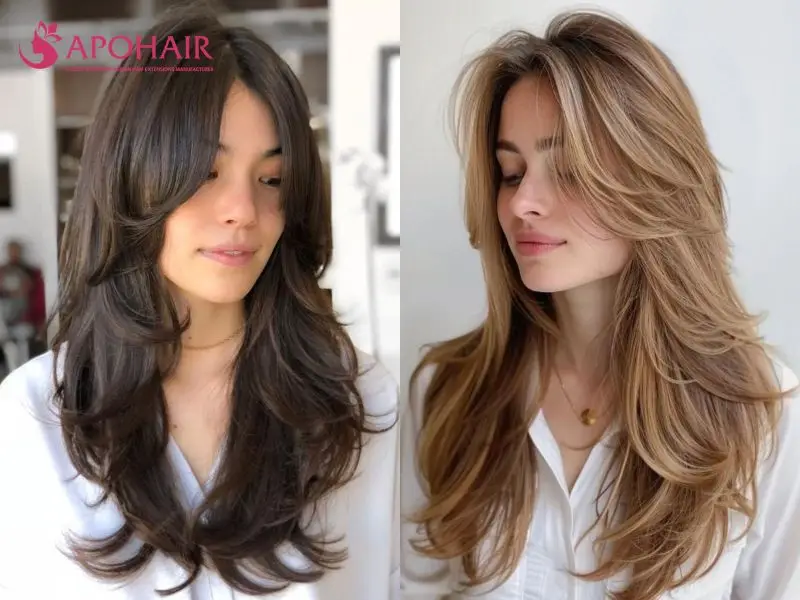
21. Long Layers With Heavy Curtain Bangs
Hair past the shoulders with cascading layers and thick face-framing curtain bangs. The fringe shortens the upper face while the layers stop the length from hanging as one weight, so the cut keeps its length without stretching the proportions.
- Best on: a tall forehead on thick hair.
- Texture: Type 1B to 2B (straight to defined wave).
- Density: thick, heavy bangs cost fine hair too much density elsewhere.
- Stylist note: Cut the curtain thick and deliberately disconnected from the main layers for maximum framing.
- Upkeep: medium, the fringe wants a daily blowout.
Why it works: Heavy curtain bangs shorten the upper face while cascading layers divide the remaining length into stages, so the hair avoids one continuous vertical drop, which lets a long face carry past-the-shoulder length without appearing further elongated.
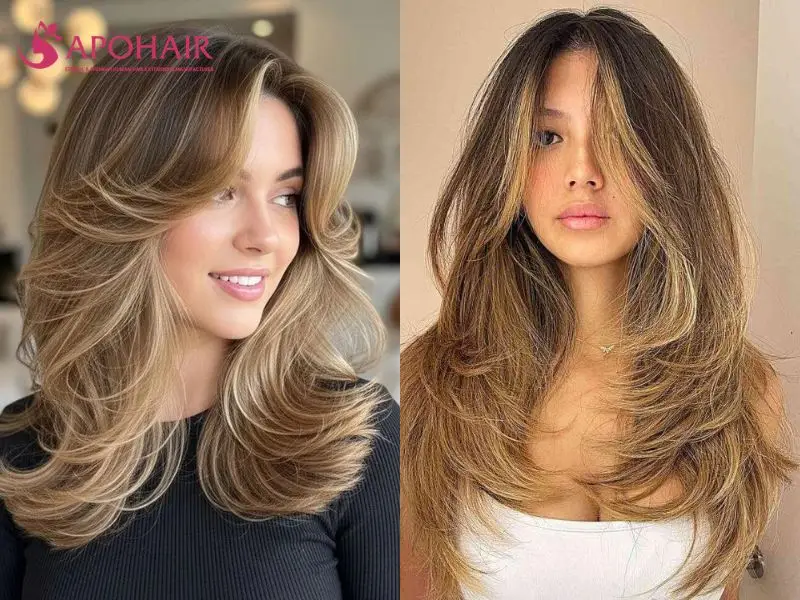
22. Face-Framing Butterfly Cut
Bouncy blowout layers that fan away from the face in two tiers. The outward-fanning shortest layers create width at the cheekbones, the most concentrated horizontal correction available at long length.
- Best on: flat cheekbones with no natural projection.
- Texture: Type 1B to 2C (straight to strong wave).
- Density: medium to thick.
- Stylist note: Set distinct chin-length face-framing layers blending into longer tiers, and keep the shortest pieces light enough to blow backward.
- Upkeep: high, the cut looks flat without heat styling.
Why it works: A butterfly cut’s shortest layers fan outward from the cheekbones before blending into longer tiers, so the eye moves sideways across the midface, which adds concentrated width and balances the vertical proportions of a long face.
23. Long Feathered 70s Cut
A retro cut with dramatic sweeping layers that flip and flow away from the face. The intense outward sweep widens the cheekbone and jaw line at once, and the movement keeps the eye from running the full length of the face.
- Best on: a narrow face wanting maximum width from the cut alone.
- Texture: Type 1A to 2A (fine straight to loose wave).
- Density: fine to medium.
- Stylist note: Layer the front sections heavily starting at the nose, keeping them light enough to hold a backward flip.
- Upkeep: high, daily round-brushing, collapses in humidity.
Why it works: A long feathered cut’s sweeping front layers flip outward from the nose through the jaw, so the eye follows their horizontal movement instead of the full hair length, which widens the midface and balances a long, narrow face.
24. Long V-Cut With Side Bangs
A sleek long cut shaped into a V at the back with long sweeping side bangs. The side fringe frames diagonally and cuts forehead height, while the V removes bulk from the front so the length does not drag.
- Best on: a tall forehead, and anyone who wears glasses.
- Texture: Type 1A to 1C (fine to coarse straight).
- Density: medium to thick.
- Stylist note: Taper steeply at the back for a pronounced V and set the side bangs at cheekbone level.
- Upkeep: low, falls into place and grows out cleanly.
Why it works: A long V-cut’s side bangs sweep diagonally across the forehead while its tapered perimeter removes weight from the front, so the style reduces upper-face height without creating a heavy vertical curtain that further elongates a long face.
25. Long Wavy Shag With Side-Swept Bangs
Heavily layered tousled waves with a soft sweeping fringe. Shaggy layers hold width through the whole length while the side bangs lay a balancing diagonal across the forehead.
- Best on: a prominent nose, with a preference for undone texture.
- Texture: Type 2A to 2C (loose to strong wave).
- Density: medium to thick.
- Stylist note: Texturize the interior extensively to encourage the natural wave, and blend the side fringe deeply into the layers.
- Upkeep: low, forgiving of an imperfect styling day.
Why it works: A long wavy shag’s side-swept bangs interrupt forehead height while its textured layers hold volume through the cheeks and sides, so the eye moves diagonally and outward, which balances the vertical length of a long face.
26. Long Layered Blowout
Voluminous rounded layers cascading through long hair. Width runs the entire length rather than sitting in one band, which stops an already narrow face from reading drawn even at maximum length.
- Best on: a long narrow face needing width down the whole profile.
- Texture: Type 1B to 1C (medium to coarse straight).
- Density: thick, fine hair drops the volume within hours.
- Stylist note: Cut long blended layers with rounded ends. Choppy layers will not hold a smooth blowout curl.
- Upkeep: high, blow-drying long thick hair takes real time.
Why it works: A long layered blowout’s rounded layers distribute volume from the cheeks through the ends, so the silhouette stays full along its entire length instead of hanging vertically, which makes a long, narrow face appear wider and more proportionate.
27. Long Wavy Hair With Straight Bangs
Long gentle waves under a wispy straight-across fringe. The fringe removes forehead height outright while the waves supply the side volume that long straight hair never produces on its own.
- Best on: fine straight hair under a tall forehead.
- Texture: Type 1A to 1B (fine to medium straight).
- Density: fine.
- Stylist note: Keep the fringe light and wispy rather than a heavy block, and add subtle interior layers so fine hair can hold a wave.
- Upkeep: high, a curling iron most days plus frequent fringe trims.
Why it works: Straight-across bangs conceal part of the forehead while gentle waves expand beside the cheeks and jaw, so the style shortens the upper third and adds horizontal volume, which prevents long hair from further stretching a long face.
28. Long Curly Shag
Heavily layered long curls with short curly fringe pieces. Layering redistributes the curl mass to the sides instead of letting it hang as a column, so the width lands at the cheeks rather than the ends.
- Best on: a narrow face on natural curls.
- Texture: Type 3A to 4A (loose curl to soft coil).
- Density: any.
- Stylist note: Perform a dry curl cut with balanced layering, keeping the curly fringe light and avoiding height at the crown.
- Upkeep: low, a consistent moisture routine.
Why it works: A long curly shag’s short fringe interrupts the forehead while balanced layers redistribute curl mass toward the cheeks and sides, so the hair expands horizontally instead of hanging as a column, which widens and shortens a long face visually.
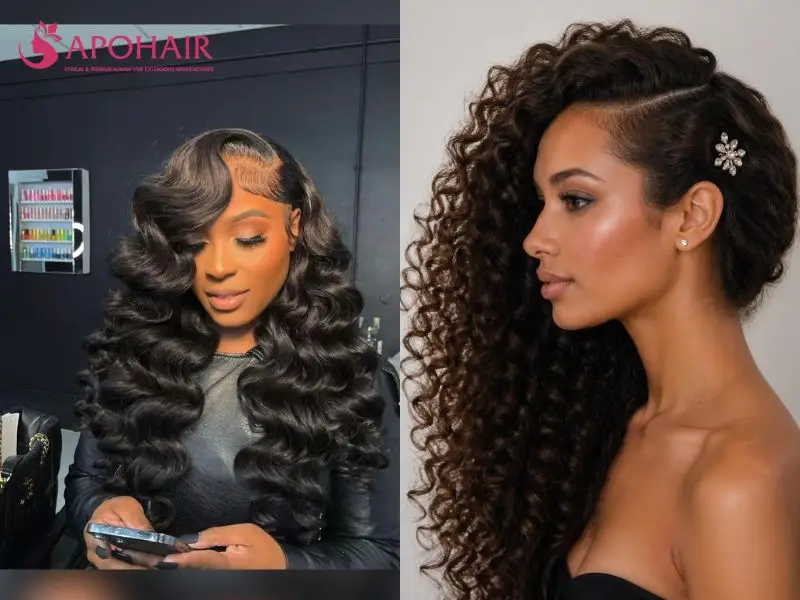
29. Voluminous Long Curls With A Side Part
Long barrel curls swept heavily to one side. The deep part breaks the face’s symmetry while the curl mass adds width down the entire profile, which makes it the strongest correction in this bracket and also the least practical.
- Best on: an evening event rather than a working week.
- Texture: Type 1B to 2B (straight to defined wave).
- Density: thick.
- Stylist note: Cut long cascading layers that hold a large barrel curl without stacking into a pyramid.
- Upkeep: high, event styling rather than a daily routine.
Why it works: A deep side part breaks the face’s vertical symmetry while long barrel curls build volume from the cheekbones downward, so the eye travels diagonally and outward, which counterbalances the length of a long, narrow face.
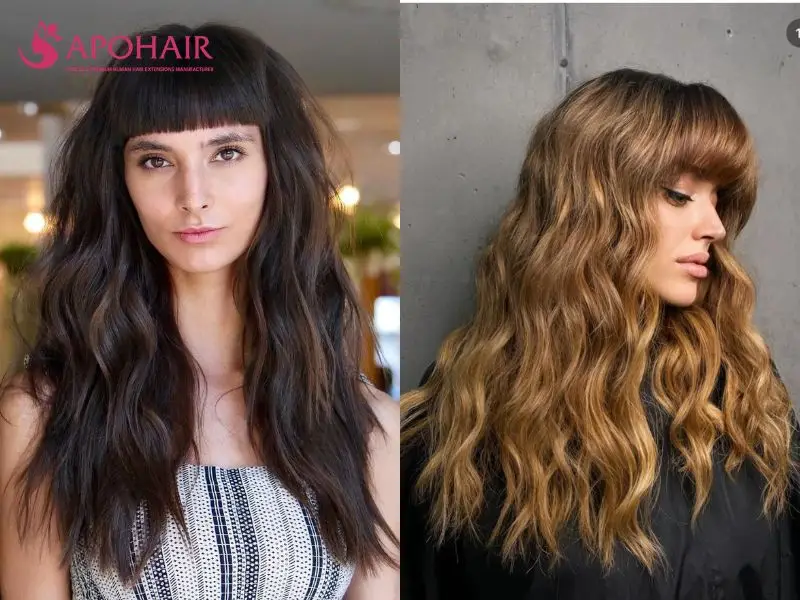
30. Long Mermaid Waves With A Full Fringe
Long crimped waves paired with a full blunt-cut fringe. Length is safe here only because two corrections run at once: the blunt fringe removes the upper third, and consistent crimped texture holds width from the cheekbones all the way down. Drop either one and the same length stretches the face instead.
- Best on: a tall forehead where a statement look is wanted.
- Texture: Type 1B to 2B (straight to defined wave).
- Density: medium to thick.
- Stylist note: Cut the fringe blunt and squarely across, with long invisible layers throughout so the heavy waves do not read as a solid block.
- Upkeep: medium, a three-barrel waver plus regular fringe trims.
Where the hair goes when it comes off the face is a separate question, and on this shape it has a hard rule attached.
Why it works: A full fringe removes visible forehead height while crimped waves maintain width from the cheekbones through the ends, so both corrections counteract the hair’s length, which lets a long face carry an extra-long style without appearing further elongated.
Best Pulled-Back Hairstyles For A Long Face
Pulling hair back exposes the full length of the face, so the rule is placement: keep everything low, and keep width at the sides. A high ponytail or top knot adds height to the exact dimension the whole guide has been trying to shorten, so skip both regardless of the occasion.
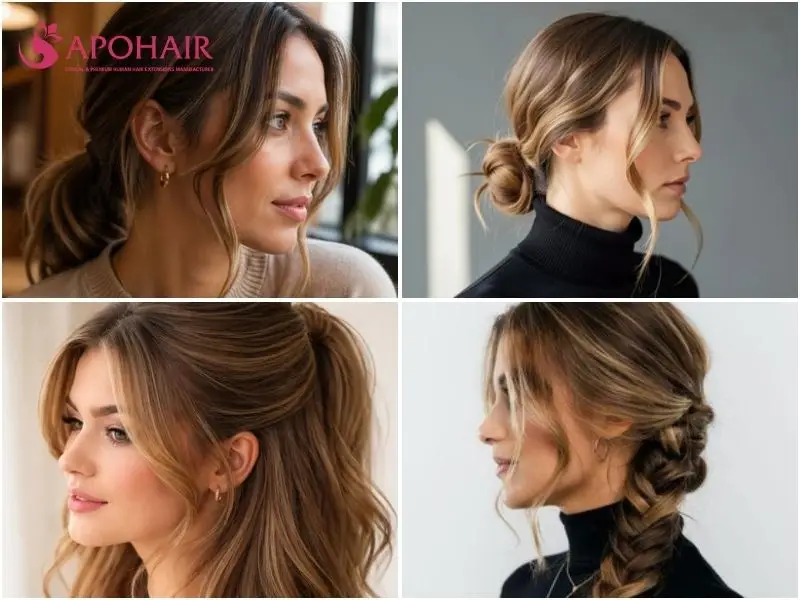
- Low ponytail at the nape. The everyday default. Set it below the occipital bone and leave two soft pieces out at the cheekbones, and it reads as a horizontal finish rather than a vertical extension.
- Low chignon sitting on the neck. The same logic with more polish, and it adds visual mass low on the head where a long face carries none.
- Half-up with volume at the sides. The option that keeps length visible: the crown stays flat, the width comes from the sections left down beside the face, and a fringe or long front pieces cover the forehead.
- Loose side braid. Sits diagonally across one side and pulls the eye off the center line. Keep it loose enough to have width, because a tight braid becomes another vertical line.
Best Special-Occasion Hairstyles For A Long Face
An occasion style carries constraints an everyday look does not. An accessory or veil has to be placed somewhere, the neckline changes the proportion between face and shoulders, the style has to survive a full evening, and it will be photographed from angles you never check in a mirror.
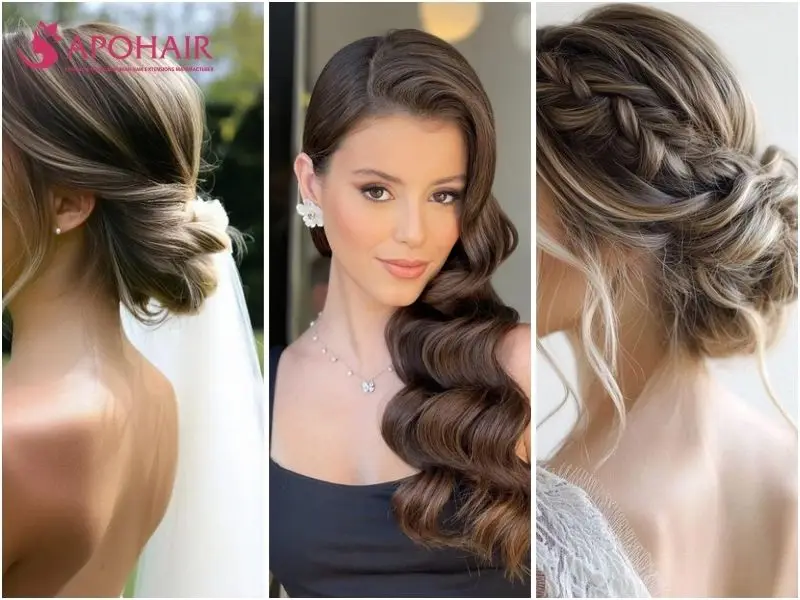
- Low chignon with side volume. The safest formal choice, and the accessory rule follows from the shape: a veil or comb pins at the nape, never at the crown. Anything mounted on top adds the height the rest of the style is working against, and it is the most common way a well-cut updo goes wrong on the day.
- Side-swept Hollywood waves. Solves the problem differently by keeping the hair down and setting the whole mass on one side, which reads as width from the front and photographs well in profile.
- Loose braided updo with width at the temples. Gives the formality of an updo while keeping volume at eye level rather than above it.
Necklines matter more than most people expect on this shape. A halter or a high neck shortens the visible run from chin to collarbone, which makes the face read less drawn. A deep V does the opposite and extends the same vertical line the hair is trying to break. If the dress is already chosen and the neckline is deep, keep a fringe or long front pieces down rather than sweeping everything back.
How To Choose The Right Hairstyle For Your Long Face?
The face shape sets the goal, and the length bracket sets the frame, but which of these 37 looks actually holds on your head depends on your own hair and features. Work through the five questions below in order. Each one narrows the list further, and the last two decide how much of the result you will actually keep up with.
What Hairstyles Suit A Long Face Over 50?
After 40 the texture changes before the shape does, and hard geometric cuts start reading harsh against skin that has lost some firmness. Soft layering delivers the same width without the severity. Past 50 the practical concern shifts to volume: medium length with body holds its shape where long heavy hair drags the whole silhouette down. Past 60, a cut that carries its own volume beats one that needs building every morning, which puts the pixie bob and the soft shag ahead of anything blow-dried.
What Are The Best Low-Maintenance Hairstyles For A Long Face?
Wash-and-go is possible on this shape, but only with cuts that produce width without heat, since a collapsed blowout leaves the face at its narrowest. The textured wavy bob, the collarbone shag and the long wavy shag all air-dry into the silhouette they were cut for. Leave the feathered layers and the long blowout to anyone who genuinely styles daily, because both of them look flat and long the moment the round brush stops.
What Hairstyles Suit A Long Face With A High Forehead?
When the upper third already runs tall, no amount of side width compensates, and the fringe stops being a style preference. Blunt bangs give the most coverage, curtain bangs the most versatility, and a wispy fringe the softest effect on fine hair. Reach for the classic French bob, the textured lob with blunt bangs, or long layers with heavy curtain bangs. Skip anything that fully exposes the hairline.
Narrowing down the right bangs for long face shape depends on stopping the fringe at the brow or cheekbone across 18 blunt, curtain, and angled side styles, while avoiding the 6 fringes that fail on a long face.
What Hairstyles Suit A Long Face With A Prominent Nose?
A prominent nose sits on the center line, and a center part draws a second line straight down to meet it. Shifting the part off-center and adding face-framing layers moves attention diagonally toward the eyes instead. The wavy midi with a deep side part, the asymmetrical wavy bob, and the long V-cut with side bangs are built around exactly that shift.
What Hairstyles Suit A Long Face With Fine, Straight Hair?
Layering only redistributes existing density, so on fine, straight hair, heavy layering removes what little width there is. Instead, you have to manufacture volume through a blunt hem that holds thickness, a wave pattern that occupies space, or a cut that builds root lift. The voluminous jaw-length bob, the voluminous curly midi and the long layered blowout all work on that principle.
If your own density will not hold a blowout or a jaw-length bob, clip-in wefts placed at the temples add side fullness without a permanent cut, and matching them to your natural texture keeps the blend invisible at the cheekbone.
Hairstyles To Avoid For A Long Face
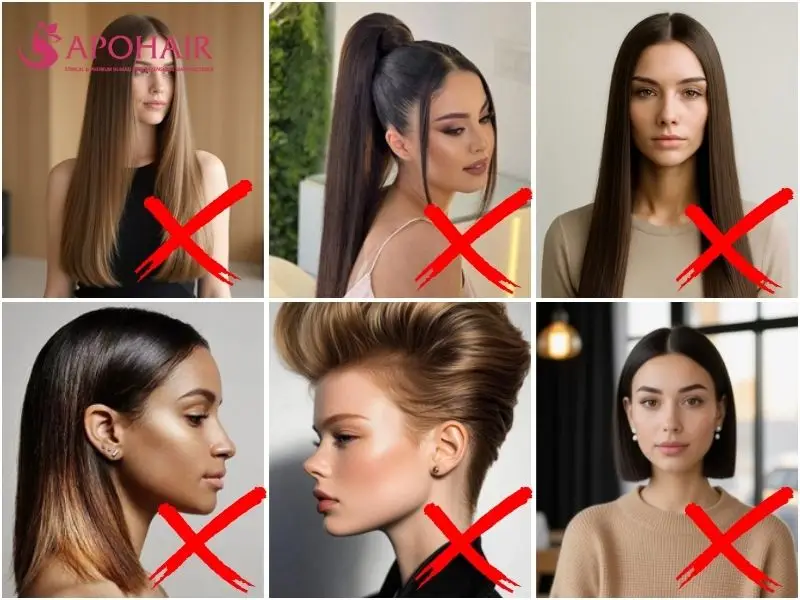
Six looks work against this shape regardless of your texture or density, and each one fails for a structural reason rather than a matter of taste.
- Very long, one-length straight hair. With no layers or waves to interrupt it, the hair hangs as two flat vertical planes beside a face that is already long, and the eye runs the full distance uninterrupted. Adding layers or a wave pattern fixes it without losing the length.
- A high ponytail or top knot. Both stack height directly above the hairline, extending the one dimension that needs shortening. A low ponytail or a nape chignon delivers the same practicality without the cost.
- A center part with no layers or fringe. It draws a hard line down the middle and splits the face into two long halves. Shifting the part off-center, or breaking it with curtain bangs, changes the whole read.
- Sleek flat sides. Hair pressed close to the head at the cheekbones removes the width the face is short of, leaving the narrowest possible silhouette on display.
- Extreme crown volume. Pompadour-style lift and heavily teased roots do to the top of the head what long one-length hair does to the bottom.
- A chin-skimming blunt cut with no width. Short alone is not enough. Cut flat to the head with no fringe and no side volume, a short cut simply exposes the full length of the face faster.
Frequently Asked Questions About Hairstyles For A Long Face
What hair length looks best on a long face?
Chin to collarbone is the most universally flattering range, because it puts the hem exactly where the face is narrowest and builds width at the jawline and cheekbones. Short pixies and long layered styles both work when paired with the right texture and a fringe. Length matters far less than whether the cut creates horizontal balance, which is why a layered long cut beats a flat short one on this shape.
Is a long face the same as an oblong face?
Yes. Long and oblong describe the same proportions, with face length noticeably greater than width and the three widths sitting close to equal. A rectangular face shares those proportions but has an angular, cornered jaw rather than a softly rounded one, and that jaw difference is what separates the two. The styling advice overlaps heavily, though a rectangular face benefits more from softening the angles while a long face benefits more from shortening the length.
Can hair extensions balance a long face shape?
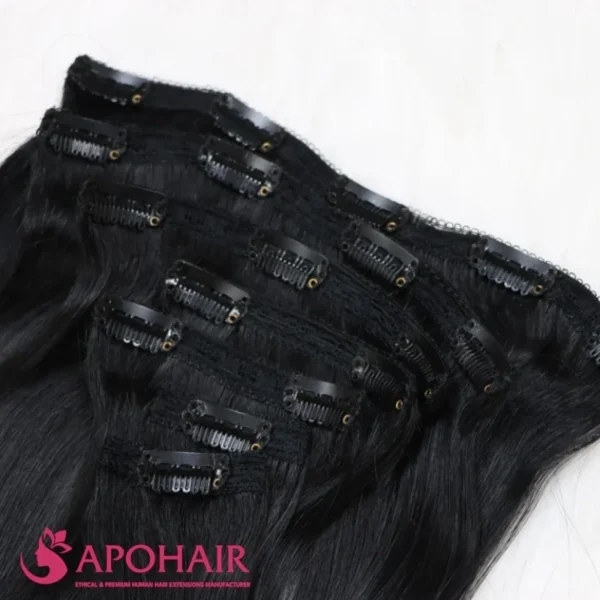
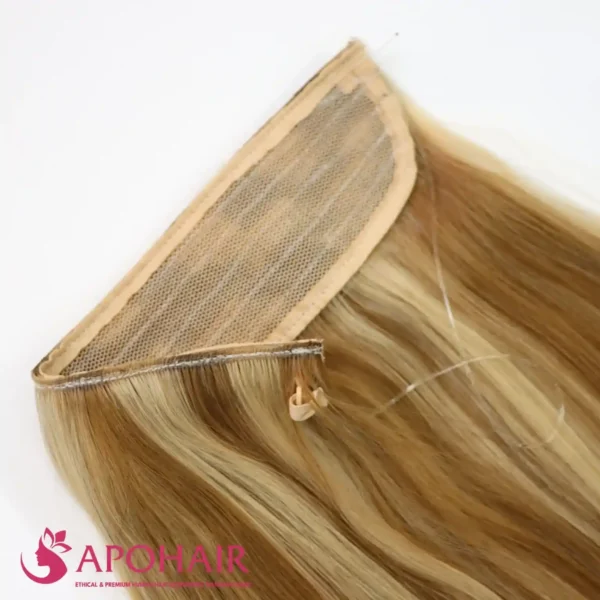
Extensions help with the two things this shape is short of, which are side volume and the density a blunt hem needs. Volumizing wefts placed at the temples widen the cheekbone line directly, and clip-in fringe pieces shorten the forehead without committing to a cut. Match the extension texture to your own, since a straight weft blended into wavy hair separates at the cheek and creates a vertical seam exactly where you wanted width.
What hairstyles suit a long face with curly hair?
Curl is an advantage on this shape, because it expands sideways at exactly the level the face is narrowest. The work is stopping it from stacking upward instead. Cut dry, keep height off the crown, and let the volume gather at the cheek and jaw. A chin-length curly bob and a long curly shag both do that, while a tall triangle of curl adds back the length you were trying to remove.
Should a long face avoid a middle part?
On flat, unlayered hair, yes, because the parting adds a vertical line to a face that already has too many. Paired with waves, layers or curtain bangs it becomes workable, since the movement supplies the width the parting takes away. If your hair is straight and one length, moving the part an inch (2.5 cm) off-center is the cheapest improvement available.
Conclusion
Every flattering cut for a long face follows the same logic: add width at the cheekbones, keep height off the crown, and use a fringe or layers to shorten the visible run from hairline to chin. Medium length carries the strongest options because it lands the hem where the face is narrowest, though both short and long work when the cut supplies width some other way.
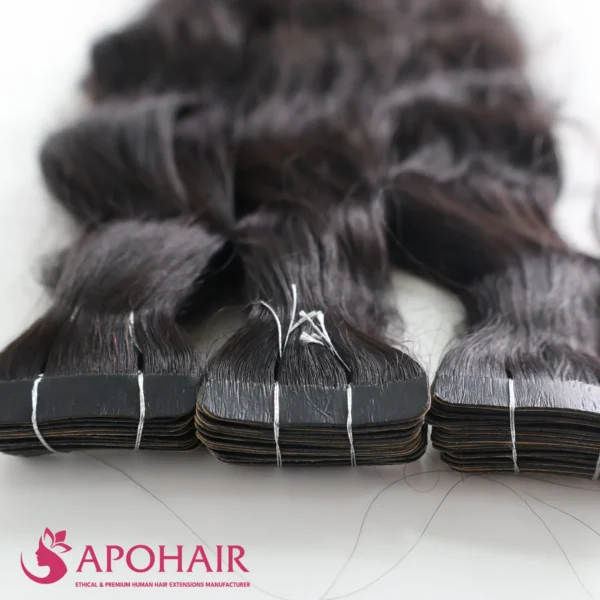
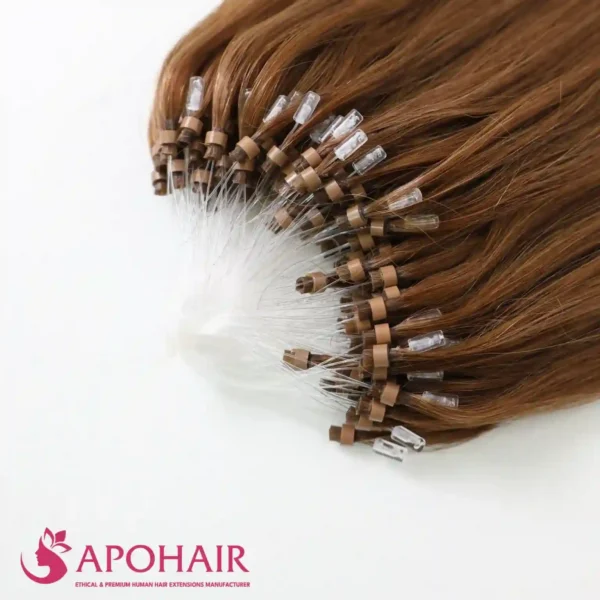
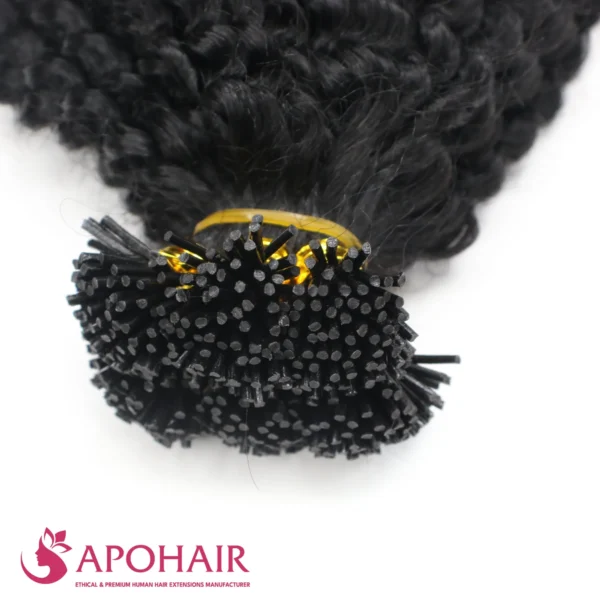
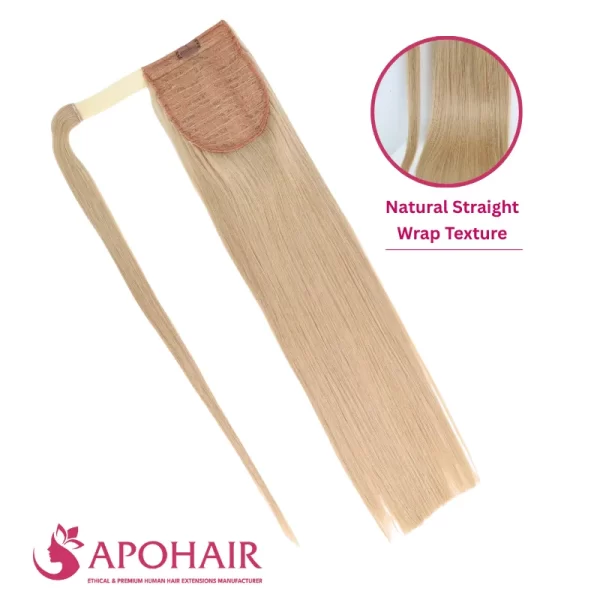
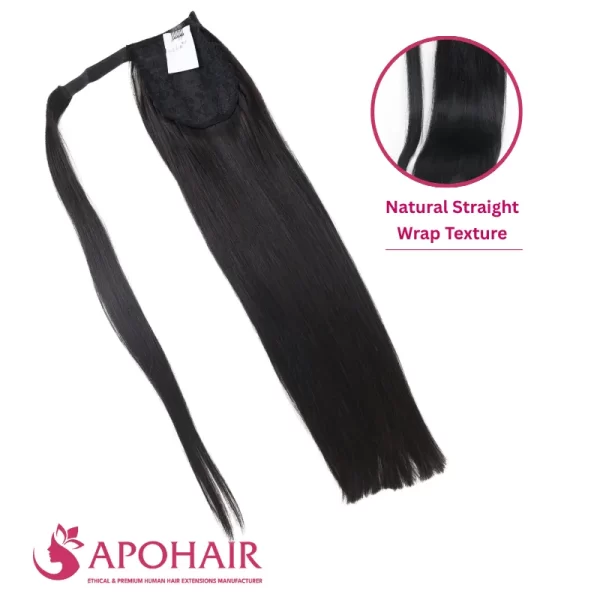
For salons building a service menu around face-shape consultations, APOHAIR supplies 100% Vietnamese human hair with the cuticle intact, in volumizing wefts and clip-in fringe pieces that blend across straight, wavy and curly textures. Factory-direct pricing and shade matching before the first order make it practical to keep a working range on hand.
Stock the side fullness this guide calls for: Every style above works by adding width at the cheekbones and jaw, and the right base material makes the difference.
Extensions for cheekbone-level width and bangs: For curtain bangs, face-framing layers, or side volume, source hair extensions wholesale from APOHAIR.
Wigs for full-look testing: Letting a client try a pixie or bob before committing to the chop? Our wigs human hair wholesale catalogue covers bases built for exactly that.
Bundles for volume-heavy curls and waves: The curly and mermaid-wave looks on this list need weight and density, which our bulk human hair bundles line delivers.
Sourcing direct from Vietnam: As a trusted source for human hair factories in Vietnam, we supply salons and distributors with factory-direct pricing on every format above.
APOHAIR – ETHICAL & PREMIUM HUMAN HAIR EXTENSIONS MANUFACTURER
- Address: Building 3A, Lane 82 Duy Tan, Cau Giay, Hanoi, Vietnam
- Factory: Yen Luong Village, Y Yen District, Nam Dinh Province, Vietnam
- WhatsApp: +84 862 132 366
- Email: [email protected]
- Website: https://apohair.com
