



37 Best Hairstyles For Women With A Diamond Face: Cuts And Styles That Widen The Forehead And Jaw
On a diamond face, the cheekbones are the widest measurement, the forehead narrows above them, and the jaw tapers to a point below, with face length running about 1.4 to 1.5 times the width. The cost is angularity: the middle dominates, and both ends look pinched. A flattering cut widens the forehead and jaw.
Below are the 37 best hairstyles for women with a diamond face: 30 cuts across medium, long and short, four pulled-back styles and three built for occasions. Each names the technique behind it, the textures it holds on and its real upkeep, and a closing list covers the cuts that expose the angles rather than balance them. By the end you will know which length bracket is yours.
What Makes A Hairstyle Flattering On A Diamond Face?
The work here is redistributing volume rather than adding it. Most other face shapes have one end that needs correcting (an oval face needs none), while a diamond has two, so a flattering cut moves fullness away from the cheekbones and out to the forehead and jaw at the same time. Four principles cover it.
- Width at the forehead. Side-swept bangs, curtain bangs and a wispy fringe all create the illusion of a wider top, countering the natural narrowing above the cheekbones.
- Volume at the jawline. Chin-length layers, flipped-out ends and jaw-level curls fill the lower taper, so the chin reads less pointed and the lower third balances the middle.
- Softening at the cheekbone line. Face-framing layers starting at cheekbone level and textured pieces break the hard horizontal of wide cheekbones rather than exposing it fully.
- Never flat, never slicked back. Any style pulled tight against the head, or lacking volume at both top and bottom, puts the raw geometry on display and exaggerates every angle.
The forehead is the half of the face that stylists name most directly. “Side-swept or curtain bangs soften a narrow forehead and add balance,” says celebrity hairstylist Hayley Heckmann, who adds that “soft layers balance sharp cheekbones and add width in the right places.”
These four apply at every length, which is why the same handful of techniques keeps reappearing below in different combinations. Rihanna, Vanessa Hudgens and Scarlett Johansson all read as diamonds, and the versatility in how they wear their hair comes from that redistribution logic rather than from any single cut.
Medium-Length Hairstyles For A Diamond Face That Widen The Jaw Line
Medium length is the strongest bracket here because the hem lands at or below the jaw, filling the lower taper before the cut does anything else. The angled lob, blunt lob and clavicut work through a solid or tucked hem; the shag, textured midi and butterfly cut redistribute weight away from the cheekbones; the curly lob and wavy collarbone cut use texture to fill the jaw; and the two side-parted cuts handle the narrow forehead. Most carry a fringe, a deep part or a face-framing piece, because the forehead half of the problem does not solve itself.
1. Angled Lob With Tucked Ends
A collarbone bob cut on a forward angle with the ends turned under toward the jaw. The tuck concentrates weight exactly at the taper, and the forward angle delivers more length to the front where the width is needed than to the back where it is not.
- Best on: women whose chin reads pointed from the front.
- Texture: Type 1A to 1C (fine to coarse straight).
- Density: medium to thick.
- Stylist note: Over-direct backward when cutting the perimeter, then blow the last inch under so the ends tuck in toward the jaw rather than flaring out past it.
- Upkeep: medium, a round brush most washes.
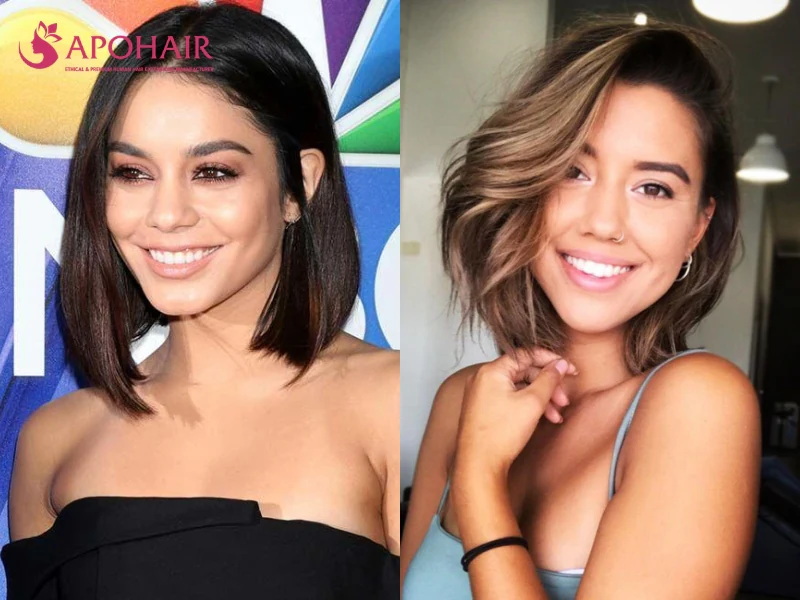
Why it works: Turning the ends under toward the jaw puts the weight right where a diamond face tapers, and the forward angle sends the extra length to the front, where the width is needed.
2. Shoulder-Length Shag With Curtain Bangs
A layered shoulder cut with a center-split fringe. The curtain widens the narrow forehead while the shag layering keeps volume off the cheekbone and spreads it downward, which covers both ends of the problem in one cut.
- Best on: a woman with a narrow forehead above prominent cheekbones.
- Texture: Type 2A to 2C (loose to strong wave).
- Density: medium to thick.
- Stylist note: Sweep the curtain outward toward the temples rather than down, since the temples are where the width has to read.
- Upkeep: low, texturizing spray and air-dry.
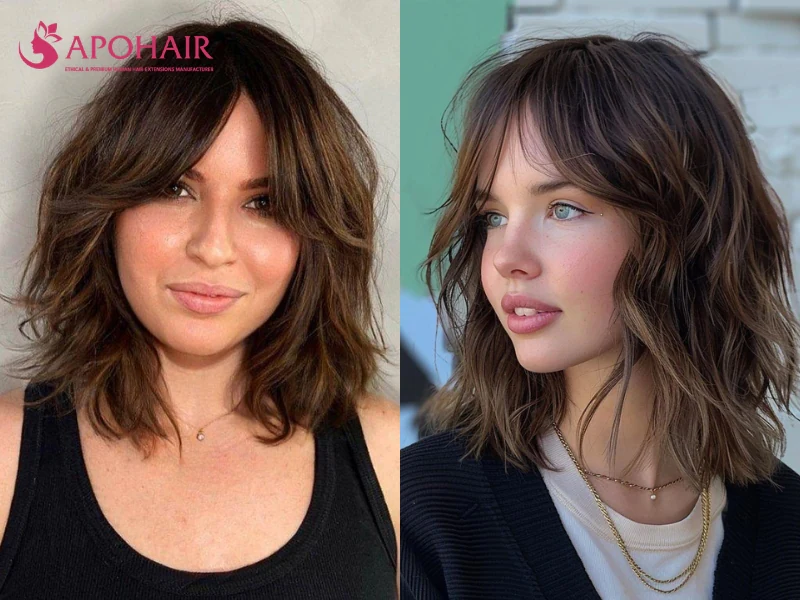
Why it works: The curtain gives women with a diamond face the forehead width they lack, while the shag layers let the volume spread downward instead of piling up at the cheekbone.
3. Blunt Lob With Curtain Bangs
A one-length collarbone cut with a soft center-split fringe. The blunt hem holds a solid block of weight below the jaw, which is the most reliable way to fill a taper on hair that will not hold a style.
- Best on: women with fine hair that loses its shape by mid-afternoon.
- Texture: Type 1A to 1C (fine to coarse straight).
- Density: fine to medium.
- Stylist note: Cut at zero elevation and leave the ends heavy. Texturizing the hem removes the weight the cut exists for.
- Upkeep: low, flat iron the ends, trim every 6 to 8 weeks.
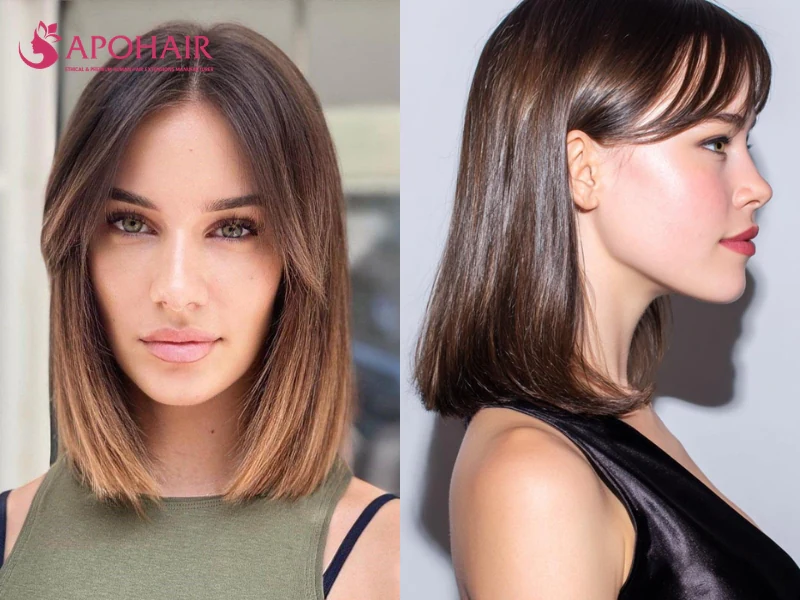
Why it works: A solid, heavy hem holds weight below the jaw even when the hair will not hold a style, which is the most reliable way to fill the lower taper of a diamond face.
4. Side-Parted Lob With Face-Framing Layers
A collarbone bob from a deep side part with layers starting at cheekbone level. The deep part throws hair across the narrow forehead while the layers break the cheekbone line instead of exposing it.
- Best on: female clients whose cheekbones read as the only feature in a photograph.
- Texture: Type 1A to 2B (straight to defined wave).
- Density: medium.
- Stylist note: Start the face-framing at the cheekbone and not above it, since a layer at the temple removes the forehead width you were building.
- Upkeep: medium, a round brush for the front sections.
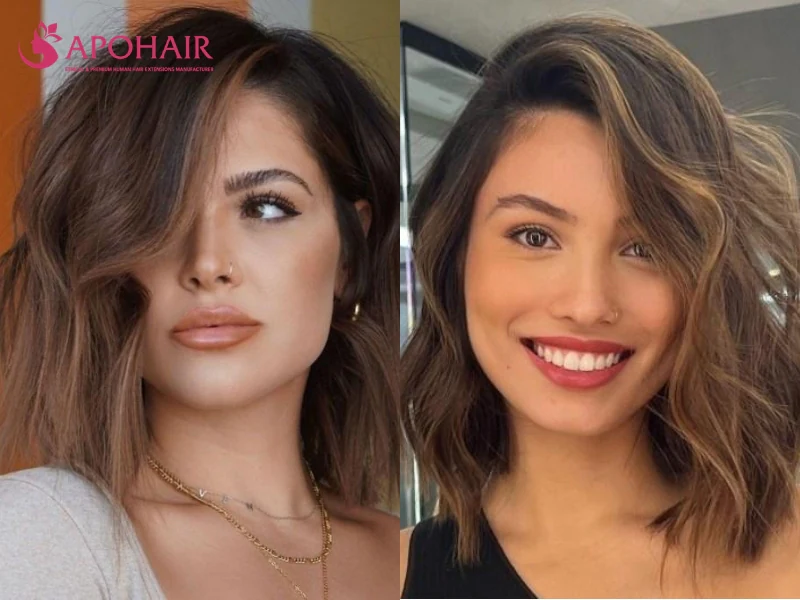
Why it works: The deep part throws hair across the narrow forehead, and layers that begin at the cheekbone break up a line a diamond face would otherwise show off in full.
5. Wavy Collarbone Cut With A Soft Fringe
A collarbone-length wavy cut under a light fringe. The wave adds body at the jaw while the fringe covers the forehead, and the softness of both keeps the cut from adding structure to a face that already has plenty.
- Best on: ladies with angular features that read hard in a sharp cut.
- Texture: Type 1B to 2C (straight to strong wave).
- Density: any.
- Stylist note: Wave from the cheekbone down only, leaving the top section smooth so no volume builds at the widest point.
- Upkeep: low, a wand every second wash.
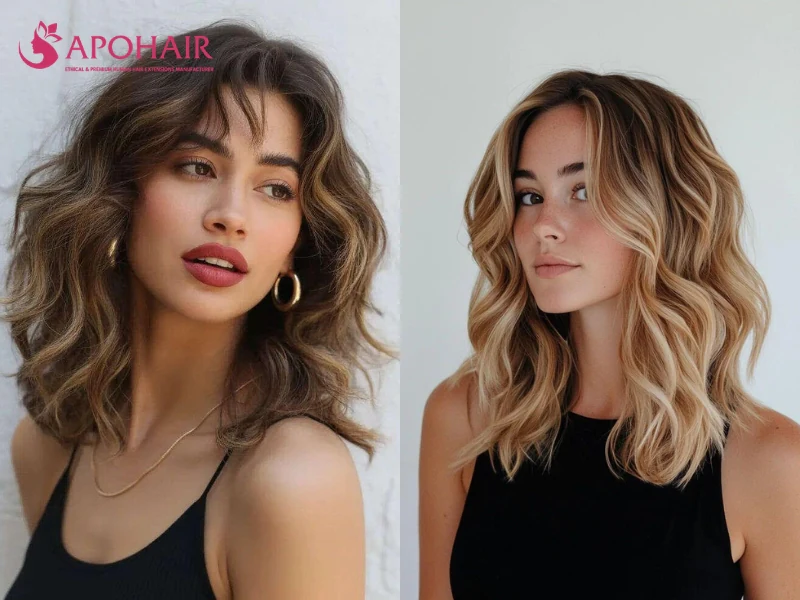
Why it works: Soft waves add body at the jaw and a light fringe covers the forehead, so nothing in the cut adds structure to a diamond face that already has plenty.
6. Curly Lob With Jaw-Length Layers
A collarbone-length curly cut with the shortest layers set at jaw level. Curl at the jaw is the fullest thing this shape can put in the taper, and setting the layer there rather than higher keeps the mass off the cheekbone.
- Best on: women whose curl expands widest at the cheek.
- Texture: Type 2C to 3C (strong wave to tight corkscrew).
- Density: medium to thick.
- Stylist note: Cut dry and set the shortest curl at the jaw. A cheekbone-level curly layer widens the exact line you are softening.
- Upkeep: medium, curl cream and a diffuser.
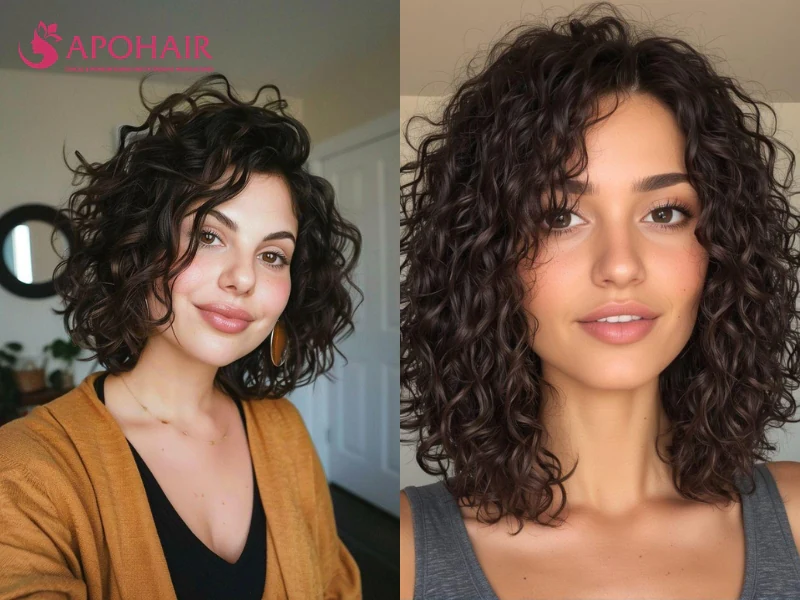
Why it works: Curl at jaw level is the fullest thing a diamond face can take in the taper, and keeping the shortest layer there stops the mass from landing on the cheekbone.
7. Textured Midi Cut With Wispy Ends
A mid-length cut with broken interior texture and light ends. The texture spreads weight through the lengths instead of letting it collect at the cheekbone, and the wispy finish keeps the silhouette from reading as a solid diamond.
- Best on: thick hair that goes wide at the cheek in a blunt cut.
- Texture: Type 1B to 2B (straight to defined wave).
- Density: thick.
- Stylist note: Texturize the interior heavily but keep the perimeter intact, so the weight leaves the middle without the hem going thin.
- Upkeep: low, texture spray and air-dry.
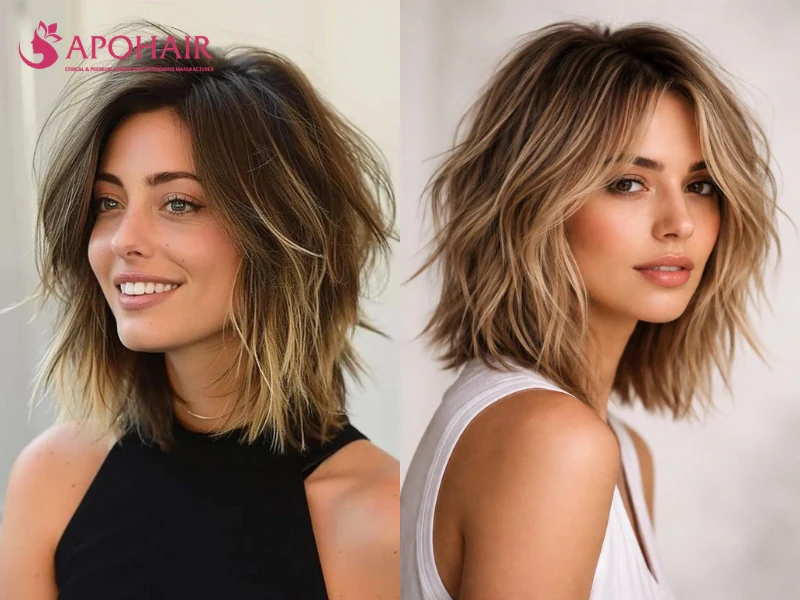
Why it works: Broken interior texture spreads the weight through the lengths instead of collecting at the cheekbone, so thick hair stops reading as a solid diamond, which many women with dense hair notice first.
8. Medium Butterfly Cut
Cheekbone-length face-framing layers disconnected from longer shoulder-length layers. The top tier softens the cheekbone line while the bottom tier carries weight to the jaw, which is the two-end correction built into a single cut.
- Best on: women with thick hair needing weight removed from the middle without losing length.
- Texture: Type 1B to 2B (straight to defined wave).
- Density: thick.
- Stylist note: Set the top tier at the cheekbone, and keep the tiers genuinely disconnected or the redistribution blends away.
- Upkeep: high, a round brush for the top tier.
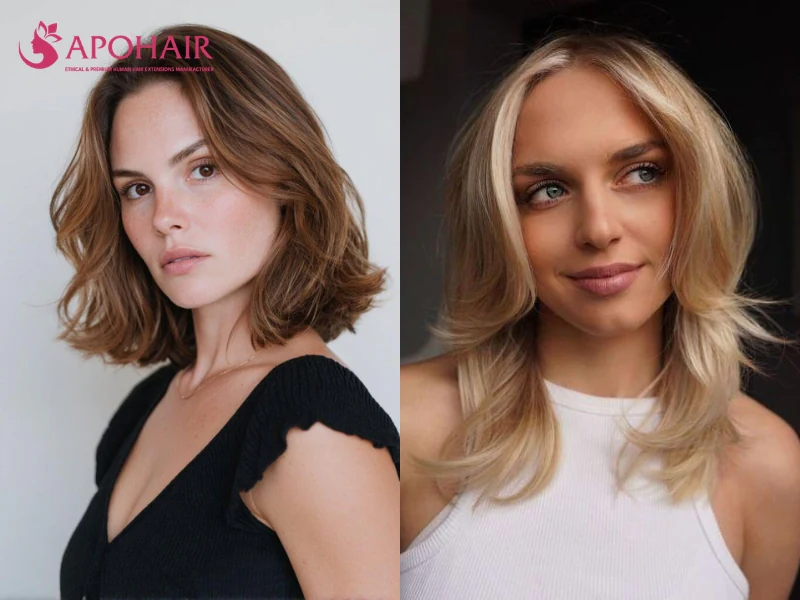
Why it works: The short top tier softens the cheekbone line while the longer tier carries weight to the jaw, a two-end correction a diamond face gets from a single cut.
9. Medium Layered Cut With A Deep Side Part
Shoulder-length layers worn from a part set well off-center. The part is the cheapest forehead-widening tool there is, since throwing hair diagonally across the top adds apparent width without a single cut being made.
- Best on: a very narrow forehead on a woman who does not want to fringe her hair.
- Texture: Type 1A to 2A (straight to loose wave).
- Density: any.
- Stylist note: Cut with the hair fallen into the finished part, and let the heavy side cross the forehead rather than sit beside it.
- Upkeep: low, a comb and root spray.
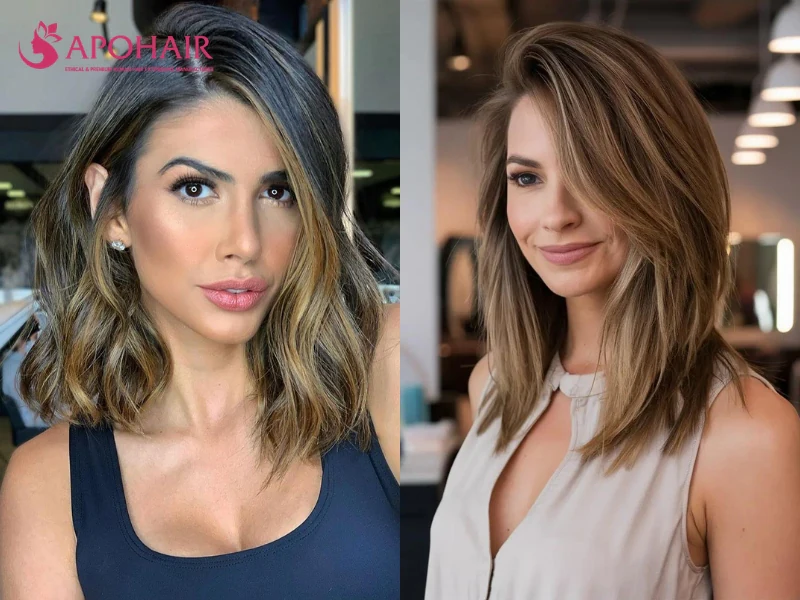
Why it works: Moving the part well off center adds apparent width to a narrow forehead without a single cut, an easy fix for a diamond face on hair you would rather not fringe.
10. Wavy Clavicut With A Blunt Micro Fringe
A collarbone cut with a short blunt fringe sitting high on the forehead. A micro fringe is one of the few blunt lines this shape can wear, because a hard horizontal high on a narrow forehead reads as width rather than as a cut-off.
- Best on: women with a narrow forehead and a hairline high enough to carry a short fringe.
- Texture: Type 1B to 2B (straight to defined wave).
- Density: medium.
- Stylist note: Cut the fringe well above the brow and keep it dense. A wispy micro fringe gives up the width the blunt version creates.
- Upkeep: high, fringe trim every 2 to 3 weeks.
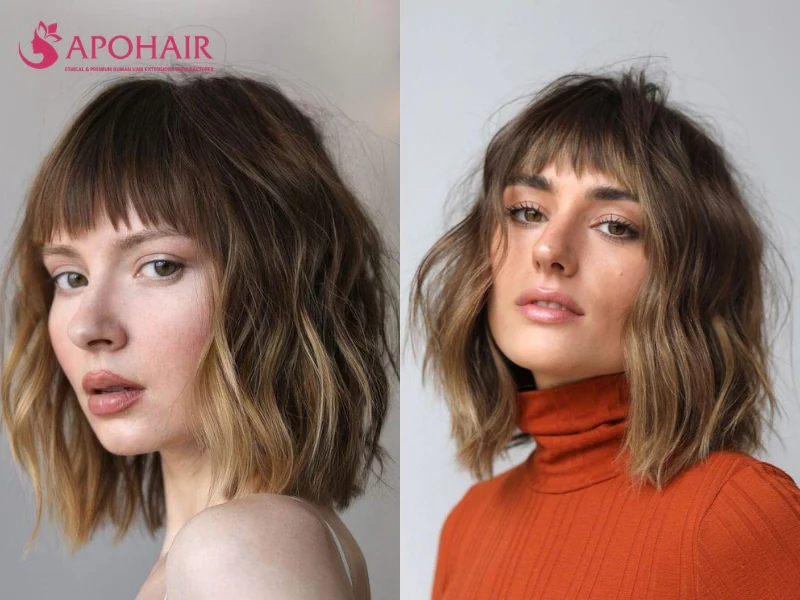
Why it works: A dense blunt fringe sitting high reads as width rather than a cut-off on the narrow forehead of a diamond face, which is why this is one of the few blunt lines it can wear.
Longer lengths handle the jaw taper differently, and they give the forehead problem more room to be solved with a fringe.
Long Hairstyles For A Diamond Face That Soften The Cheekbones
Long hair works here provided the layering starts at the cheekbone or below, since a layer cut above it pulls volume up to the widest point and sharpens everything the cut was meant to soften. The curtain-bang and blunt-fringe cuts open up the forehead; the deep side part, side sweep and side-swept shag work on diagonals; the chin-level layers and butterfly cut fill the jaw; and the curls, V-cut blowout and Hollywood waves supply mass through volume. None of them start layering at the temple.
11. Long Layers With Curtain Bangs
Long hair with cascading layers under a center-split fringe. The curtain widens the forehead while the layers carry weight down past the jaw, which makes this the most reliable long option on this shape.
- Best on: women whose long hair has gone heavy and shapeless at the cheek.
- Texture: Type 1B to 2C (straight to strong wave).
- Density: medium.
- Stylist note: Start the layers at the cheekbone and sweep the curtain outward toward the temples.
- Upkeep: medium, a daily round-brush for the fringe.
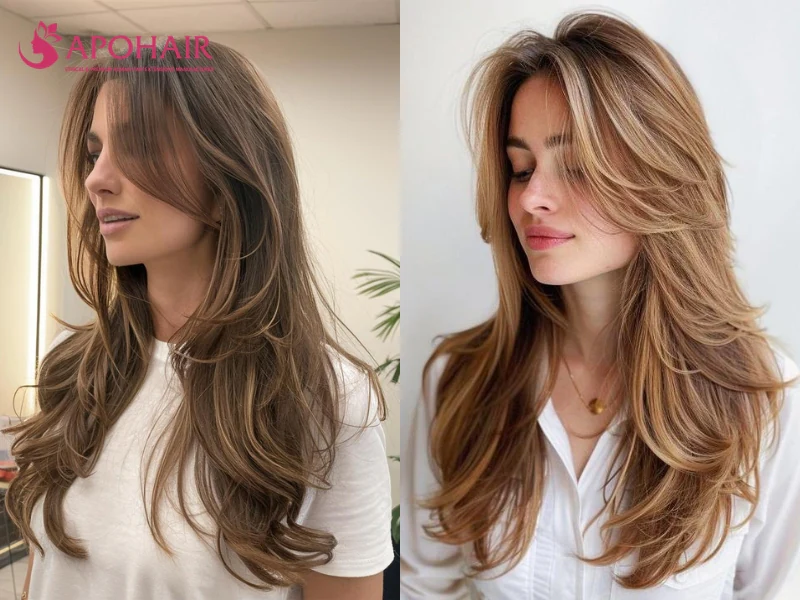
Why it works: Under the curtain the forehead widens, and the layers carry weight past the jaw, making this the most reliable long option for women with a diamond face.
12. Long Soft Waves With A Deep Side Part
Long wavy hair from a part set well off-center. The deep part covers a section of the narrow forehead and adds apparent width across the top, while the waves build volume at the jaw, so the two ends get handled without a fringe.
- Best on: a narrow forehead on a woman unwilling to cut bangs.
- Texture: Type 1B to 2C (straight to strong wave).
- Density: medium to thick.
- Stylist note: Set the part before waving, and let the waves start at the cheekbone so the volume gathers below the widest point.
- Upkeep: medium, a wand every second wash.
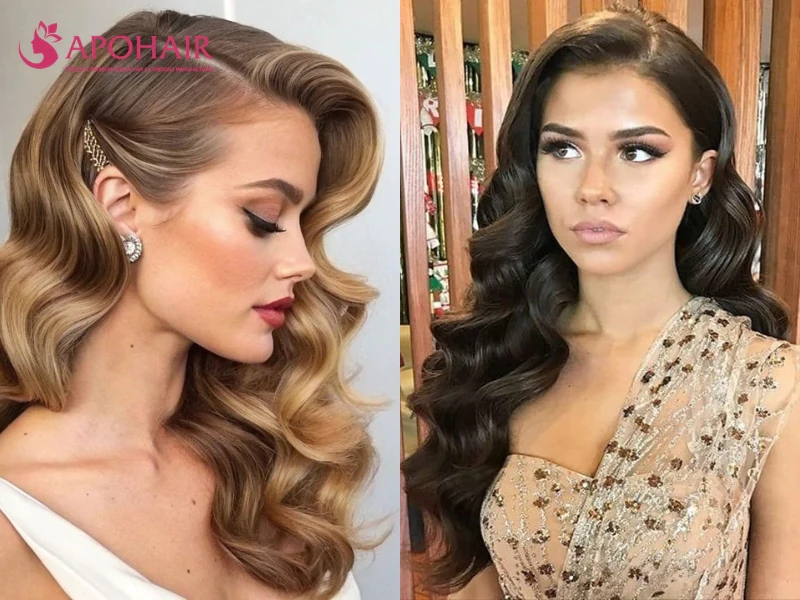
Why it works: With the part set deep, a section of the narrow forehead is covered and the waves build volume at the jaw, so a diamond face gets both corrections without a fringe.
13. Long Straight Cut With Chin-Level Layers
Long straight hair with the shortest layers cut at chin height. The layer lands its weight in the taper rather than at the cheek, which is the whole difference between a long cut that flatters this shape and one that sharpens it.
- Best on: straight hair that hangs flat past a pointed chin.
- Texture: Type 1A to 1C (fine to coarse straight).
- Density: medium to thick.
- Stylist note: Set the shortest layer at the chin. Every inch higher moves the volume closer to the cheekbone.
- Upkeep: low, trim every 10 to 12 weeks.
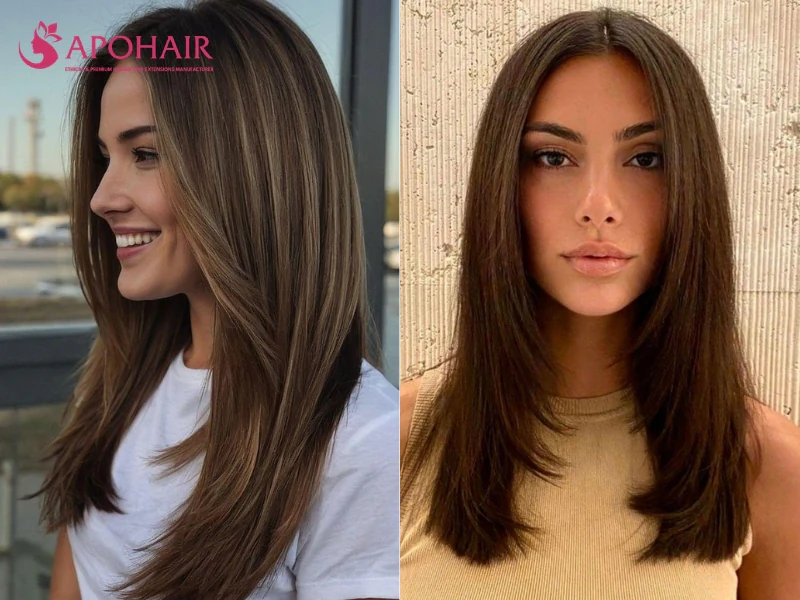
Why it works: Landing the shortest layer at the chin puts the weight in the taper rather than at the cheek, which is the whole difference between flattering and sharpening a diamond face.
14. Long Butterfly Cut With Cheekbone Layers
Cheekbone-length face-framing layers disconnected from long layers below the shoulders. The short tier breaks the cheekbone line while the long tier carries the length, so the widest point of the face sits inside movement rather than being outlined by it.
- Best on: women with high cheekbones and hair long enough to carry two tiers.
- Texture: Type 1B to 2B (straight to defined wave).
- Density: thick.
- Stylist note: Keep the top tier light enough to blow backward, and set it at the cheekbone rather than the chin.
- Upkeep: high, a round brush for the top tier.
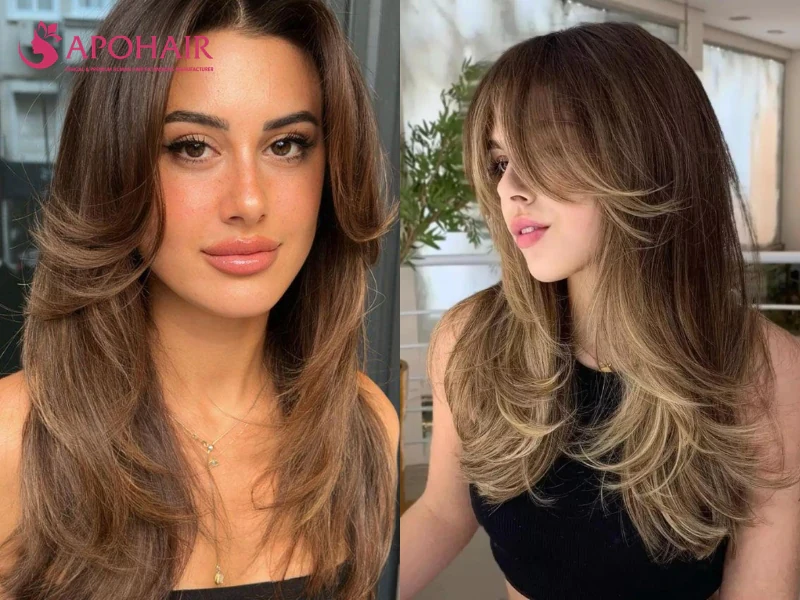
Why it works: Here the short tier breaks the cheekbone line while the long tier carries the length, so the widest point of a diamond face sits inside movement instead of being outlined by it.
15. Long Curly Layers With Face-Framing Pieces
Long natural curls with framing pieces cut at cheekbone level. Curl fills the jaw taper on its own, and the framing pieces are what stop the mass from concentrating at the cheek instead.
- Best on: curl that pools at the cheek and thins toward the ends.
- Texture: Type 3A to 3C (loose curl to tight corkscrew).
- Density: medium to thick.
- Stylist note: Cut dry and remove weight from the mid-lengths at cheek height, letting it build again below the jaw.
- Upkeep: medium, deep conditioning and a careful detangle routine.
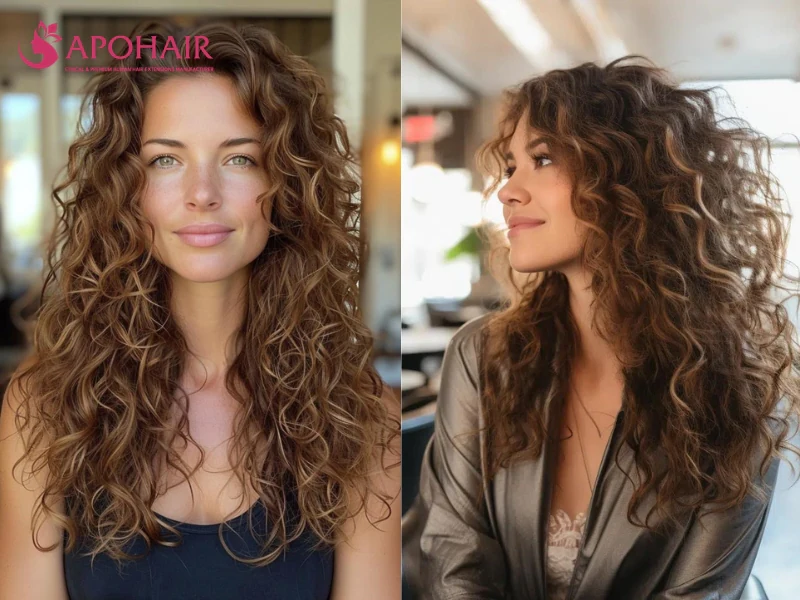
Why it works: Curl fills the jaw on its own, and the framing pieces keep that mass from gathering at the cheek, which is exactly where women with a diamond face do not want it.
16. Mermaid Waves With A Side Sweep
Long continuous S-waves swept to one side. The wave pattern occupies width down the whole length including the jaw, and the side sweep throws mass across the forehead, so a single styling decision serves both ends. The wave pattern itself is easy to reproduce at home: mermaid waves hair can be set with a hair waver, a flat iron, or a curling wand.
- Best on: women with straight hair that has no movement of its own.
- Texture: Type 1B to 2B (straight to defined wave).
- Density: medium to thick.
- Stylist note: Use a three-barrel waver for a consistent pattern and set the sweep before waving.
- Upkeep: medium, one session holds two to three days.
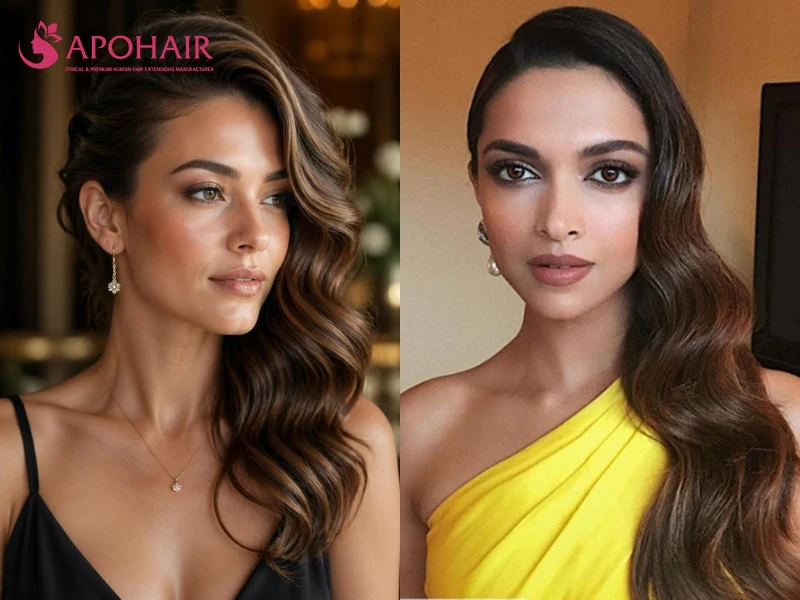
Why it works: The wave pattern adds width down the whole length including the jaw, and the sweep throws hair across the forehead, so one styling choice serves both ends of a diamond face.
17. Long Wavy Shag With Side-Swept Bangs
Long shag layering under a heavy side fringe. The layering spreads weight through the lengths while the diagonal fringe covers more forehead than a curtain does, which suits a hairline that sits high and narrow.
- Best on: women with a high, narrow hairline.
- Texture: Type 2A to 2C (loose to strong wave).
- Density: medium to thick.
- Stylist note: Cut the side fringe heavy enough to lie flat across the forehead, and blend it into the face-framing.
- Upkeep: low, texturizer, fringe trim every 4 weeks.
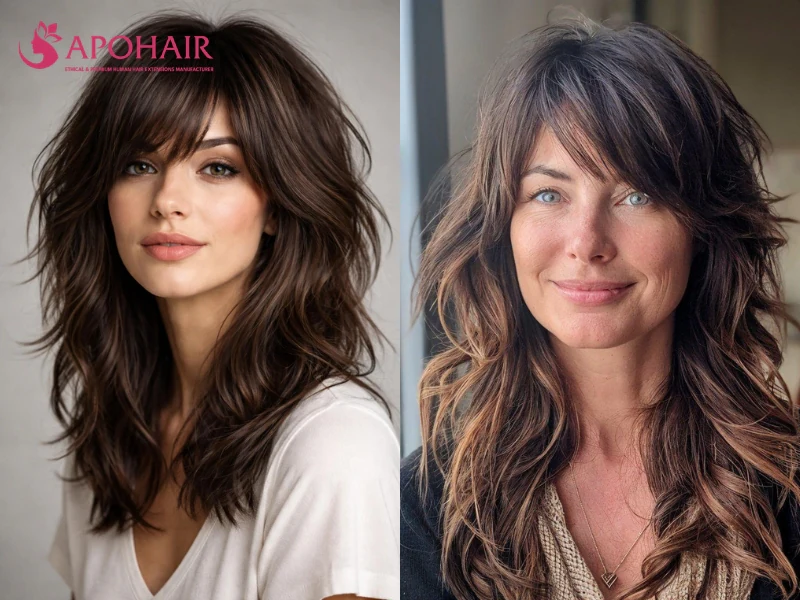
Why it works: Layering spreads weight through the lengths while the heavy diagonal fringe covers more forehead than a curtain, a good match for the high, narrow hairline of a diamond face.
18. Extra-Long Straight Hair With Blunt Bangs
Very long straight hair under a full straight-across fringe. Length alone would sharpen this shape, and what makes it work is the fringe: a dense horizontal across a narrow forehead is the strongest width illusion available at the top of the face.
- Best on: women with a narrow forehead where a soft fringe reads too thin.
- Texture: Type 1A to 1C (fine to coarse straight).
- Density: medium to thick.
- Stylist note: Cut the fringe blunt and wide, taking it out to the temples rather than stopping at the pupils.
- Upkeep: medium, fringe trim every 3 to 4 weeks.
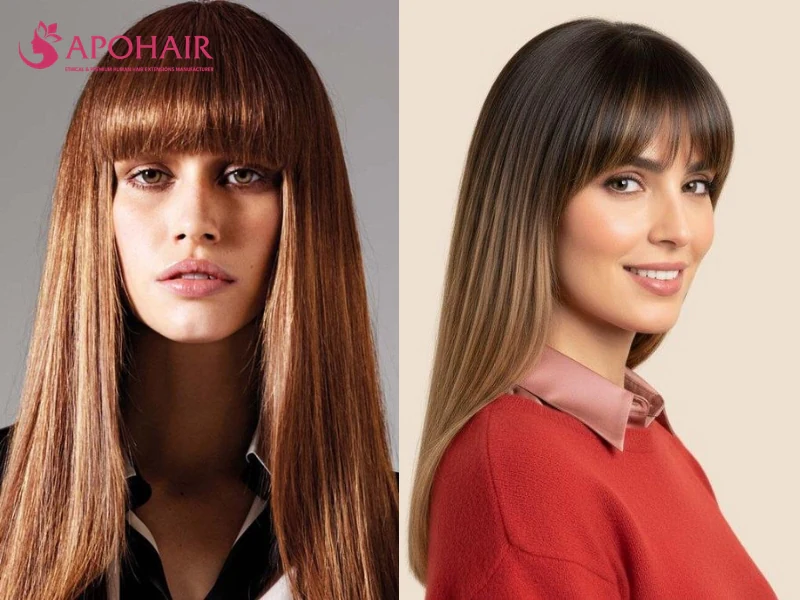
Why it works: Length alone would sharpen a diamond face, so the dense full fringe does the work, a strong horizontal that widens a narrow forehead.
19. Voluminous V-Cut Blowout
Long hair cut to a V at the back and blown out with rounded volume. The volume sits below the cheekbone through the mid-lengths and shoulders, filling the taper while the V keeps the ends from going heavy.
- Best on: thick hair that needs weight taken out of the ends.
- Texture: Type 1B to 1C (medium to coarse straight).
- Density: thick.
- Stylist note: Cut rounded layers rather than choppy ones so the blowout holds, and point-cut the V perimeter.
- Upkeep: high, a round brush every wash.
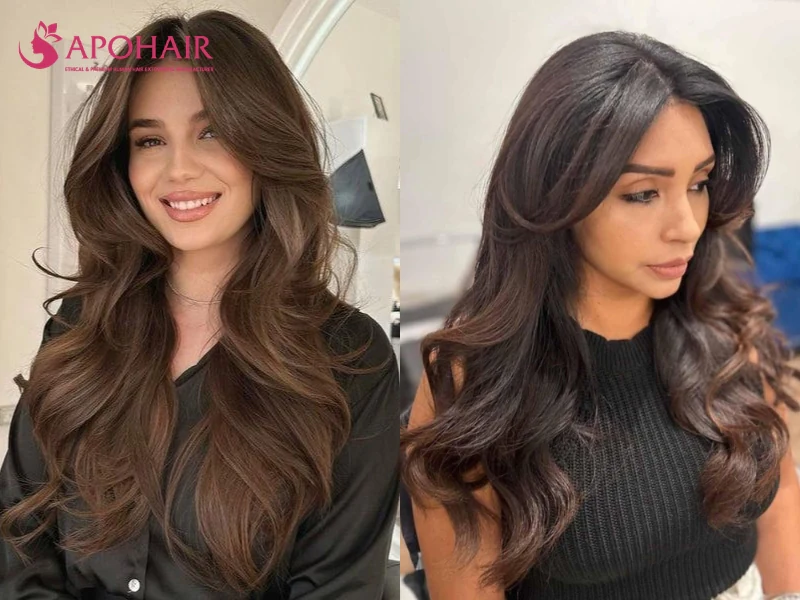
Why it works: The volume sits below the cheekbone through the mid-lengths and shoulders, filling the taper, while the V keeps the ends from going heavy on a diamond face.
20. Glamorous Hollywood Waves With A Deep Side Part
Long polished waves set to one side from a deep part. It is the most formal-leaning cut in the gallery, and it earns its place because the deep part and the low wave mass hit both correction points at once.
- Best on: an event, or any woman who wants one dressed-up option in the rotation.
- Texture: Type 1B to 2B (straight to defined wave).
- Density: medium to thick.
- Stylist note: Set the wave pattern below the cheekbone and pin the top section flat while it cools.
- Upkeep: high, this is styling rather than a cut you wake up with.

Why it works: Pairing a deep part with a low mass of waves hits both correction points at once, which makes this dressed-up look a strong event choice for a diamond face.
Short cuts remove most of the material this shape uses, which makes the short bracket the one with the narrowest margin for error.
Short Hairstyles For A Diamond Face That Fill Out The Forehead
Short hairstyles for a diamond face work here only when the fringe carries the forehead and the hem clears the cheekbone, since a cut cropped level with the cheek exposes the widest point with nothing above or below to balance it. The three pixie cuts and the bixie build width through a fringe; the French bob, chin-length bobs and jaw-length bob fill the taper with a hem; the A-line bob works on an angle; and the short shag handles texture. Nearly all ten put something at the forehead, because at this length there is no other way to reach it.
21. Textured Pixie With Wispy Bangs
A short cut with piecey top layers and a light fringe falling across the forehead. The fringe supplies the width at the top while the texture keeps the crown from reading flat, which are the two things a pixie has to get right on this shape.
- Best on: a narrow forehead on a woman who wants very short hair.
- Texture: Type 1A to 1C (fine to coarse straight).
- Density: fine to medium.
- Stylist note: Take the fringe out wide to the temples rather than keeping it central, since the width has to read at the sides of the forehead.
- Upkeep: medium, a matte paste, trim every 4 to 6 weeks.
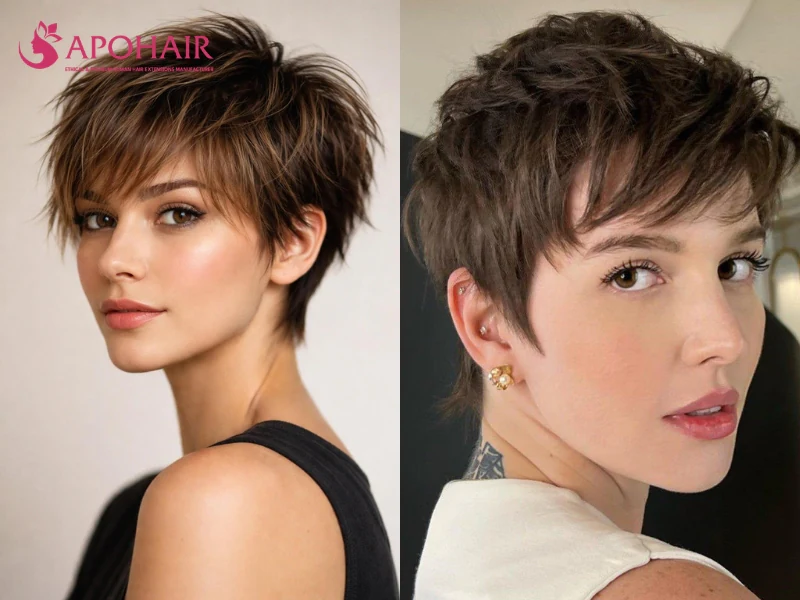
Why it works: A fringe taken out wide supplies the top width and the texture keeps the crown from reading flat, the two things a pixie has to get right for a woman with a diamond face.
22. Side-Parted Pixie With A Deep Sweep
A pixie parted deeply with the top swept diagonally across the forehead. The sweep is what widens the narrow top, since throwing hair across the forehead adds apparent width where the hairline pulls in. The lift at the crown is there to stop the cut sitting flat, not to add height, because this shape already runs longer than it is wide.
- Best on: a very narrow hairline that a straight fringe would only emphasize.
- Texture: Type 1A to 2A (fine straight to loose wave).
- Density: medium.
- Stylist note: Part deep and slice the sweep diagonally so it lies across the forehead. Keep the crown moderate.
- Upkeep: low, a quick style each morning.

Why it works: The diagonal sweep widens the narrow top where the hairline pulls in, and a moderate crown stops the cut sitting flat without adding height a diamond face does not need.
23. Layered Pixie Crop With A Piece-y Fringe
A cropped cut with heavily layered top and a broken-up fringe. The separated fringe pieces cover more forehead area than a solid one while staying light enough not to look heavy on a small hairline.
- Best on: women with fine hair and a narrow forehead.
- Texture: Type 1A to 1B (fine to medium straight).
- Density: fine.
- Stylist note: Point-cut the fringe into separate pieces and fan them outward toward the temples.
- Upkeep: low, a texturizing paste.
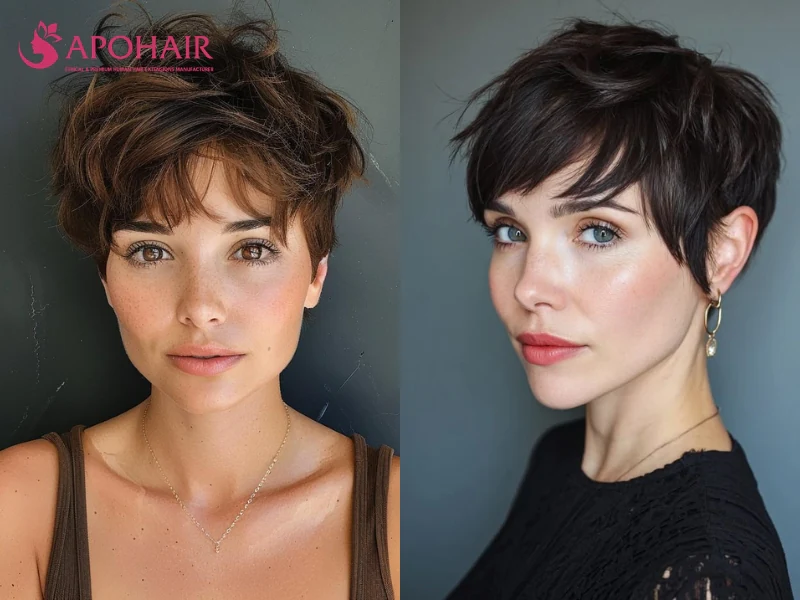
Why it works: Separated fringe pieces cover more forehead than a solid fringe yet stay light, so a diamond face on fine hair gets its width without any heaviness.
24. Soft Bixie Cut With Tucked Sides
A cut between a bob and a pixie with the sides tucked in behind the ears just below cheek level. The tuck keeps the sides close without cropping them level with the cheekbone, so the widest point is softened rather than exposed.
- Best on: female clients whose cheekbones read wide in every photograph.
- Texture: Type 1B to 2B (straight to defined wave).
- Density: medium.
- Stylist note: Cut the sides short enough to tuck cleanly, and leave the fringe long enough to still cover the forehead once they are tucked.
- Upkeep: medium, texturizing spray.
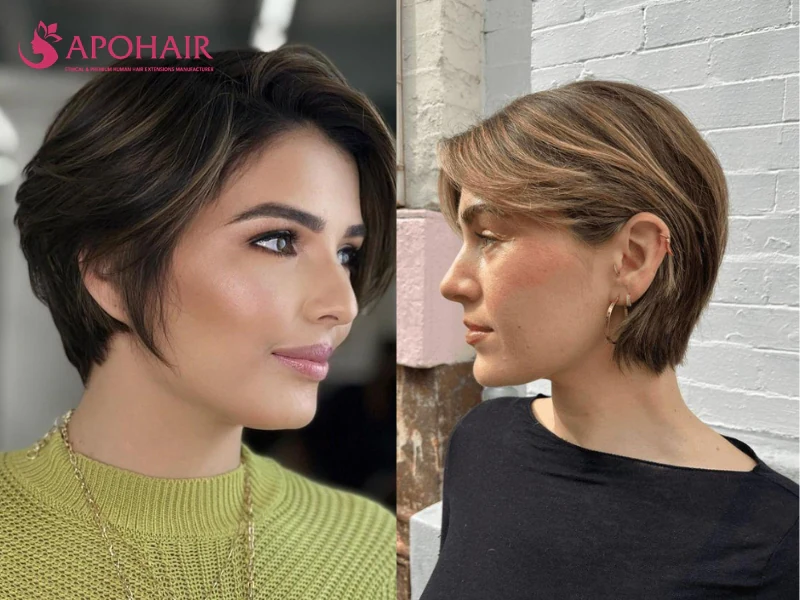
Why it works: Tucking the sides just below cheek level keeps them close without exposing the widest point, while the fringe keeps the forehead covered, so the cut slims a diamond face instead of sharpening it.
25. Ear-Length French Bob
A short blunt bob finishing at the ear, usually worn with a fringe. The fringe handles the forehead and the blunt hem sits just above the jaw, which reads as a deliberate frame rather than a cut-off at the cheek.
- Best on: straight hair with enough weight to hold a precise line.
- Texture: Type 1A to 1B (fine to medium straight).
- Density: fine to medium.
- Stylist note: Keep the hem at the ear or below. A French bob cut level with the cheekbone lands on the widest point and undoes the cut.
- Upkeep: medium, trim every 4 to 6 weeks.

Why it works: The fringe handles the forehead and the blunt hem sits just above the jaw, so the cut reads as a deliberate frame for a diamond face rather than a cut-off at the cheek.
26. Chin-Length Bob With Side-Swept Bangs
A bob finishing at the chin under a sweeping side fringe. The fringe widens the forehead and the hem fills the taper, which makes this the most complete short answer on the shape.
- Best on: women with a narrow forehead and a pointed chin in equal measure.
- Texture: Type 1A to 2A (straight to loose wave).
- Density: medium.
- Stylist note: Cut the fringe long and heavy enough to blend into the front sections rather than sitting separately.
- Upkeep: medium, blow-dry the fringe most days.
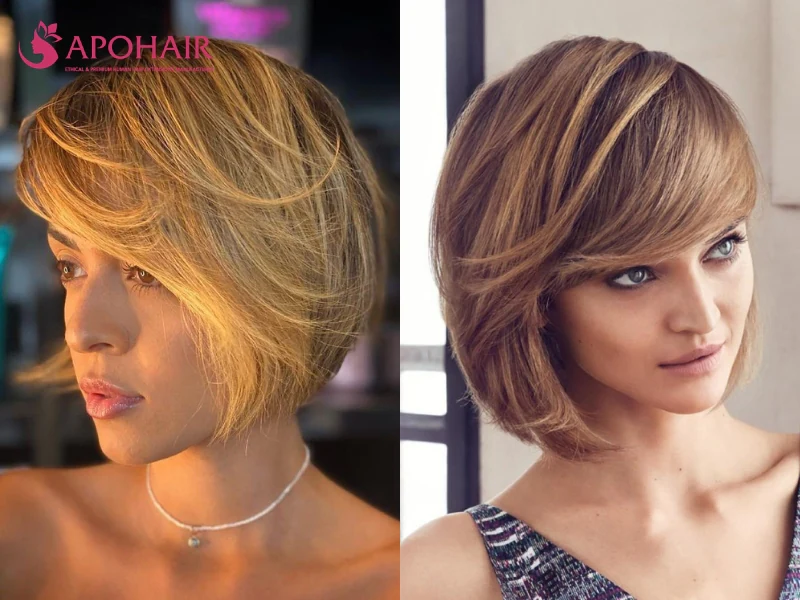
Why it works: The sweeping fringe widens the forehead and the hem fills the taper, which makes this the most complete short answer to a diamond face.
27. Chin-Length Bob With Flipped-Out Ends
A bob cut at the chin with the last inch turned outward. The flip pushes width sideways at exactly the height the face tapers, and unlike a stacked or wedge shape it reads from the front where face-shape balance is actually judged.
- Best on: ladies whose chin reads narrow head-on.
- Texture: Type 1A to 1C (fine to coarse straight).
- Density: medium.
- Stylist note: Cut a slight graduation so the ends have somewhere to turn, then blow the last inch outward rather than under.
- Upkeep: medium, a round brush most washes.
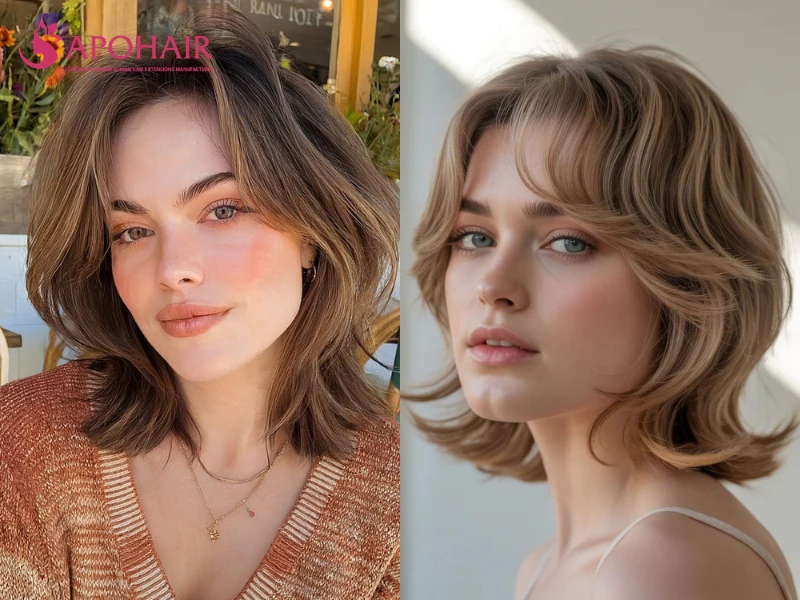
Why it works: The flip pushes width sideways at exactly the height a diamond face tapers, and it reads from the front, where face-shape balance is actually judged.
28. Jaw-Length Bob With A Curtain Fringe
A bob finishing at the jaw with a center-split fringe. The hem lands its weight in the taper and the curtain opens across the forehead, which is the shortest length at which both corrections still fit in one cut.
- Best on: any woman moving from a lob toward a short cut for the first time.
- Texture: Type 1B to 2B (straight to defined wave).
- Density: medium to thick.
- Stylist note: Sweep the curtain out toward the temples, and keep the hem at the jaw rather than above it.
- Upkeep: medium, a daily fringe style.
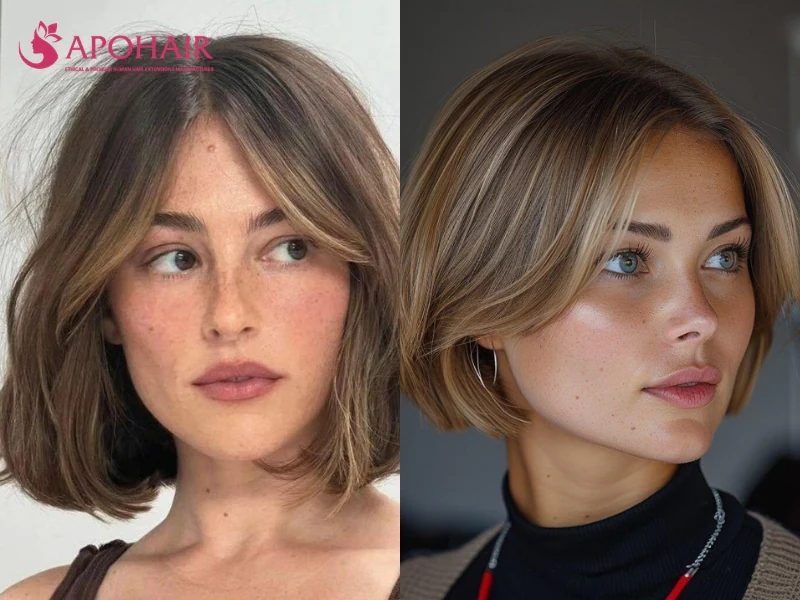
Why it works: The hem lands its weight in the taper and the curtain opens across the forehead, the shortest length at which both corrections still fit in one cut on a diamond face.
29. Asymmetrical A-Line Bob
A bob angled forward and cut longer on one side. The asymmetry breaks the symmetry of the diamond outline, and the forward angle delivers length to the front where the taper needs filling.
- Best on: a face that reads as a very even geometric shape.
- Texture: Type 1A to 2A (straight to loose wave).
- Density: medium.
- Stylist note: Over-direct backward while cutting and set the longer side on the same side as the deeper part.
- Upkeep: medium, flat iron to keep the angle reading.
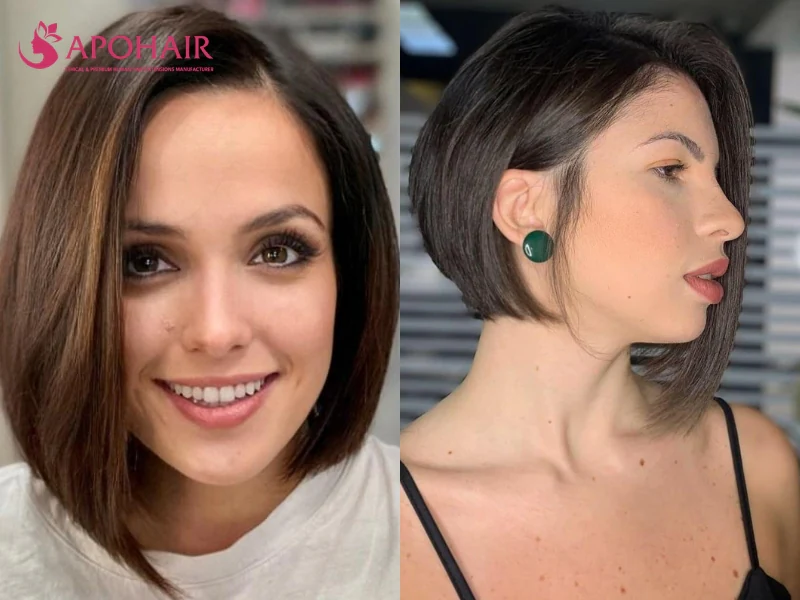
Why it works: The longer side breaks the symmetry of the diamond outline, and the forward angle brings length to the front, where the taper needs filling.
30. Short Shag With A Wide Fringe
A short heavily layered cut with a fringe taken out wide toward the temples. The layering keeps the shape from sitting flat while the width of the fringe rather than its length does the forehead work.
- Best on: any woman who wants short hair without a polished routine.
- Texture: Type 1B to 2C (straight to strong wave).
- Density: medium.
- Stylist note: Cut the fringe wide rather than long, taking the outer corners past the pupils toward the temples.
- Upkeep: very low, sea salt spray.
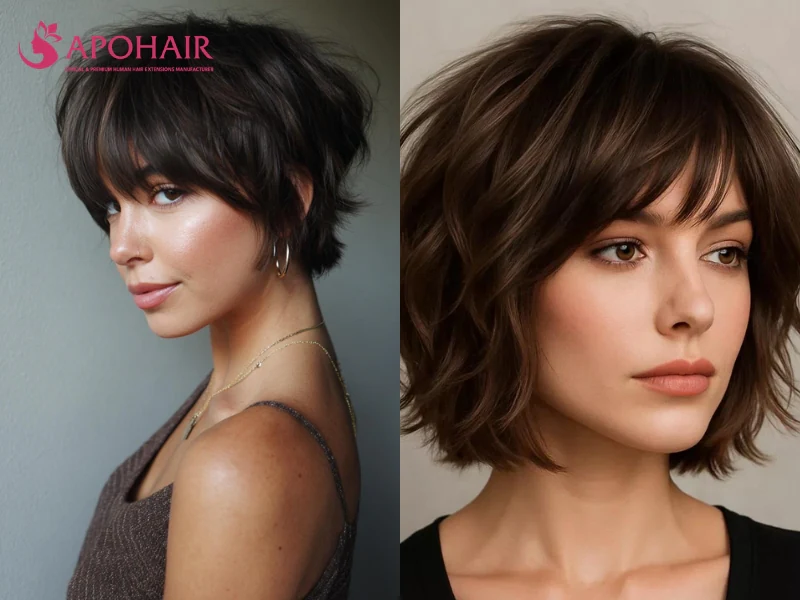
Why it works: Taking the fringe wide rather than long does the forehead work for a diamond face, while the layering keeps the short shape from sitting flat for women who want a low-effort routine.
Pulling the hair back removes both corrections at once, which is why the fourth principle rules out most of the obvious options.
Best Pulled-Back Hairstyles For A Diamond Face
The fourth principle bites hardest here: a style pulled tight against the head exposes the narrow forehead, the wide cheekbones and the pointed chin all at once, with nothing softening any of them. Every option below keeps something at the forehead and volume at the temples.
- Half-up with volume at the temples. The strongest option, since it lifts width out at exactly the level the forehead pulls in while the lower half stays down and fills the jaw. Backcomb at the temples rather than the crown.
- Low bun with a soft fringe left out. The bun handles the practicality and the fringe keeps the forehead covered. Without the fringe this is the style the fourth principle warns against.
- Side ponytail with a wispy fringe. Low and off-center, so the mass sits on one side of the jaw and the asymmetry breaks the geometric read.
- Loose braided crown. A braid running across the top of the head adds a horizontal band of width at the forehead, which is the one pulled-back style that actively widens rather than merely avoiding exposure.
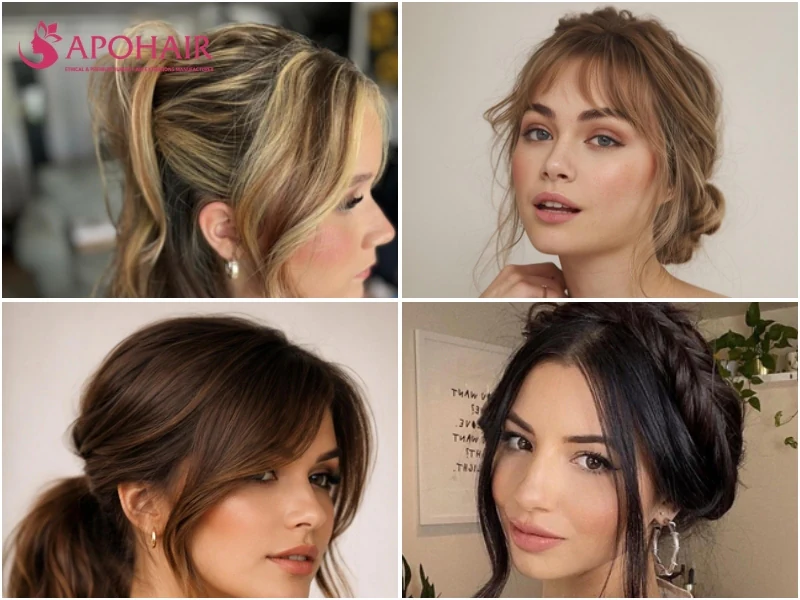
Skip a slicked-back ponytail or bun with no fringe. It is the single most exposing thing this shape can wear, and it is also the most common mistake our team sees with diamond-faced clients.
Best Special-Occasion Hairstyles For A Diamond Face
An occasion style carries constraints an everyday look does not. An accessory has to sit somewhere, the neckline changes what the jaw is read against, the style has to hold for a full evening, and it will be photographed from angles where the cheekbones read widest.
- Updo with temple volume and a soft fringe. A gathered style with fullness built at the temples rather than the crown. It keeps the forehead correction intact through the whole evening, which a smooth updo gives up in the first hour.
- Half-up with curled ends at the jaw. Top half gathered, lower half curled to land at jaw level. It is the formal option that keeps the lower taper filled rather than exposed.
- Braided updo with a wide crown band. A braid worked wide across the top of the head. The band supplies forehead width while the gathered length keeps the style formal.
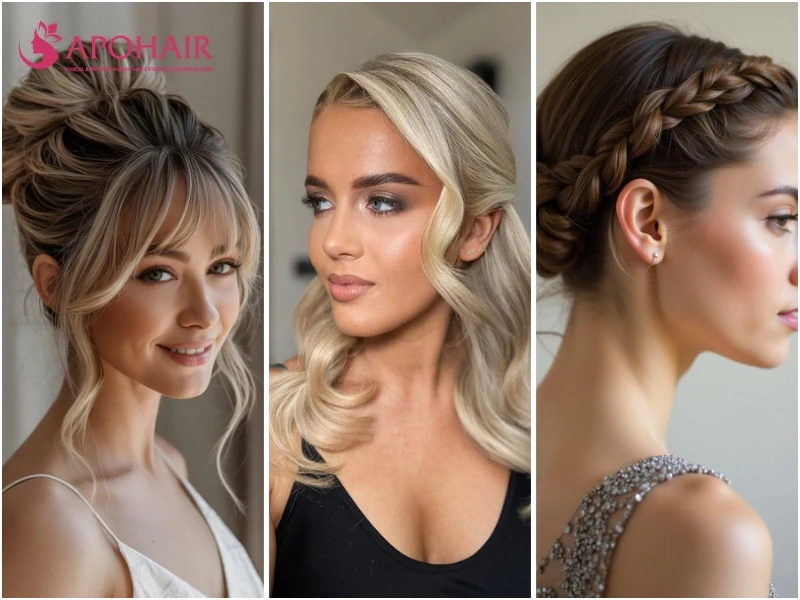
Accessory placement is where this shape differs from the others. Pin combs and clips at the temples, not the crown, since anything mounted on top of the head lengthens a face already running 1.4 to 1.5 times its width, much as it does on long faces, while something set wide at the temple adds the horizontal the forehead is short of. On necklines, a boat neck or an off-shoulder cut adds visual width low on the frame and supports what the hair is doing at the jaw.
How Should Women Choose The Right Hairstyle For A Diamond Face?
The shape sets the goal and the length bracket sets the frame, but which of these 37 looks holds on your head depends on your own hair and where your cheekbones sit. Work through the five questions below in order. The first two narrow the list fastest, and the last three adapt the choice to your hair type and age.
Where Should Layers Start On High Cheekbones?
At the cheekbone or below, never above it, and this single decision separates most of the cuts that work here from most that do not. A layer cut at the temple lifts volume to the widest point and sharpens the whole geometry, while the same layer set at the cheekbone breaks that line instead. The side-parted lob with face-framing layers, the long butterfly cut with cheekbone layers and the long straight cut with chin-level layers all place it correctly. If your cheekbones sit unusually high, drop the shortest layer to the jaw rather than the cheek.
Do Bangs Work On A Diamond Face?
Bangs are the primary tool for the forehead half of the problem, and this is one of the few shapes that can wear a blunt version, since a dense horizontal across a narrow forehead reads as width. Curtain bangs, side-swept bangs and a blunt micro fringe all work. What matters more than the style is the width: take the fringe out toward the temples rather than stopping at the pupils, because a narrow fringe on a narrow forehead confirms the shape instead of correcting it. Skip an ultra-thin wispy fringe, which fails to create any visible line at all.
What Hairstyles Suit A Diamond Face With Fine Or Thick Hair?
Fine hair cannot hold volume at both ends, so the weight has to come from a solid hem rather than from layering: the blunt lob with curtain bangs and the layered pixie crop with a piece-y fringe both build the illusion without needing density. Thick hair has the opposite issue, since left solid it collects at the cheekbone and widens the widest point. Take the weight out from inside while keeping the perimeter intact, which is what the textured midi, the medium butterfly cut and the voluminous V-cut blowout are built to do.
What Hairstyles Suit A Diamond Face With Curly Hair?
Curl fills the jaw taper without any styling, so the work is stopping it from collecting at the cheekbone where it makes the widest point wider. Cut dry in every case and set the shortest curl at the jaw rather than the cheek. The curly lob with jaw-length layers, the long curly layers with face-framing pieces and the shoulder-length shag with curtain bangs all place the volume correctly. Tucking the sides behind the ears just below cheek level is worth knowing about here, since it is the fastest way to take bulk off the cheek without cutting anything.
What Hairstyles Suit A Diamond Face Over 50?
On women over 50, the cheekbones stay prominent while the jaw loses what little volume it had, which sharpens the taper and makes the lower correction more important than it was. Medium length or a chin-length bob with a solid or flipped hem does the most work: the angled lob with tucked ends, the blunt lob with curtain bangs and the chin-length bob with flipped-out ends all put weight where the face is losing it. Very long, heavy hair pulls the whole silhouette down and draws attention straight to the chin.
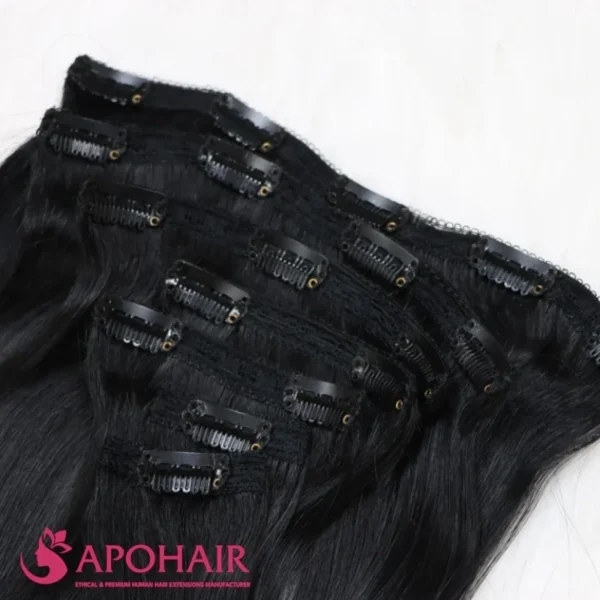
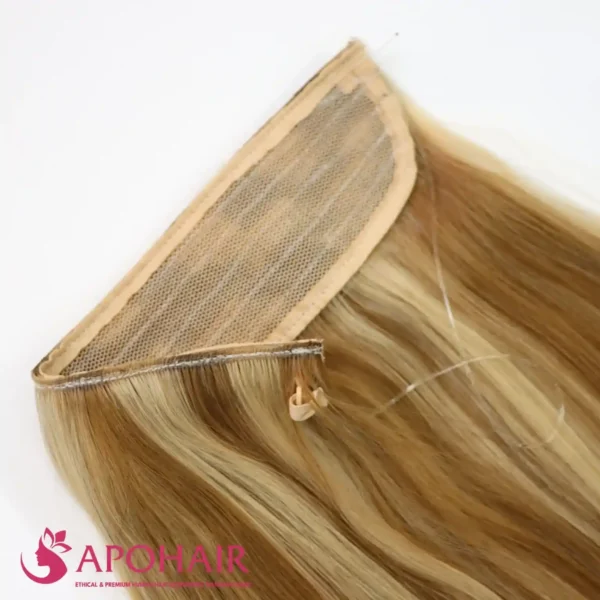
If a client’s own density will not fill the jaw, clip-in wefts placed below the ear add fullness exactly where this shape tapers, and a clip-in fringe widens the forehead without committing the client to a cut.
Hairstyles Women Should Avoid With A Diamond Face
Five styles work against this shape regardless of texture or density, and each one either exposes the angles or adds bulk to the widest point.
- A cut cropped level with the cheekbone. The hem lands exactly on the widest measurement and stops the eye there, with nothing above or below to balance it. Dropping the same cut to the ear or the jaw fixes it entirely.
- Slicked-back ponytails or buns with no face-framing. Pulling everything tight puts the narrow forehead, the wide cheekbones, and the pointed chin on display at once, which is the raw geometry with no correction applied.
- Heavy volume concentrated at cheekbone level. Blowouts or curls that build their fullest point at the cheek make the widest part of the face wider, which is the one direction this shape cannot afford.
- A center part on flat, straight hair. A sharp center line splits an already narrow forehead in half and makes it read narrower still, with no movement anywhere to offset it.
- One-length long hair with no layers or fringe. A flat heavy curtain drags the eye downward and emphasizes the pointed chin, turning a taper into a severe, elongated silhouette.

Frequently Asked Questions About Hairstyles For A Diamond Face
What hair length suits a diamond face best?
Medium length from collarbone to shoulder is the most universally flattering for women with this shape, because the hem naturally creates volume at the jawline where the face needs filling while keeping layers active around the cheekbones. Short and long both work with the right technique, as the 30 cuts above show, but medium requires the least deliberate intervention to reach balance. If you are choosing without a stylist to consult, start there.
Is a diamond face the same as a heart-shaped face?
No, and the difference is where the width sits. A heart-shaped face is widest at the forehead and narrows continuously to the chin. A diamond face is widest at the cheekbones, with the forehead narrowing above them as well as the jaw narrowing below, which gives it two tapers instead of one. The styling consequence is direct: a heart shape only needs the forehead covered and the jaw filled, while a diamond needs the forehead widened as well.
Which celebrities have a diamond face shape?
Rihanna, Vanessa Hudgens, Scarlett Johansson, Ashley Greene and Megan Fox are widely described as having diamond face shapes. Looking at how any of them wear their hair across short bobs, long waves and bold fringes shows the same principle applied repeatedly: volume placed at the forehead and jaw, and kept off the cheekbone. Rihanna’s range in particular is a useful reference for how far the shape can be pushed.
Can hair extensions help style a diamond face?
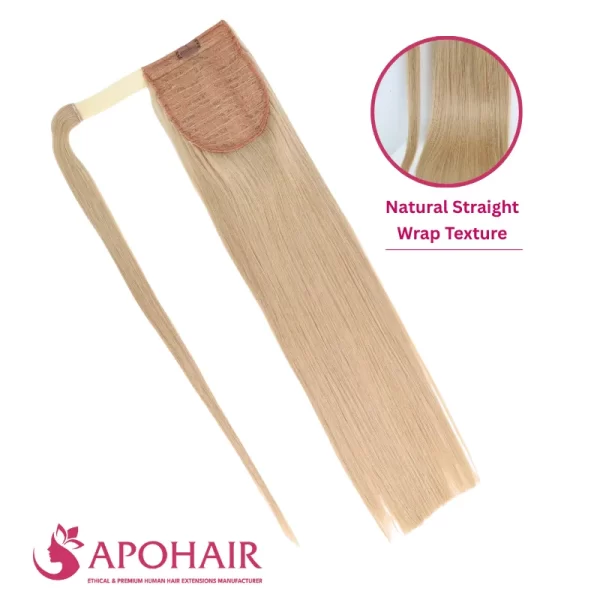
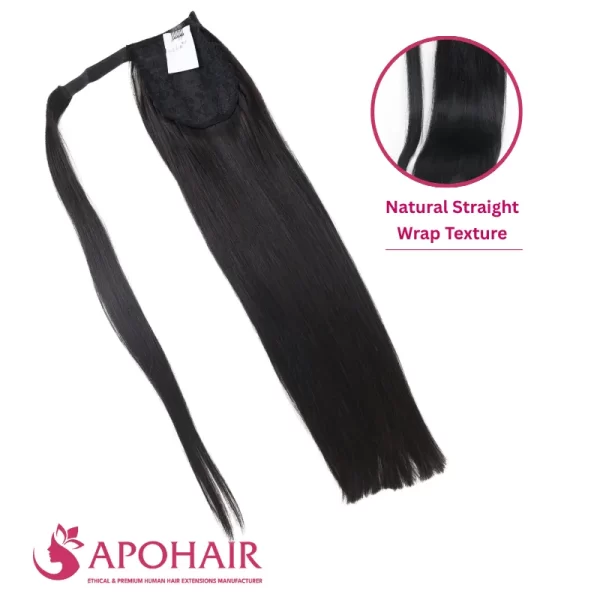
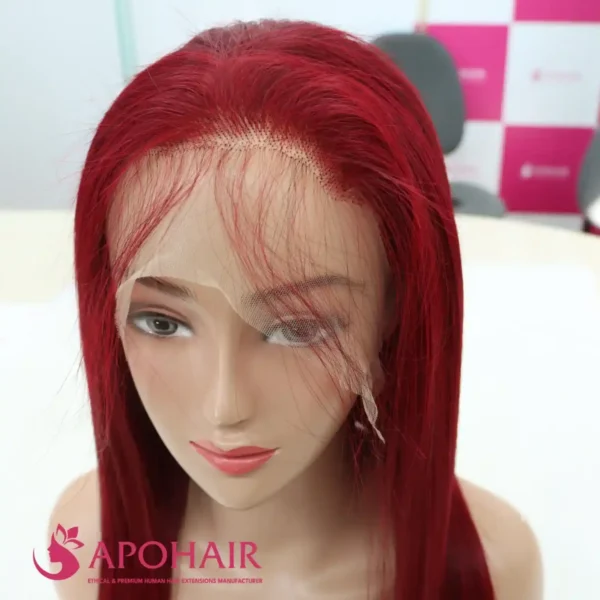
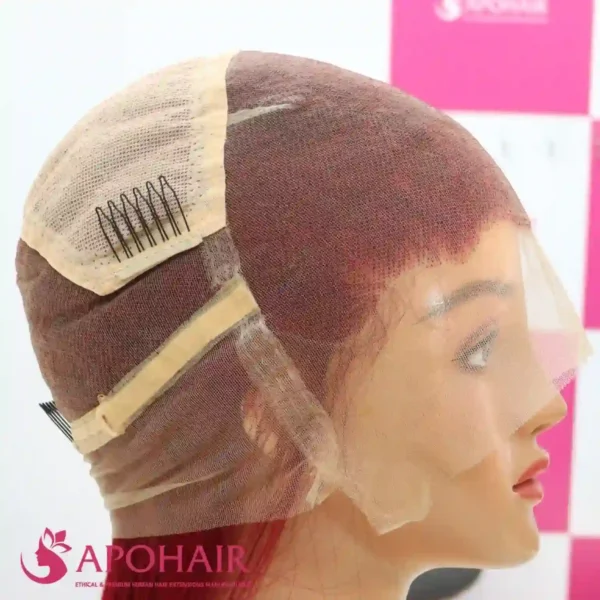
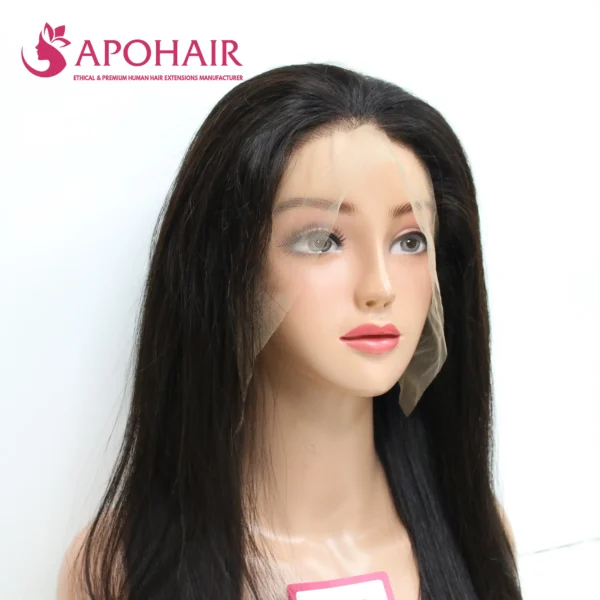
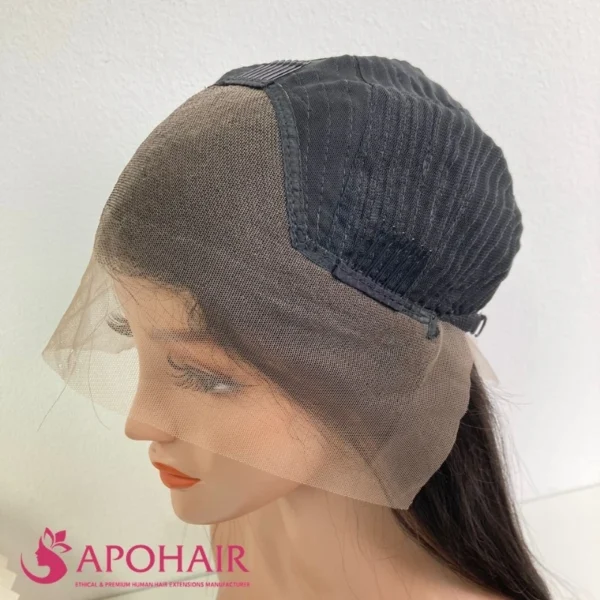
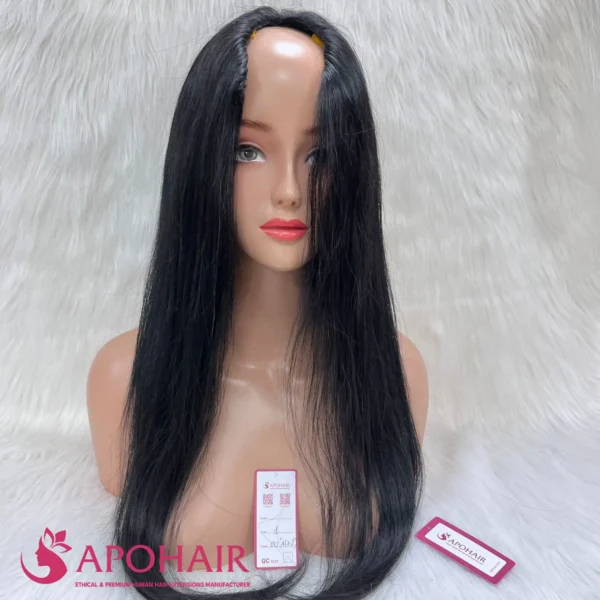
For stylists, extensions solve both of this shape’s problems without a haircut. Clip-in wefts placed below the ear add the fullness that fills the jaw taper, turning a flat bob into a balanced one, and a clip-in fringe widens the forehead while leaving the client’s own hairline untouched. They also supply the length that a V-cut blowout or long layered look needs. Short lace-front wigs from a wholesale human hair wig supplier, starting at 6 inches (15 cm), let a client wear a diamond-face bob without committing to the cut.
Conclusion
For women, every flattering cut for a diamond face works by redistribution rather than addition: fullness moves off the cheekbone and out to the forehead and jaw. Width at the top through a fringe, weight at the bottom through a hem or a flipped end, and layers that start at the cheekbone rather than above it are the three moves, and the medium bracket delivers all three at once. The constraint that holds at every length is the fourth principle, since nothing pulled flat against the head can do any of this.
For salons building a service menu around face-shape consultations for women, APOHAIR, a virgin hair factory from Vietnam, supplies 100% Vietnamese human hair with the cuticle intact, in clip-in wefts, fringe pieces and lace-front wigs that blend across straight, wavy and curly textures. Factory-direct pricing and shade matching before the first order make it practical to keep a working range on hand.
Sourcing for diamond-face clients: Diamond-face requests come down to adding width at the forehead, filling the jaw, and softening the cheekbone line, so a salon or reseller serving these clients needs hair that delivers length, density, and texture on demand.
Extensions: Long layers, mermaid waves, and voluminous blowouts need more hair than most clients grow, so a buyer can build that range by sourcing human hair extensions wholesale and cover several formats in one order.
Bundles: Curly lobs, wavy shags, and Hollywood waves need density through the mid-lengths, so buyers serving those clients can source from a human hair bundles supplier in roughly 100g bundles, with textures from silky straight to kinky curly.
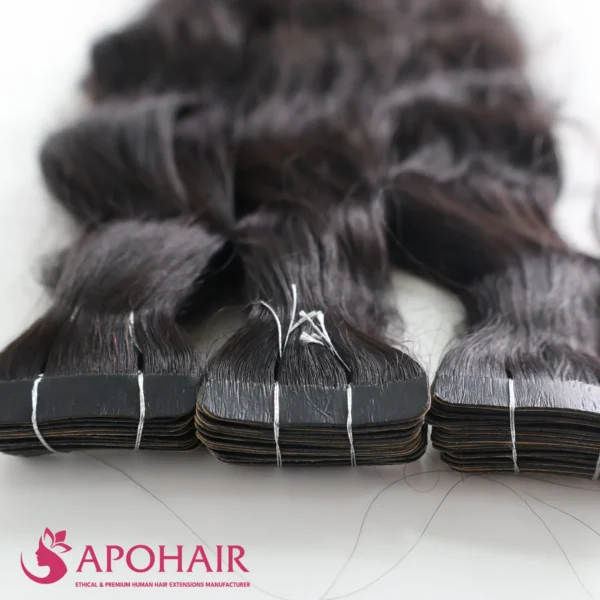
Tape in: Natural color tape hair extensions wholesale fit clients who want chin-level fullness or jaw fill without a new cut, and a buyer can order the shade that matches each client’s base color.
Clip in: Clients trying curtain bangs or extra length before committing to a cut are the natural audience for a clip in extensions supplier, where a reseller can stock several lengths and shades for those try-before-you-cut customers.
Weft: Wholesale weft hair extensions start at 200g per type, with textures, colors, and lengths mixable in one order, which suits a salon stocking long layers and mermaid waves for several clients at once.
APOHAIR — ETHICAL & PREMIUM HUMAN HAIR EXTENSIONS AND WIGS MANUFACTURER
- Address: Building 3A, Lane 82 Duy Tan, Cau Giay, Hanoi, Vietnam
- Factory: (Old) Yen Luong Village, Y Yen District, Nam Dinh Province, Vietnam; (New) Minh Luong Hamlet, Van Thang Commune, Ninh Binh Province, Vietnam
- WhatsApp: +84 862 132 366
- Email: [email protected]
- Website: https://apohair.com
